


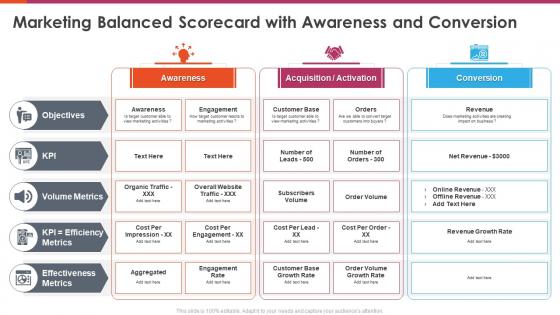
Marketing balanced scorecard marketing balanced scorecard with awareness and conversion




Try Before you Buy Download Free Sample Product
 Impress Your
 Audience
 100%
100% Editable
 Save Hours
 of Time


Our Marketing Balanced Scorecard Marketing Balanced Scorecard With Awareness And Conversion are topically designed to provide an attractive backdrop to any subject. Use them to look like a presentation pro.
People who downloaded this PowerPoint presentation also viewed the following :
Marketing balanced scorecard marketing balanced scorecard with awareness and conversion with all 6 slides:
Use our Marketing Balanced Scorecard Marketing Balanced Scorecard With Awareness And Conversion to effectively help you save your valuable time. They are readymade to fit into any presentation structure.





FAQs for Marketing balanced scorecard marketing balanced scorecard with
Pick 3-5 KPIs max that actually matter to your business goals. Conversion rate, customer acquisition cost, and lifetime value are the big ones for profitability. For engagement, track click-through rates and time on page - but honestly, don't waste time on follower counts and stuff like that. Total vanity. You'll also want revenue attribution and ROAS to show your marketing actually works. Oh, and build simple dashboards around these metrics. I see too many people trying to track everything at once and getting overwhelmed. Start focused, add more later if you need to.
So quantitative metrics are basically your hard data - clicks, conversions, revenue, email open rates, that kind of stuff. Pretty straightforward to track. Qualitative is trickier but way more interesting honestly - it's all the "why" stuff like brand sentiment, customer feedback, what people are actually saying about you on social. Most of us live and die by the numbers (I'm totally guilty of this too), but the qualitative data is what explains WHY those numbers look the way they do. You really can't make smart decisions with just one side. I'd start with your key metrics, then dig into what insights might explain the patterns you're seeing.
So customer journey mapping is basically your cheat sheet for figuring out which touchpoints actually matter. Track how people interact with your marketing from awareness all the way to conversion - you'll see exactly where you're losing them. Way better than that useless last-click attribution stuff (seriously, who even uses that anymore?). The real magic happens when you spot which channels work together. Start with Google Analytics and plot your top conversion paths. Takes like 10 minutes and you'll immediately see the patterns. Then you can actually optimize based on real data instead of just guessing.
Honestly, automation tools are a game changer for tracking your marketing performance. They'll automatically follow customer journeys across all your channels - email opens, clicks, conversions, the whole thing. No more spending hours pulling data manually (thank god). Everything connects to your CRM and analytics too, which is pretty sweet. I'd start small though - hook up your email platform and website tracking first. The automated dashboards update in real-time, so you'll actually see what's working ROI-wise instead of just guessing.
ROI is your best friend when deciding which marketing campaigns actually deserve your money. Simple math: spend $1,000, make $3,000 back, boom - that's 200% ROI. What's cool is you can compare totally different campaign types side by side. Like, Facebook ads vs email campaigns vs whatever random idea your boss had last week. Most teams honestly just wing it and go with their gut feeling instead of checking the numbers. Track this stuff consistently and you'll know exactly where to throw more budget. Way better than guessing which campaigns are winners.
Dude, A/B testing is a game changer – you get real data instead of just guessing what works. Test one thing at a time though, like subject lines or ad copy, so you actually know what made the difference. I'm weirdly obsessed with it now because the results are so clear cut. Email subject lines are perfect to start with since they're super easy to test. You'll quickly see what clicks with your audience versus what falls flat. Way better than making decisions based on what you think people want – sometimes you're totally wrong about that stuff.
Honestly, work backwards from your actual business goals - that's the key. Don't get caught up in fluffy stuff like "brand awareness" (I mean, what does that even tell you?). You want SMART goals that actually matter: 50 qualified leads monthly, boost customer lifetime value 15% by Q2, whatever. Just make sure it ties to revenue somehow. Oh, and definitely set up proper tracking before you start - learned that one the hard way! You'll be way less stressed when it's time to show results. Trust me on this.
So basically, when people like and share your stuff, it creates this ripple effect through your whole marketing strategy. More engagement means better brand visibility, which usually drives more traffic to your site and bumps up conversions. Here's the thing though - social media is such a slow burn. You won't see instant sales from every post, but it's building trust that helps all your other marketing work better. I'd definitely track your engagement metrics next to conversion data so you can see how everything connects. It's honestly one of those investments that pays off over time rather than right away.
Attribution is such a nightmare - customers jump around between channels and you can't tell what actually made them buy. Your data's all scattered too, like your email platform doesn't sync with Google Analytics or whatever. Makes tracking the whole journey basically impossible. Don't even get me started on iOS privacy updates screwing everything up. Honestly, most people obsess over vanity metrics anyway. Who cares about Instagram likes if they're not buying anything? I'd say connect your data first, then only track stuff that actually moves the needle revenue-wise.
Honestly, dig into your analytics and see which audiences are actually buying stuff vs just browsing around. I'm obsessed with conversion paths - they show the real journey people take, not just that last click everyone focuses on. Break down your campaigns by age, location, device, whatever fits your business. Compare how much each group costs to acquire. Here's the thing though - sometimes your "worst" performing segments just need different messaging, or maybe you should ditch them entirely. That's where you'll find extra budget to put toward what's working. Time of day matters more than people think too.
Honestly, customer segmentation is a game-changer because you'll actually see what's working instead of staring at useless averages all day. Like, your 25-year-old city customers are gonna behave completely different from 50-year-old suburbanites - obviously, right? Breaking it down by segments shows you which messages hit with each group, where you're burning cash, and what channels actually work. Way better than just knowing "our email open rate is 23%" or whatever. I'd start with your top 3-4 segments and track one solid metric for each. Makes the data so much clearer.
So attribution models help you figure out which touchpoints actually convert people, not just that final Google search that steals all the glory. Your email newsletter might look worthless if you only check last-click data, but it probably got them interested first. Different models split up the conversion credit - some favor first contact, others spread it around evenly, or give recent interactions more weight. I'd start simple with first-touch vs last-touch to see the difference. Multi-touch gets complicated fast but honestly gives you the real story of how people actually buy from you.
Honestly, real-time attribution is where it's at right now. Privacy stuff is making everything harder (thanks Apple lol) but companies are getting smarter with multi-touch attribution to map actual customer journeys. Predictive analytics is big too - everyone wants to prove real impact instead of just "this happened then that happened." Lifetime value beats acquisition costs as the metric that matters. Oh and those unified platforms connecting online/offline data? Finally happening. I'd audit what you're tracking now first. You're probably missing key touchpoints without realizing it. Start there and see what gaps pop up.
Honestly, qualitative feedback is where you find the real story behind your numbers. Like, your conversion rate might look amazing, but then customer interviews reveal people are buying *despite* your terrible checkout process - not because it's good. That's the stuff you can't see in spreadsheets alone. Numbers tell you what happened, but talking to actual customers shows you the why. Pain points, feelings, missed opportunities - it's all there. I'd start with quick surveys after purchases and dig through support tickets. There's usually some obvious pattern everyone's been ignoring.
Start with Google Analytics 4 - it's free and handles most web stuff you need. Then grab whatever platform tools you're using (Facebook Ads Manager, LinkedIn, etc). HubSpot's pretty good if you want everything in one place, but wow it gets expensive quick. Honestly? The specific tool doesn't matter as much as tracking the right stuff consistently. I'd stick to maybe 2-3 platforms max and actually learn them well. Way better than juggling ten different dashboards and feeling overwhelmed all the time.
-
Wonderful templates design to use in business meetings.
-
Excellent work done on template design and graphics.
-
The content is very helpful from business point of view.
-
Graphics are very appealing to eyes.
-
Illustrative design with editable content. Exceptional value for money. Highly pleased with the product.