

Marketing Budget Plan Analysis Dashboard For Startups




Try Before you Buy Download Free Sample Product
 Impress Your
 Audience
 100%
100% Editable
 Save Hours
 of Time


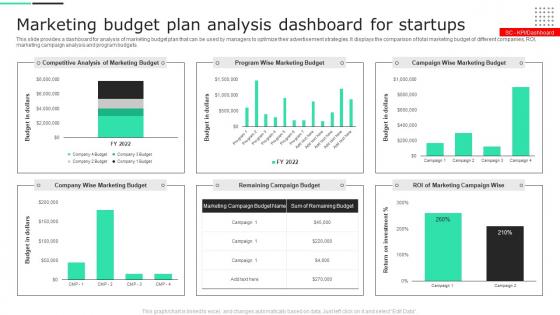
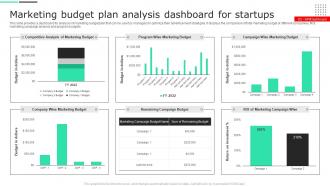
This slide provides a dashboard for analysis of marketing budget plan that can be used by managers to optimize their advertisement strategies. It displays the comparison of total marketing budget of different companies, ROI, marketing campaign analysis and program budgets.
People who downloaded this PowerPoint presentation also viewed the following :
Marketing Budget Plan Analysis Dashboard For Startups with all 7 slides:
Use our Marketing Budget Plan Analysis Dashboard For Startups to effectively help you save your valuable time. They are readymade to fit into any presentation structure.





FAQs for Marketing Budget Plan Analysis
Key marketing budget components include advertising spend, content creation costs, digital marketing tools, personnel expenses, and performance measurement resources. These elements work together by allocating funds strategically across channels, enabling businesses to track ROI effectively, optimize campaign performance, and scale successful initiatives, with many organizations finding that structured budget planning delivers measurable growth and competitive advantage.
Businesses can determine optimal budget allocation by analyzing historical performance data, customer acquisition costs per channel, target audience preferences, and competitive benchmarking across digital and traditional platforms. Through testing different allocation ratios, companies in retail, SaaS, and financial services find that data-driven budget distribution enhances ROI while enabling strategic pivots based on real-time performance metrics.
Key factors include historical performance data, market conditions, competitive landscape, seasonal trends, planned campaign launches, and anticipated business growth. These elements enable organizations to allocate resources strategically across channels like digital advertising, content creation, and events, while many companies find that incorporating buffer allocations for emerging opportunities ultimately delivers greater marketing ROI and competitive advantage.
Companies measure marketing ROI by tracking conversion rates, customer acquisition costs, lifetime value metrics, attribution modeling, and revenue generated per campaign across different channels. Through advanced analytics platforms, businesses can analyze email marketing performance, social media engagement, and paid advertising effectiveness, enabling data-driven budget allocation decisions that maximize profitability and competitive advantage.
Market research and competitive analysis provide essential data for strategic budget allocation, revealing target audience preferences, market opportunities, pricing benchmarks, and competitor spending patterns. These insights enable businesses to optimize resource distribution across channels, set realistic performance targets, and identify high-impact investment areas, ultimately delivering more effective campaigns and stronger competitive positioning in increasingly crowded markets.
Businesses can adjust their marketing budgets by reallocating resources toward high-performing channels, implementing flexible spending thresholds, and prioritizing cost-effective digital strategies over traditional advertising. Through real-time performance monitoring and scenario planning, companies in retail, hospitality, and financial services streamline budget decisions, ultimately maintaining competitive positioning while optimizing ROI during economic fluctuations.
Marketing budget planning tools include Salesforce Marketing Cloud, HubSpot, Marketo, Google Analytics, and Microsoft Power BI, along with specialized platforms like Allocadia and Plannuh. These solutions streamline budget allocation by automating data collection, tracking campaign performance, and providing real-time ROI analytics, with many organizations finding that integrated dashboards ultimately deliver better resource optimization and strategic decision-making capabilities.
Small businesses can create effective marketing budgets by prioritizing high-impact, low-cost strategies like social media marketing, email campaigns, content creation, and local partnerships while allocating 7-12% of revenue to marketing activities. Through strategic resource allocation and performance tracking, small businesses streamline operations, maximize ROI on digital platforms, and compete effectively with larger competitors, ultimately delivering sustainable growth and enhanced customer acquisition.
Common pitfalls include underestimating digital marketing costs, failing to track ROI metrics, allocating insufficient funds for testing, neglecting seasonal fluctuations, and not reserving budget for unexpected opportunities. These oversights often result in campaigns running over budget, missed growth opportunities, and poor resource allocation, with many organizations finding that inadequate planning ultimately undermines their competitive advantage and market positioning.
Companies should review marketing budgets quarterly for tactical adjustments and annually for strategic overhauls, with monthly monitoring of key performance metrics and spending patterns. This approach enables organizations to respond to market changes, seasonal fluctuations, and campaign performance data while maintaining strategic alignment, ultimately delivering optimized resource allocation and competitive advantage.
Marketing budget tracking strategies include monthly variance analysis, quarterly performance reviews, automated expense monitoring, campaign-level budget allocation, and regular ROI assessments. These approaches streamline financial oversight by establishing clear spending thresholds, implementing approval workflows, and utilizing dashboard analytics, with many organizations finding that proactive monitoring and flexible reallocation ultimately deliver better campaign performance and cost efficiency.
Digital marketing analytics inform budget decisions by tracking ROI, identifying high-performing channels, measuring customer acquisition costs, and revealing audience engagement patterns across campaigns. Through comprehensive data analysis, organizations can reallocate resources from underperforming initiatives to successful strategies, optimize spending across social media, email, and paid advertising channels, ultimately delivering improved conversion rates and maximized marketing efficiency.
Marketing expenditures typically range from 5-10% of annual revenue, though this varies significantly by industry, company size, and growth stage. SaaS companies often allocate 15-20%, while established manufacturing firms might spend 3-5%, with startups frequently investing 20% or more to build market presence and accelerate customer acquisition in competitive landscapes.
Businesses can allocate budget for emerging marketing technologies by setting aside 10-15% of their marketing budget for innovation, conducting pilot programs with measurable ROI metrics, and gradually scaling successful initiatives. Many companies start with low-risk investments in platforms like AI-powered analytics or social commerce tools, ultimately enhancing customer targeting and operational efficiency while maintaining competitive advantage.
SMART goals provide clear direction for marketing budget allocation by ensuring objectives are Specific, Measurable, Achievable, Relevant, and Time-bound, which enables precise resource planning and performance tracking. This strategic approach helps organizations optimize spending across channels like digital advertising, content creation, and events, while measuring ROI effectively, ultimately delivering better campaign outcomes and competitive advantage.
-
Helpful product design for delivering presentation.
-
Wow, never been this impressed with any online service provider. Really appreciate the customer support all along from the navigation to purchasing the right products.