


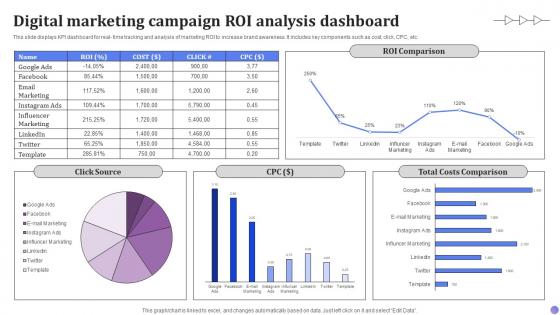
Digital Marketing Campaign Roi Analysis Dashboard




Try Before you Buy Download Free Sample Product
 Impress Your
 Audience
 100%
100% Editable
 Save Hours
 of Time


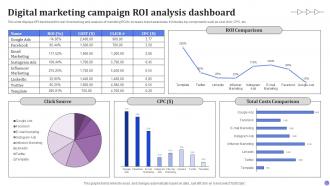
This slide displays KPI dashboard for real time tracking and analysis of marketing ROI to increase brand awareness. It includes key components such as cost, click, CPC, etc.
People who downloaded this PowerPoint presentation also viewed the following :
Digital Marketing Campaign Roi Analysis Dashboard with all 7 slides:
Use our Digital Marketing Campaign Roi Analysis Dashboard to effectively help you save your valuable time. They are readymade to fit into any presentation structure.





FAQs for Digital Marketing Campaign
Key metrics to measure digital marketing ROI effectively include customer acquisition cost, lifetime value, conversion rates, return on ad spend, and attribution modeling across channels. These metrics enable businesses to optimize campaign performance, allocate budgets strategically, and demonstrate tangible value, with many organizations finding that comprehensive tracking ultimately delivers improved profitability and competitive advantage.
Businesses can accurately track conversions through multi-touch attribution models, UTM parameters, cross-device tracking, conversion pixels, and integrated analytics platforms like Google Analytics 4. These technologies streamline measurement by consolidating data across social media, email, search, and display campaigns, enabling marketing teams to optimize budget allocation and demonstrate clear ROI to stakeholders.
Attribution modeling plays a crucial role in Digital Marketing ROI by tracking customer touchpoints across multiple channels, determining which interactions drive conversions, and allocating revenue credit accurately throughout the customer journey. These models enable marketers to optimize budget allocation, identify high-performing channels, and calculate true campaign effectiveness, with many organizations finding significantly improved ROI measurement and strategic decision-making capabilities.
Social media ROI is evaluated through metrics like conversion rates, cost per acquisition, engagement rates, click-through rates, and revenue attribution tracking. By analyzing these performance indicators alongside social listening data and customer lifetime value, businesses can measure campaign effectiveness, optimize ad spend allocation, and demonstrate tangible returns on their social media investments.
Email marketing ROI analysis tools include Google Analytics, Mailchimp Analytics, HubSpot, Klaviyo, Campaign Monitor, and Constant Contact's reporting features. These platforms streamline performance tracking by measuring open rates, click-through rates, and conversion metrics, while integrating with e-commerce systems to calculate actual revenue generated, ultimately enabling marketers to optimize campaigns and demonstrate measurable business impact.
Customer lifetime value is calculated by multiplying average purchase value, purchase frequency, and customer lifespan, then subtracting acquisition costs. Many retail and subscription businesses use predictive analytics to track revenue patterns, segment high-value customers, and optimize marketing spend, ultimately delivering better resource allocation and significantly higher campaign profitability across channels.
Common pitfalls include neglecting attribution modeling, focusing solely on last-click metrics, ignoring long-term customer value, failing to account for organic traffic influenced by paid campaigns, and excluding indirect conversions from social media engagement. These measurement gaps often lead retail and B2B companies to undervalue campaigns that drive brand awareness, ultimately missing opportunities to optimize budget allocation and maximize cross-channel marketing effectiveness.
Content marketing contributes to Digital Marketing ROI by building brand authority, generating qualified leads, and reducing customer acquisition costs through organic reach. This strategic approach delivers measurable value across industries, with many financial services and healthcare organizations finding that quality content drives higher conversion rates, extends customer lifetime value, and ultimately creates sustainable competitive advantage.
Paid ads can positively impact organic search performance by increasing brand visibility, click-through rates, and user engagement signals, which search algorithms favor when ranking pages. While paid campaigns require immediate investment, they often enhance organic rankings through improved brand recognition and website traffic patterns, with many businesses finding that strategic combination of paid and organic efforts delivers higher overall ROI than either approach alone.
Establishing clear KPIs before launching digital marketing strategies is crucial for measuring success, allocating resources effectively, and demonstrating tangible business value. These metrics enable organizations to track conversion rates, customer acquisition costs, and revenue attribution across channels, while providing stakeholders with measurable outcomes that justify marketing investments and guide strategic optimization decisions.
Website analytics provide the foundational data for measuring Digital Marketing ROI by tracking conversions, customer acquisition costs, revenue attribution, and campaign performance across channels. These metrics enable marketers to calculate precise ROI ratios, identify high-performing strategies, and optimize budget allocation, with many organizations finding that comprehensive analytics ultimately deliver 15-20% better marketing efficiency.
A/B testing enables businesses to optimize digital marketing ROI by comparing different campaign elements, measuring conversion rates, and identifying high-performing variations across email subject lines, ad copy, and landing pages. Through systematic testing, organizations in retail, SaaS, and e-commerce streamline budget allocation, enhance customer engagement, and maximize campaign effectiveness, ultimately delivering measurable improvements in conversion rates and cost-per-acquisition.
Best practices for optimizing digital campaigns include tracking conversion metrics, A/B testing creative elements, refining audience targeting, reallocating budgets to high-performing channels, and implementing attribution modeling. These strategies enhance campaign effectiveness by identifying profitable segments, eliminating underperforming assets, and maximizing spend efficiency, with many organizations finding that continuous optimization delivers significantly improved conversion rates and reduced customer acquisition costs.
Seasonality significantly impacts Digital Marketing ROI measurements by creating fluctuations in consumer demand, ad costs, and conversion rates throughout different periods. Retail businesses experience peak ROI during holidays, while B2B companies often see stronger performance in Q1 and Q3, making year-over-year comparisons essential for accurate assessment.
Successful ROI-driven digital marketing strategies include Amazon's personalized recommendation engine generating 35% of revenue, Netflix's data-driven content personalization reducing churn by 93%, and Starbucks' mobile app driving 40% of transactions through targeted offers and loyalty integration. These approaches demonstrate how strategic combination of customer data analytics, personalized experiences, and omnichannel engagement delivers measurable business outcomes, with many organizations finding that integrated digital strategies significantly enhance customer lifetime value while reducing acquisition costs.
-
“Ample and amazing variety of templates available, really helpful for making professional PPT for day to day workings.”
-
“One of the best experiences with SlideTeam for my presentation.Everything on time, communication is efficient and price is reasonable. All good in one place.”