


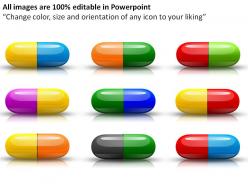
Medicine capsules powerpoint presentation slides




Try Before you Buy Download Free Sample Product
 Impress Your
 Audience
 100%
100% Editable
 Save Hours
 of Time


Use all the tools at your disposal. High end Medicine Capsules Powerpoint Presentation Slides design are on hand to give your presentations an edge.
People who downloaded this PowerPoint presentation also viewed the following :
Medicine capsules powerpoint presentation slides with all 23 slides:
Captain your ship with our Medicine Capsules Powerpoint Presentation Slides. Your thoughts will steer a true course.
FAQs for Medicine capsules
So capsules are basically two parts - the shell and whatever medicine's inside. Most shells are made from gelatin, though some companies use plant stuff like cellulose instead. The actual drug can be powder, little pellets, or even liquid. Your stomach dissolves the shell and releases everything. Honestly pretty smart design if you ask me. Oh, and if you're wondering what type yours are, just check the inactive ingredients on your bottle - they list all that stuff there. Way more detail than you probably need but hey, at least you'll know!
So hard capsules are those two-piece shells - usually gelatin - that you stuff with powders or pellets. Soft ones are completely different though, they're sealed units filled with liquids or semi-solid stuff. Most companies go with hard capsules because they're honestly just way easier to mass produce and cheaper. You'll mainly see soft capsules for oils and suspensions, or when drugs don't dissolve well and need that extra bioavailability boost. The machinery's totally different too - hard caps use regular powder fillers, but soft ones need these specialized machines. My rule of thumb? Liquid formulation = go soft, powder = stick with hard capsules.
Honestly, capsules are so much better if you hate the taste of meds - they skip your taste buds entirely. The dissolution is way more predictable too since tablets have to break down first, so you get consistent timing. Most people find them easier to swallow without those annoying sharp tablet edges. Oh, and here's something useful - you can usually open capsules and mix the contents into food or drinks, which is a lifesaver for kids or anyone who struggles with pills. Just double-check with your pharmacist first since some are time-release and you'll mess that up if you open them.
So it really depends on what you're going for. Quick release? Use something like gelatin that dissolves fast. Want it slow and steady over hours? Go with polymers that break down gradually. There's also enteric coating - honestly pretty cool how it skips the stomach acid entirely. I'd say start with your timeline first, then pick your materials from there. For extended stuff, hydroxypropyl methylcellulose works well, or ethylcellulose. Just match your polymer and wall thickness to whatever release pattern you need. Oh, and coating specs matter too obviously.
Most capsules are made from gelatin - that's the traditional cow or pig-based stuff that's been around forever. Pretty cheap and your stomach breaks it down easily. But there's way more plant-based options now, especially HPMC which is this cellulose thing. Works better than gelatin in hot weather too, which is actually kind of nice. You'll see pullulan and starch ones starting to show up more. Honestly, if you're picking capsules for something, just check what your customers want first - seems like everyone's got dietary restrictions these days.
Yeah, capsules are actually way better for getting people to take their meds! Compliance sits around 70-80% compared to tablets at like 60-65%. That smooth gelatin coating makes them so much easier to swallow - no gross bitter taste lingering in your mouth afterward. Liquids are such a pain with all the measuring. Honestly, most patients tell me capsules just feel "cleaner" somehow? They don't leave that chalky residue tablets do. If your patients are struggling with their current meds, definitely suggest switching to capsule form if it's available.
So basically the capsule shell is what holds everything together until it hits your stomach and dissolves. Regular gelatin ones are made from animal stuff - pork or beef collagen mostly. Works fine but obviously vegans and some religious groups can't use them. HPMC and pullulan are the plant-based alternatives that do the same job, just cost more to make. Honestly, if you're targeting a wide audience, I'd go with the veggie caps from the start. Why limit your market over something like that? They dissolve just as well anyway.
So you basically need to figure out how much space your drug takes up, then pick the smallest capsule that fits it. Most people go with size 0 or 1 - they're like the goldilocks of capsules, not too big to choke on but roomy enough for most doses. The sizes run from 000 (huge) down to 5 (tiny). Here's the annoying part though - your initial math will probably be wrong because excipients and how the powder flows can mess everything up. I always tell people to do fill weight tests super early. Way better to find out your powder's being weird now rather than later when you're already committed to a size.
Honestly, the regulatory stuff is a nightmare but you've gotta deal with it. FDA wants GMP compliance, facility registration, and documentation of everything - I mean everything. EU has similar hoops through EMA. The paperwork will literally make you want to cry, but there's no way around it. Your capsule materials need validation, dosing has to be consistent, and quality control is huge throughout manufacturing. Oh, and labeling requirements plus post-market surveillance too. Actually, start with ICH guidelines first since they work across multiple markets - saves you from learning different rules for each country. Trust me on that one.
So enteric coatings are basically this protective shell that won't dissolve in your stomach acid - only breaks down once it hits your small intestine where the pH is higher. Super useful for drugs that would get trashed by stomach acid or irritate your gut lining. Aspirin's a perfect example - regular aspirin can really tear up your stomach, but the coated version? Much gentler. The coating polymers stay solid until pH hits around 5.5, then they dissolve. Honestly, if you're dealing with any acid-sensitive compounds, this is probably your best bet for better absorption and way fewer stomach issues.
Dude, the capsule tech coming out is honestly insane. There are ones with actual sensors that ping your phone when you take them - like, what?? They're already prescribing these for people who forget their meds a lot. Plus there's delayed-release ones that target exactly where they need to go in your gut, and they're even making biodegradable versions from seaweed now instead of gelatin. Oh, and get this - some can release different drugs at different times from one pill. Feels straight out of a movie sometimes.
Look, capsules usually win for moisture-sensitive stuff - they're just better at keeping water out than tablets. Hard gelatin ones especially. APIs that hate hydrolysis or oxidation? Yeah, they definitely last longer in capsules. Plus tablets get beat up during that whole compression process, which doesn't help stability. But here's the thing - formulation trumps everything else honestly. I've seen enteric-coated tablets crush regular capsules for acid-sensitive drugs. So don't just assume capsules are automatically better. Check what excipients they're using and how it's stored. That matters way more than the delivery method itself.
Heat and humidity will totally mess up your capsules. The gelatin gets brittle and cracks, or sometimes goes the other way and gets all sticky and gross. Moisture makes them absorb water from the air, which basically ruins their structure. Temperature changes are the worst - all that expanding and contracting just beats them up over time. Keep them somewhere cool and dry, like under 77°F with humidity below 60%. Those little packets in the bottle actually do something, btw. Otherwise you're just gonna end up with useless meds that don't work anymore.
So there's a few ways to do this! Enteric coatings are probably your best bet - they dissolve at specific pH levels so you control whether it hits the stomach or intestine. You can also mess around with the drug formulation itself, like mixing it into wax or polymer matrices that break down slower. Oh, and some capsules have multiple pellets inside that release at different times, which is pretty cool honestly. I'd figure out exactly when you want the drug released first, then pick your coating system from there. The timing control you can get is actually wild these days.
Oh man, capsule production is actually pretty rough on the environment. Most aren't biodegradable so they just pile up in landfills. The manufacturing process uses tons of energy too - especially for those gelatin ones that need all that chemical processing. Pharma companies basically never mention this stuff, which is annoying. Look for plant-based capsules if you can find them. Don't flush old meds down the toilet either! Those take-back programs at pharmacies are way better. Your pharmacist might know about greener options too if you ask.
-
The content is very helpful from business point of view.
-
Very unique, user-friendly presentation interface.