


Mo human hand design infographics with icons flat powerpoint design




Try Before you Buy Download Free Sample Product
 Impress Your
 Audience
 100%
100% Editable
 Save Hours
 of Time


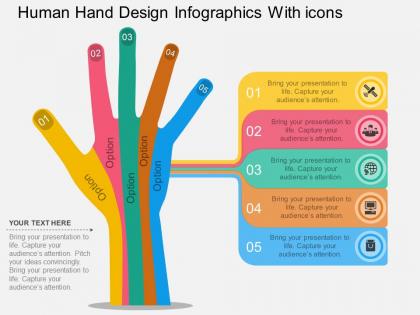
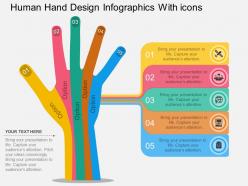
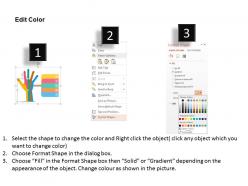
Want to present fivefold idea, use our professionally prepared human hand design info graphics with icons flat PowerPoint design. Various ideas have been presented in shape of a hand along with brief description in text alongside. PPT slides depict graphics containing the appropriate information presented in form of a hand with diverse colors for different ideas of every finger of a hand. PPT icons depict the true scheme regarding the text in an incredible manner. Here the five fingers represent five different kind of information. Hand has been used in PowerPoint visuals for display of the notion that hand is that part of body which has to finally implement the planned ideas. Left hand space has been utilized for the side note if any in the presentation images. Organized actions with innovation and colorful graphics have been portrayed for presenting business ideas and marketing designs. Agenda can be displayed on the right side if needed. Vertical alignment has been used in the presentation illustrations for the human hand with five fingers depicting different information. If you want to give any presentation related to info graphics, must try our PowerPoint stock photos. Enhance the stature of your presentation with our mo Human Hand Design Infographics With Icons Flat Powerpoint Design. Adorn the beauty of your thoughts with their colourful backgrounds.
People who downloaded this PowerPoint presentation also viewed the following :
Mo human hand design infographics with icons flat powerpoint design with all 4 slides:
Finish with a flourish with our mo Human Hand Design Infographics With Icons Flat Powerpoint Design. They ensure there are no half measures.
FAQs for Mo human hand design infographics with icons
So basically it's the thumb that makes everything work - you can touch it to any finger which is huge for grabbing stuff precisely. There's actually 27 bones in your hand (wild, right?) plus all these muscles and tendons that let each finger do its own thing. Your palm's curved shape is perfect for gripping tools, and fingertips are loaded with nerve endings for feeling textures and whatnot. Honestly I never really thought about it until someone mentioned it, but try picking up your phone right now - it's crazy how all those parts just coordinate automatically.
So basically, hands are wild when you compare different animals. Humans got those opposable thumbs that let us grip tools precisely - super useful for making stuff. Chimps have these crazy long fingers perfect for swinging branch to branch. Cats obviously have the retractable claw thing going on (honestly so cool). Bats are weird though - their finger bones stretch out to hold up wing membranes. It's all about what each species needs to survive. Our hands evolved for crafting and manipulation, which is probably why we're so good at building things. When you're studying this stuff, just think about how the shape matches what the animal actually does day-to-day.
Okay so basically tendons are what actually move your fingers - they connect muscle to bone and do all the work. Ligaments are different, they just hold bone to bone together so your joints don't get all wobbly. Pretty much your hand's entire puppet system, you know? Without them you'd have zero grip strength. Like, couldn't even hold your phone (which honestly would solve a lot of problems lol). But yeah, tendons pull while ligaments keep everything stable. Next time you're scrolling or whatever, it's kinda wild thinking about all those tiny fibers working together for every single movement.
Dude, your thumb is literally what makes humans so good at handling stuff! Most animals can't touch their thumb to each fingertip like we can - that's where all the precision comes from. Threading needles, gripping hammers, whatever. Your other four fingers team up to create different grip patterns too. I never realized how much I use mine until I sprained it last year and couldn't open jars for weeks lol. The way your palm curves and all those flexible joints just automatically adjust to different shapes and sizes. Pretty wild when you think about it.
Carpal tunnel's probably the biggest one you'll deal with, plus arthritis and trigger finger - they absolutely wreck your grip. Metacarpal fractures happen all the time too. Honestly, tendon injuries are the worst since they control all your fine movements. People are constantly tearing ligaments, and with everyone glued to keyboards these days, repetitive strain is everywhere. My wrist actually started bugging me last month from too much mouse work. Anyway, if you're designing something hand-related, just focus on supporting that natural wrist curve and cutting down repetitive motions. That alone prevents most of this stuff.
Baby hands are wild - they're basically all palm with stubby little fingers, but man can they grip hard. You know how newborns latch onto your finger? That's serious strength right there. Growing up changes everything though. Fingers shoot out way faster than palms do, so kids gradually get those longer digits that actually work properly. The bones harden from cartilage too, which is why toddlers can't do precision stuff like adults. If you're making anything hand-related, don't just shrink adult measurements - grab actual kid data instead.
Dude, the tech for studying hand mechanics is insane now. Motion capture shows exactly how your tendons and muscles work together - like you can literally watch it happen in real time. MRI and ultrasound let scientists peek inside without cutting you open, which is pretty cool. Force sensors track how you grip stuff and where pressure hits your palm. Oh and 3D modeling too, obviously. All this data's making prosthetics way better, plus the rehab techniques physical therapists use. Even affects the ergonomic design of tools you probably use every day without thinking about it.
Oh man, hands are so culturally loaded! Like in Middle Eastern countries, eating with your left hand is a total no-go since it's considered dirty. And don't even get me started on gestures - that innocent "OK" sign? Super offensive in Brazil apparently. I learned that the hard way once lol. Different places have rules about pointing too - some cultures think using your index finger is rude, so they use an open palm instead. It's wild how the same body part gets completely different meanings. Just watch what locals do when you're somewhere new and copy them.
Yeah, hand design is super important for prosthetics! Engineers basically reverse-engineer how our hands work - studying grip patterns, joint movement, all that stuff. Then they try to recreate it in artificial limbs. Even something as simple as grabbing your coffee cup is ridiculously complex when you break it down. The whole thing blows my mind honestly. This research helps with other assistive tech too, like robotic hands for people with mobility issues. Oh, and if you're doing any hand-related projects, definitely check out the latest grip taxonomy studies - they're pretty revolutionary for functional design right now.
So your brain basically has these super detailed maps of your hands in the motor cortex. Fingertips get tons more space than your palm - makes total sense since you need way more precision for stuff like threading needles. Musicians and surgeons? Their hand maps are insane compared to regular people. The really wild part is how these maps actually change based on what you do with your hands. More practice literally rewires your brain to give you better control. That's why typing feels automatic after a while, or why some people can do incredibly precise movements that would make the rest of us look clumsy.
Honestly, hands are way smarter than we give them credit for. Five fingers working together beats having a million specialized tools - it's all about that thumb action and how each finger moves on its own. Engineers go crazy trying to copy this for a reason. Tactile feedback is huge too, plus being able to adjust grip strength automatically. If you're building robots, forget trying to recreate all 27 bones (nightmare fuel). Focus on thumb-finger coordination patterns instead - that's where the real magic is. Multi-modal sensing over brute strength every time.
Yeah, your hands definitely matter for sports! Longer fingers help with basketball shooting and rock climbing - better grip span. But shorter, thicker hands? They're actually better for weightlifting and wrestling because of the power thing. Hand size affects whether you can palm a ball or hold a racquet right. Even finger length ratios influence fine motor stuff like archery. I never really thought about that until I started climbing more seriously. Point is, don't fight your anatomy - find grips and techniques that work with what you've got instead of against it.
So grip strength is basically the best way to peek into how someone's whole hand system works. You're getting info on muscle coordination, bone structure, neural control - all from one test. Honestly, it's crazy how much you can predict about someone's overall health just from how hard they can squeeze. Everything from using tools to playing sports connects back to grip strength. My PT friend always starts assessments there because it gives you the most reliable baseline. Plus if you're studying hand evolution or whatever, grip testing is where you'd want to begin.
So ergonomics is just designing stuff that actually works with how your hands naturally move. Your hands have specific ways they like to grip things and certain angles that feel comfortable - when designers ignore that, you end up with carpal tunnel and all sorts of painful problems. A good mouse should fit your palm without forcing weird positions. I swear, some keyboards seem designed by people who've never actually typed before. When you're setting up your desk, just pay attention to whether your hands can stay relaxed. Awkward positions today = pain tomorrow.
Dude, hand anatomy research is seriously useful for PT work. Understanding how tendons, muscles, and bones interact lets you create way better treatment plans for stroke patients or people with arthritis. The biomechanics gets pretty nerdy - I actually find it fascinating though. You can predict which exercises work best and avoid stuff that might cause re-injury. Oh, and grip strength research has come so far lately. Next time you're treating someone with hand issues, definitely look up recent studies on their condition. You'll probably discover some evidence-based techniques you hadn't thought of before.
-
Informative presentations that are easily editable.
-
Design layout is very impressive.