

Multiple Project Tracker Status Report





Try Before you Buy Download Free Sample Product
 Impress Your
Audience
 100%
Editable
 Save Hours
of Time


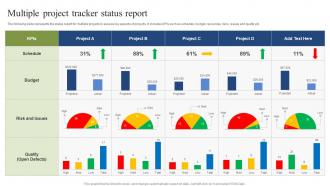
The following slide represents the status report for multiple projects to assess key aspects of projects. It includes KPIs such as schedule, budget, resources, risks, issues and quality etc.
People who downloaded this PowerPoint presentation also viewed the following :
Multiple Project Tracker Status Report with all 7 slides:
Use our Multiple Project Tracker Status Report to effectively help you save your valuable time. They are readymade to fit into any presentation structure.






FAQs for Multiple Project
So there's five main phases: initiation, planning, execution, monitoring, and closure. Initiation is where you figure out what you're actually trying to do and set your goals. Planning maps out how you'll get there. Then execution happens - this is where shit usually hits the fan, honestly. While you're executing, you're also monitoring everything to catch problems early. Closure wraps it all up with lessons learned and whatnot. Here's what's tricky though - these phases aren't really separate boxes. They bleed into each other constantly. If monitoring shows something's broken, you might circle back to planning. Treat them more like a cycle than rigid checkboxes.
Look, you'll save yourself a ton of headaches if you just communicate well with stakeholders from day one. Keep them in the loop with regular updates - builds trust and they actually feel like part of the process. I learned this the hard way when a project completely imploded because everyone thought we were aligned but we weren't even close. Listen to what they're saying too, not just talking at them. Being upfront about problems? Way better than pretending everything's fine when it's not. They're more likely to have your back when things get messy if you've been straight with them all along.
Start with a basic risk register - just tracks what could blow up your project. Risk matrices are clutch for figuring out what to worry about first (probability vs impact). SWOT analysis works great when you've got the whole team brainstorming together. Monte Carlo simulations are solid for complex stuff, but honestly they're way too much for most projects. Oh, and build risk check-ins into your regular meetings - people forget about this part. My take? Just pick like 2-3 tools and stick with them. Don't go crazy trying to use everything at once.
So basically, Agile chops everything into these short 2-4 week chunks instead of planning the whole thing upfront. Way less rigid than traditional project management - which honestly feels kinda outdated now? You get constant feedback and can pivot when things change (and they always do). Instead of your stakeholders vanishing for months then suddenly reappearing at the end, they're actually involved the whole time. You deliver working stuff regularly rather than crossing your fingers that your big final reveal works. If your requirements keep shifting, definitely try 2-week sprints first.
Honestly, good leadership can make or break a project - I've seen it happen so many times. You're basically the one setting the vibe and keeping everyone focused on what actually matters. When stuff hits the fan (which it will), your team looks to you for direction and motivation. Clear communication is huge. Remove roadblocks for people instead of creating more bureaucracy. Don't wait forever to escalate problems either - that always backfires. Oh, and be around. Like actually available for quick chats and check-ins. It prevents so many disasters later.
Track your budget, timeline, scope, and quality stuff first - that's baseline. But here's the thing, I've watched projects nail every target and still get called disasters because people were pissed off. Stakeholder happiness matters just as much as hitting deadlines, honestly. Team morale too. Set up your KPIs right at kickoff so you're not later trying to prove you actually succeeded. Earned value management works great for the number-crunching side. Don't skip pulse surveys and retrospectives though - those soft indicators will save your ass when leadership starts asking questions.
Ugh, scope creep is the worst - that's when your simple project suddenly becomes a monster. Communication breakdowns happen constantly too. People set crazy deadlines that make no sense. Document literally everything or you'll regret it later. I learned that the hard way on my last project. Regular check-ins help catch problems before they blow up. Always pad your timeline because stuff takes longer than you think. And practice saying no nicely - stakeholders will try to add random features that'll wreck everything. Trust me on that one.
Ugh, project management tools are honestly a lifesaver for this stuff. I'd start with something like Asana or Monday - they track who's doing what and when it's due without drowning everyone in emails. The best part? Your whole team can actually see what's happening in real time instead of playing guesswork. Cloud storage fixes that annoying "which version is the right one?" problem too. Oh, and automated reports will save you tons of time each week (I wish I'd discovered this sooner). Don't try to implement everything at once though - just pick whatever's driving you most crazy first.
Honestly, you can't overcommunicate with remote teams. Daily standups are clutch, plus those shared dashboards where everyone can see what's happening. I learned this the hard way - never assume people know what you're thinking! One-on-ones help too. Time zones are tricky though, so build in async stuff wherever you can. Document literally everything somewhere central or it'll disappear into Slack hell. Oh and this might sound cheesy, but schedule some random video hangouts that aren't work-related. You'll thank me later when your team actually feels like... a team.
Oh man, cultural stuff can totally make or break your global team. Direct cultures will tell you straight up what's wrong, but indirect ones dance around issues - makes feedback sessions interesting. Hierarchy's another big one. Your Tokyo teammates might never openly disagree with leadership, while your New York crew challenges everything. Time management? Forget about it - what flies in one region bombs in another. I learned this the hard way on a project last year. Best thing you can do is figure out everyone's style upfront, then adjust how you communicate and schedule things. Rotating meeting times helps too.
Look, SMART objectives literally save you from project chaos. You know how some goals are like "improve our website"? Useless. But Specific, Measurable, Achievable, Relevant, Time-bound goals? That's your actual roadmap. I've been in those painful meetings where nobody knows if we're winning or failing. SMART objectives fix that by forcing you to define success upfront. Write down your next objective and run it through all five criteria - catches the fuzzy thinking that kills projects. Trust me, it beats dealing with scope creep and blown deadlines later.
Figure out your critical path first - what tasks will actually kill your deadline if they slip. Then use MoSCoW to rank everything else (Must have, Should have, etc). Map out who's free when and match people's skills to what needs doing. I totally screwed this up once by dumping three urgent things on Sarah simultaneously - don't be me! Always track everyone's capacity and add buffer time because stuff will break. Oh, and make a visual board showing priorities and who's doing what. You'll spot bottlenecks instantly.
Ugh, scope creep is the worst - it'll destroy your timeline and budget every single time. Picture building a house but everyone keeps wanting to add rooms halfway through. That "just one tiny feature" request? It snowballs fast. I've watched projects balloon 30-50% over their original estimates because nobody said no early enough. The sneaky part is how gradual it feels until suddenly you're months behind and way over budget. My advice? Write down EVERYTHING upfront. When changes come up (and they will), document exactly what it'll cost in time and money before you even consider it.
Think of lessons learned as your project cheat codes. You document what bombed and what killed it so you don't repeat the same garbage twice. Build up that knowledge base and your future self will thank you. Honestly, I've seen teams waste so much time redoing stuff that already failed somewhere else. Spot risks faster, improve your process, make realistic estimates based on actual data. The trick is writing this stuff down while it's still fresh in your head - not six months later when you've forgotten half of it. Just start a simple log after each milestone.
Honestly, you need to figure out who all your stakeholders are right from the start - and what actually matters to them. Don't assume you know their priorities! Regular updates are key, but tailor them instead of sending the same boring email to everyone. I've watched projects crash because someone important felt ignored. Face-to-face meetings work way better for your big players. Oh, and don't try to make everything sound perfect when there are problems - people hate that. Just be straight about risks and changes. Set up some kind of basic engagement plan early on. Then actually follow it.
-
Excellent Designs.
-
I never had to worry about creating a business presentation from scratch. SlideTeam offered me professional, ready-made, and editable presentations that would have taken ages to design.