


Organizational structure in scrum scrum team organization structural chart




Try Before you Buy Download Free Sample Product
 Impress Your
 Audience
 100%
100% Editable
 Save Hours
 of Time


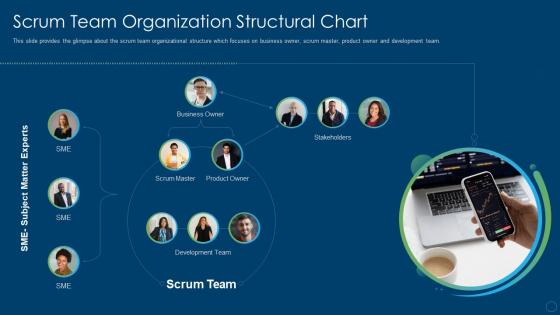
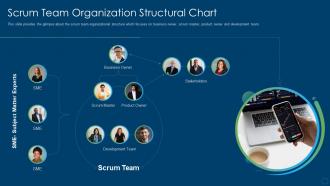
This slide provides the glimpse about the scrum team organizational structure which focuses on business owner, scrum master, product owner and development team.
People who downloaded this PowerPoint presentation also viewed the following :
Organizational structure in scrum scrum team organization structural chart with all 9 slides:
Use our Organizational Structure In Scrum Scrum Team Organization Structural Chart to effectively help you save your valuable time. They are readymade to fit into any presentation structure.








FAQs for Organizational structure in scrum scrum team
Scrum teams comprise three key roles: the Product Owner who defines requirements and priorities, the Scrum Master who facilitates processes and removes impediments, and Development Team members who build the product. These roles interact through daily standups, sprint planning, and retrospectives, with the Product Owner providing vision, the Scrum Master enabling collaboration, and developers delivering working increments, ultimately ensuring faster delivery and enhanced team productivity.
The Scrum Master facilitates collaboration by removing impediments, organizing daily standups and retrospectives, and ensuring transparent communication across all team activities. Through these structured interactions, teams streamline workflow coordination, enhance cross-functional knowledge sharing, and maintain continuous improvement cycles, with many organizations finding that effective facilitation ultimately delivers faster sprint completions and stronger team cohesion.
The Product Owner manages backlog prioritization by defining user stories, assessing business value, gathering stakeholder requirements, and ensuring alignment with strategic goals. Through continuous refinement and stakeholder collaboration, Product Owners maximize return on investment, deliver customer-focused features, and guide development teams toward high-impact deliverables, ultimately enabling organizations to respond quickly to market demands while maintaining product vision consistency.
Essential skills for effective Scrum team members include collaboration, adaptability, cross-functional expertise, problem-solving abilities, and strong communication. These competencies enable teams to navigate complex projects by fostering transparency, embracing iterative development, and maintaining continuous improvement, with many organizations finding that diverse skill sets ultimately deliver faster product releases and enhanced customer satisfaction.
Scrum teams ensure inclusive sprint planning through structured facilitation techniques including round-robin discussions, anonymous input methods, time-boxed individual contributions, and dedicated retrospective feedback sessions. These approaches enable diverse perspectives by encouraging quieter members to participate actively, facilitating balanced workload distribution, and ultimately delivering more comprehensive sprint goals with enhanced team buy-in.
Common challenges include unclear role definitions, weak commitment to sprint goals, inadequate daily standup participation, poor visibility into individual contributions, and insufficient retrospective follow-through. These accountability gaps often emerge in remote environments or larger organizations, where teams struggle with transparency and ownership, ultimately affecting sprint delivery and team dynamics.
Scrum team composition significantly impacts performance through balanced skill diversity, clear role definition, and optimal team size of 5-9 members. Cross-functional teams with complementary expertise, dedicated Product Owners, and experienced Scrum Masters deliver faster sprint cycles, higher quality deliverables, and improved stakeholder satisfaction, with many organizations finding that well-structured teams reduce development time by 30-40%.
Cross-functionality enables Scrum teams to deliver complete features independently, reduce dependencies on external resources, accelerate delivery cycles, and maintain consistent velocity throughout sprints. This approach enhances collaboration between developers, testers, and designers, while minimizing bottlenecks, ultimately delivering faster time-to-market and improved product quality for organizations.
Team size significantly impacts Scrum ceremony effectiveness through communication complexity, participation levels, and time management requirements. Smaller teams of 3-5 members enable focused daily standups and streamlined sprint planning, while larger teams may require breakout sessions or extended timeframes, with many organizations finding that optimal sizing around 7-9 members balances diverse expertise with efficient collaboration and decision-making speed.
Remote Scrum teams can leverage digital collaboration tools, establish clear communication protocols, maintain regular video-based ceremonies, and create shared virtual workspaces for transparency. These strategies streamline distributed workflows by enhancing real-time communication, ensuring consistent sprint visibility, and fostering team cohesion, with many organizations finding that structured remote practices ultimately deliver improved productivity and broader talent access.
Scrum teams should engage stakeholders through regular sprint reviews, product backlog refinement sessions, and continuous feedback loops to ensure alignment with business objectives. By involving stakeholders in sprint planning discussions, demo presentations, and retrospective insights, teams deliver enhanced product value, improved customer satisfaction, and reduced project risks, ultimately achieving faster time-to-market and stronger stakeholder buy-in.
Daily stand-ups, sprint retrospectives, pair programming, collaborative tools like Slack, and visual management boards enhance Scrum team communication effectively. These techniques streamline information flow by encouraging transparency, facilitating real-time problem-solving, and creating structured feedback loops, with many development teams finding that regular face-to-face interactions and shared digital workspaces ultimately deliver faster project delivery and stronger team cohesion.
Scrum teams measure performance through velocity tracking, sprint burndown charts, retrospective feedback, and quality metrics like defect rates and customer satisfaction scores. These measurements enable continuous improvement by identifying bottlenecks, optimizing workflows, and enhancing collaboration practices, with many organizations finding that regular retrospectives and data-driven adjustments ultimately deliver faster delivery cycles and higher-quality outcomes.
Team culture significantly impacts Scrum success through communication patterns, collaboration willingness, transparency levels, accountability standards, and adaptability to change. A positive culture enhances sprint effectiveness, retrospective honesty, and cross-functional cooperation, while toxic cultures can undermine daily standups and sprint commitments, with high-performing teams finding that psychological safety and shared ownership ultimately deliver faster iterations and superior product outcomes.
Scrum teams manage dependencies through structured communication protocols, regular cross-team ceremonies, dependency mapping, shared backlogs, and integrated sprint planning sessions. These coordination mechanisms enable teams to identify potential bottlenecks early, synchronize deliverables, and maintain consistent progress, with many organizations finding that strategic dependency management significantly reduces delays and enhances overall project velocity.
-
Excellent Designs.
-
Innovative and attractive designs.
-
Great experience, I would definitely use your services further.
-
Perfect template with attractive color combination.
-
Awesome use of colors and designs in product templates.