


Overview Of Competitive Analysis Frameworks Types Of Competitor Analysis Framework




Try Before you Buy Download Free Sample Product
 Impress Your
 Audience
 100%
100% Editable
 Save Hours
 of Time


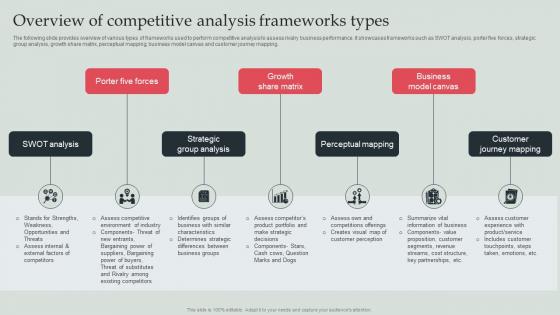
The following slide provides overview of various types of frameworks used to perform competitive analysis to assess rivalry business performance. It showcases frameworks such as SWOT analysis, porter five forces, strategic group analysis, growth share matrix, perceptual mapping, business model canvas and customer journey mapping.
People who downloaded this PowerPoint presentation also viewed the following :
Overview Of Competitive Analysis Frameworks Types Of Competitor Analysis Framework with all 9 slides:
Use our Overview Of Competitive Analysis Frameworks Types Of Competitor Analysis Framework to effectively help you save your valuable time. They are readymade to fit into any presentation structure.








FAQs for Overview Of Competitive Analysis Frameworks Types Of
You need four main things for competitive analysis: identifying your competitors (both direct and indirect ones), figuring out where everyone sits in the market, doing SWOT comparisons, and benchmarking performance. Don't forget to look at their pricing, marketing tactics, and what features they're pushing. Here's the thing though - it's super tempting to analyze every tiny detail they post on social media or whatever. Focus on stuff that'll actually change how you operate. Oh, and do this regularly! Like quarterly check-ins. One-and-done analysis is pretty useless since things move fast.
Start with regular competitor research - pricing, features, market position, you know the drill. Then flip it into a SWOT framework. Their strengths? Those are threats coming your way. Weaknesses they have become opportunities you can exploit. Honestly, it's like getting inside their head and working backwards. Your strengths help you fight back against what they're throwing at you. Where you're weak shows exactly where they can hurt you most. Oh, and don't just do this once - competitive stuff changes way too fast. I'd say revisit quarterly so you're not working with stale intel.
You gotta segment first before looking at competitors, trust me on this one. Otherwise you're comparing companies that aren't even fighting for the same customers - makes zero sense. Once you break down the market, you'll actually see who's going after which groups and spot the real opportunities. I learned this the hard way when I thought two brands were direct competitors, but turns out one was chasing budget shoppers while the other wanted premium buyers only. Segment first, then map competitors. Way more useful that way.
Dude, you should totally dig into customer reviews - not just yours but your competitors' too. People absolutely roast companies in reviews and it's honestly like having a free market research team. Set up Google Alerts for competitor names and scroll through their social media complaints. I spend way too much time doing this but whatever, it works! Look for patterns in what pisses people off about pricing or features. Then figure out what customers actually love versus hate. Cross-reference that stuff and you'll see exactly where you can swoop in and do better. It's like having a cheat sheet for the real customer experience.
Honestly, the worst mistake is tunnel vision - only watching direct competitors while some random startup disrupts everything from the side. Analysis paralysis kills momentum too. I've watched teams research for months then... nothing. Zero action. Also don't work with stale data since markets move crazy fast now. Track where competitors are heading, not just current moves. That's way more valuable. Stick to 3-5 key players max, refresh quarterly, and actually connect findings to real decisions you're making. Otherwise you're just collecting useless intel.
So PESTLE is basically the big picture stuff your competitors probably aren't looking at. Most people get stuck analyzing direct rivals with Porter's Five Forces or whatever. But PESTLE covers the macro forces - political, economic, social, tech, legal, environmental - that actually shape your whole industry. Think of it like stepping back to see the forest instead of just the trees. I always tell people to start there because you'll catch threats and opportunities that others miss. Plus it makes your other analysis way sharper. Honestly, most companies skip this step and wonder why they got blindsided.
Honestly? Focus on market share, revenue growth, customer acquisition cost, and lifetime value. Those four tell you everything you need to know about where you stand. Pricing position and brand sentiment are solid additions if you've got bandwidth for it. Here's what I wish someone told me earlier - don't chase vanity metrics like follower counts. Been there, wasted time on that. Quarter by quarter, benchmark yourself against your top 3 competitors on these core numbers. Then figure out where the biggest gaps are and go from there. Way more actionable than trying to track everything under the sun.
Dude, visualization tools are a game changer for competitive analysis. Instead of staring at endless spreadsheets, you get actual charts and graphs that make sense. Heat maps show where competitors sit in the market, bubble charts group similar players together. I literally used to dread this stuff until I started making everything visual - like going from reading a boring textbook to watching Netflix, you know? Those 2x2 positioning maps are perfect to start with. Then you can get fancy with perimeter plots to find market gaps. Trust me, patterns jump out immediately that you'd never catch otherwise.
Just use stuff that's out there for everyone - their websites, press releases, customer reviews, industry reports. Don't get sneaky trying to extract insider info from employees or pretending you're someone else. I've actually seen companies get burned doing shady stuff like that. Respect their IP too. Here's how I think about it: would you be pissed if competitors did this exact same thing to your company? If yes, then don't do it. Keep everything clean and defensible so you can sleep at night.
Honestly, digital analytics is like a goldmine for competitor research. Tools like SEMrush and SimilarWeb let you peek at their traffic and keyword rankings. Social media gives away so much too - engagement rates, follower growth, the whole deal. I usually check their ad spend and campaign stuff monthly because doing random searches is pretty useless. Oh, and you can even see what tech they're using on their sites which is kinda cool. My advice? Pick 2-3 main competitors and set up a simple dashboard. Way easier than trying to remember to check everything manually.
Competition totally depends on your industry - like tech moves crazy fast with network effects, but manufacturing is all about scale and supply chains. Healthcare? Regulations make it super weird to compete. Retail though... that's just brutal price wars everywhere. What I'd do is figure out the 3-4 things that actually matter for winning in your space first. Then build around those instead of some cookie-cutter framework. Generic templates are pretty useless when every industry plays by different rules. Focus on what drives real advantage where you're at.
Honestly? Just do three things and don't overthink it. Make a simple competitor matrix - who's doing what, how much they charge, who they're targeting. Yeah, SWOT analysis sounds boring but it actually helps you figure out where you fit. The "jobs to be done" thing is gold though - like, what are customers *actually* trying to solve? You'll find competitors hiding in weird places you never expected. Oh, and spend way more time talking to real people than going down Google rabbit holes. That's where the good stuff is.
Build your frameworks like Lego blocks - modular pieces you can actually swap out when things change. Skip the quarterly reviews, honestly they're useless now. Monthly or weekly updates are where it's at. I watched a whole team get destroyed because they stuck to their annual competitive analysis while their market flipped three times in six months. Set up alerts for competitor moves and funding news so you're not scrambling to catch up later. Oh, and focus on leading indicators instead of the stuff that already happened - way more helpful.
Watch what your competitors are doing with AI/ML and cloud stuff - that's where the real action is. Automation tools too. IoT, blockchain, AR/VR might matter depending on your space. Honestly, don't get sucked into every flashy trend (I've seen way too many companies waste money chasing nothing). Focus on how they're actually using tech - better customer experience, cutting costs, breaking into new markets. Google Alerts work great for tracking competitor names plus words like "partnership" or "launches." Oh, and check their job postings! New tech hires usually mean they're planning something big.
So basically, these frameworks stop you from just randomly stalking competitor websites and freaking out about everything they're doing (guilty as charged lol). Tools like Porter's Five Forces or SWOT give you an actual system for figuring out threats and opportunities. You'll spot where competitors suck, find customer segments nobody's targeting, or nail down pricing that makes sense. The trick is switching up which framework you use depending on what you're trying to figure out. Don't just default to the same one every single time - that's lazy and you won't get good insights.
-
SlideTeam’s pool of 2Million+ PPTs has really benefited my team, everyone from the IT department to HR. We are lucky to have crossed ways with them.
-
Their designing team is so expert in making tailored templates. They craft the exact thing I have in my mind…..really happy.