


Overview Of Recruitment Training Strategies And Methods Powerpoint Presentation Slides




Try Before you Buy Download Free Sample Product
 Impress Your
 Audience
 100%
100% Editable
 Save Hours
 of Time


Recruitment training is a form of ongoing education that assists recruiters in being more effective in their duties and progressing in their careers. The goal of recruiting training is to improve the skills and capabilities of newly hired applicants. Check out our competently designed template on Overview of Recruitment Training Strategies and Methods that will determine the current situation of the companys selection process, identify the critical requirements of the new recruitment training program, analyze the efficiency of the companys selection process and take required steps to improve the efficiency. This template provides the details on the companys current selection process, the companys employee on boarding program, current issues in the recruitment process, and potential solutions for eliminating the problems. This module also covers details on recruitment training programs, employee skill gap analysis, and company hiring budget analysis. Additionally, this template provides information on the employee recruitment process model, analysis of key recruitment metrics, important actions to improve recruitment outcomes, schedule, and agenda of recruiting training plan and recruiting training strategies and methods. Also, this presentation provides information on key metrics using dashboards. Get access now.
People who downloaded this PowerPoint presentation also viewed the following :
Content of this Powerpoint Presentation
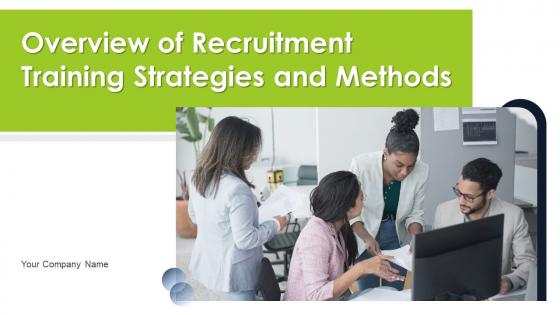
Slide 1: This slide displays title i.e. 'Overview of Recruitment Training Strategies and Methods' and your Company Name.
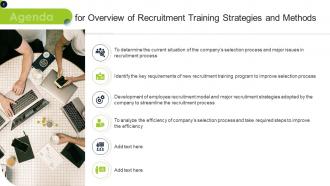
Slide 2: This slide presents agenda.
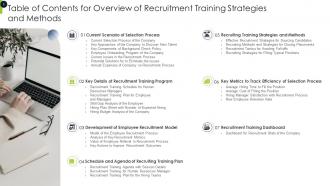
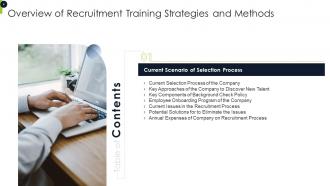
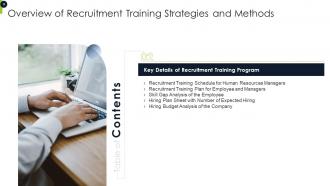
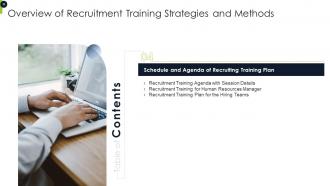
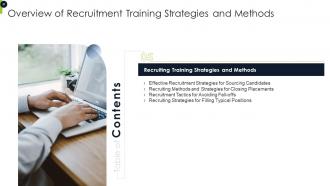
Slide 3: This slide exhibits table of contents.
Slide 4: This slide depicts title for seven topics that are to be covered next in the template.
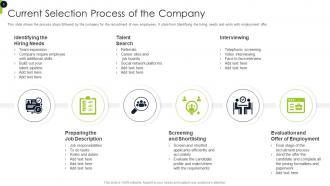
Slide 5: This slide shows the process steps followed by the company for the recruitment of new employees.
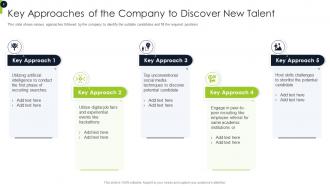
Slide 6: This slide shows various approaches followed by the company to identify the suitable candidates and fill the required positions.
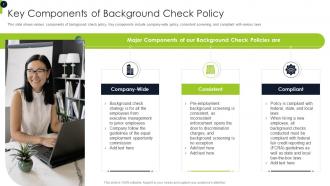
Slide 7: This slide shows various components of background check policy. Key components include company-wide policy, consistent screening, etc.
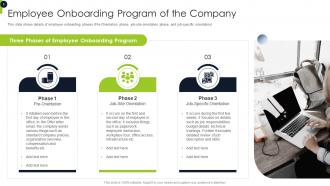
Slide 8: This slide shows details of employee onboarding phases (Pre-Orientation phase, job-site orientation phase, and job-specific orientation.
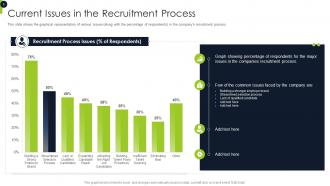
Slide 9: This slide shows the graphical representation of various issues (along with the percentage of respondents) in the company’s recruitment process.
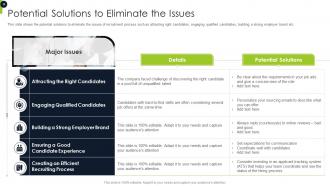
Slide 10: This slide shows the potential solutions to eliminate the issues of recruitment process such as attracting right candidates, engaging qualified candidates, etc.
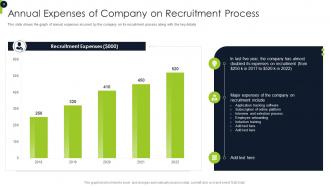
Slide 11: This slide shows the graph of annual expenses incurred by the company on its recruitment process along with the key details.
Slide 12: This slide depicts title for five topics that are to be covered next in the template.
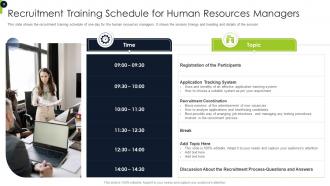
Slide 13: This slide shows the recruitment training schedule of one day for the human resources managers.
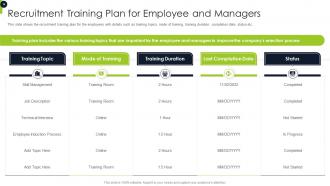
Slide 14: This slide shows the recruitment training plan for the employees with details such as training topics, mode of training, training duration, completion date, etc.
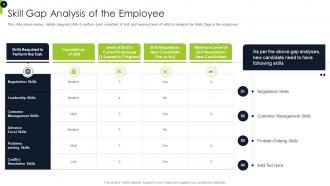
Slide 15: This slide shows various details (required skills to preform task, important of skill, and required level of skills) to analyze the Skills Gaps in the employees.
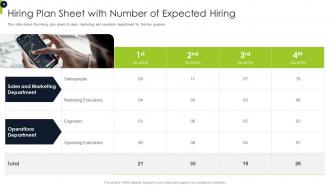
Slide 16: This slide shows the Hiring plan sheet of sales, marketing and operation department for the four quarters
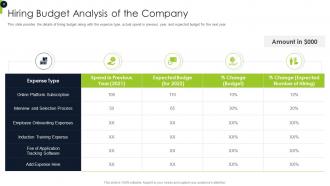
Slide 17: This slide provides the details of hiring budget along with the expense type, actual spend in previous year, and expected budget for the next year.
Slide 18: This slide depicts title for four topics that are to be covered next in the template.
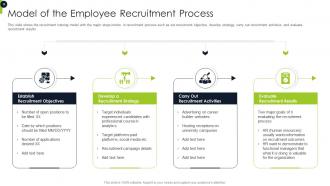
Slide 19: This slide shows the recruitment training model with the major steps involve in recruitment process such as set recruitment objective, develop strategy, etc.
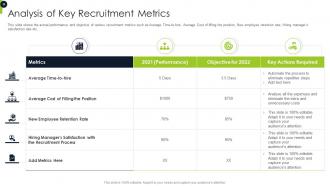
Slide 20: This slide shows the actual performance and objective of various recruitment metrics such as Average Time-to-hire, Average Cost of filling the position, etc.
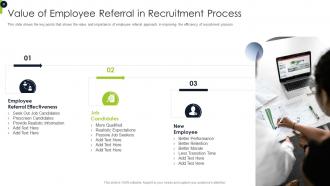
Slide 21: This slide shows the key points that shows the value and importance of employee referral approach in improving the efficiency of recruitment process.
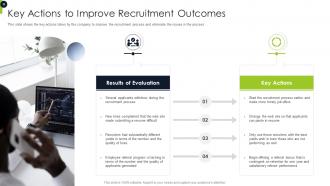
Slide 22: This slide shows the key actions taken by the company to improve the recruitment process and eliminate the issues in the process.
Slide 23: This slide depicts title for three topics that are to be covered next in the template.
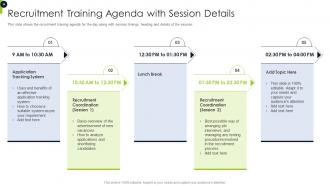
Slide 24: This slide shows the recruitment training agenda for the day along with session timings, heading and details of the session.
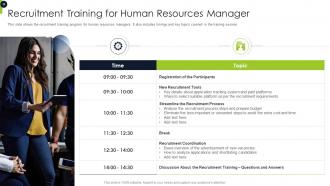
Slide 25: This slide shows the recruitment training program for human resources managers. It also includes timings and key topics covered in the training session
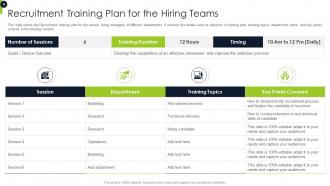
Slide 26: This slide shows the Recruitment training plan for the various hiring managers of different departments.
Slide 27: This slide depicts title for four topics that are to be covered next in the template.
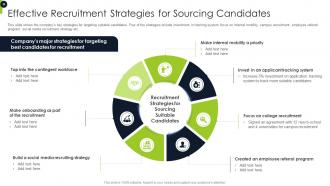
Slide 28: This slide shows the company’s key strategies for targeting suitable candidates.
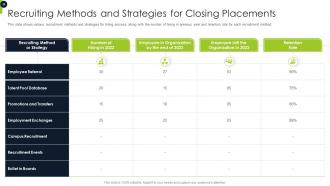
Slide 29: This slide shows various recruitment methods and strategies for hiring process, along with the number of hiring in previous year and retention rate for each.
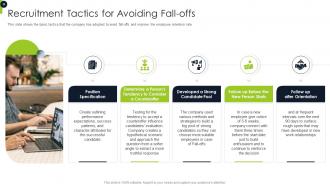
Slide 30: This slide shows the basic tactics that the company has adopted to avoid fall-offs and improve the employee retention rate.
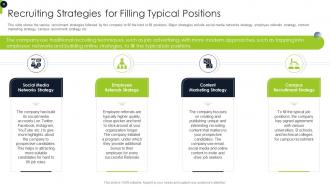
Slide 31: This slide shows the various recruitment strategies followed by the company to fill the hard to fill positions.
Slide 32: This slide depicts title for four topics that are to be covered next in the template.
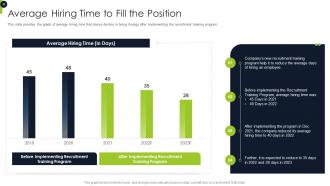
Slide 33: This slide provides the graph of average hiring time that shows decline in hiring timings after implementing the recruitment training program.
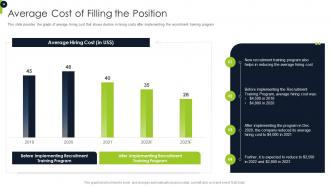
Slide 34: This slide provides the graph of average hiring cost that shows decline in hiring costs after implementing the recruitment training program.
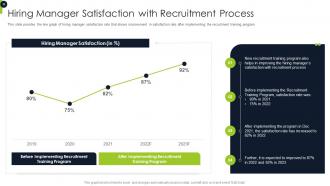
Slide 35: This slide provides the line graph of hiring manager satisfaction rate that shows improvement in satisfaction rate.
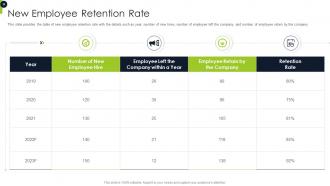
Slide 36: This slide provides the table of new employee retention rate with the details such as year, number of new hires, number of employee left the company, etc.
Slide 37: This slide depicts title for the topic that is to be covered next in the template.
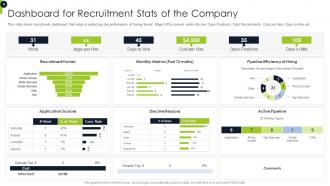
Slide 38: This slide shows recruitment dashboard that helps in analyzing the performance of haring funnel.
Slide 39: This is the icons slide.
Slide 40: This slide presents title for additional slides.
Slide 41: This slide presents your company's vision, mission and goals.
Slide 42: This slide shows details of team members like name, designation, etc.
Slide 43: This slide shows about your company, target audience and its client's values.
Slide 44: This slide depicts posts for past experiences of clients.
Slide 45: This slide displays puzzle.
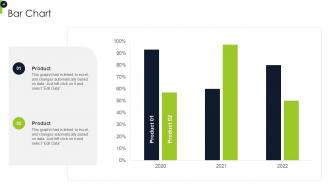
Slide 46: This slide exhibits yearly bar charts for different products. The charts are linked to Excel.
Slide 47: This slide shows roadmap.
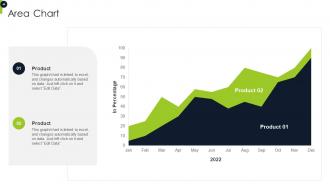
Slide 48: This slide exhibits monthly area charts for different products. The charts are linked to Excel.
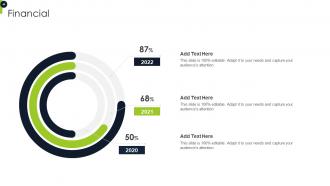
Slide 49: This slide showcases financials.
Slide 50: This slide displays Venn.
Slide 51: This is thank you slide & contains contact details of company like office address, phone no., etc.
Overview Of Recruitment Training Strategies And Methods Powerpoint Presentation Slides with all 56 slides:
Use our Overview Of Recruitment Training Strategies And Methods Powerpoint Presentation Slides to effectively help you save your valuable time. They are readymade to fit into any presentation structure.







FAQs for Overview Of Recruitment Training Strategies And Methods
Focus on interview techniques and candidate assessment first - that's your bread and butter. Legal compliance training is boring as hell but you can't skip it unless you want discrimination lawsuits. Teach sourcing strategies beyond job boards, communication skills since they're literally your company's face, and unconscious bias awareness. Oh, and how to actually sell your workplace culture without sounding fake. Role-playing exercises work great even though everyone hates them initially. Your team will thank you later when they're not fumbling through real interviews.
Look at your current numbers first - time-to-hire, hire quality, where people bail in the process. Then just ask your recruiters what they're struggling with! Honestly, they usually know their weak spots better than anyone. Watch them during interviews too, see how they actually interact with candidates. Compare what your team does vs. what's working industry-wide (like AI screening tools or virtual interview skills). The data plus their honest feedback will show you exactly where to focus training. Way better than guessing what they need.
Honestly, tech has completely changed how we can train recruiters now. AI simulations let your team practice interviews without bugging real candidates. VR training creates super realistic scenarios - though I'll admit it still feels a bit sci-fi to me. Mobile platforms are clutch because recruiters can squeeze in quick learning modules between calls. Nobody's sitting through 8-hour training sessions anymore. Analytics show you what's actually working instead of guessing. The trick is finding tools that fit into what you're already doing. Don't pile on more software that'll just frustrate everyone.
Dude, simulation training is honestly a game-changer for recruitment stuff. You get to practice those super awkward candidate conversations without actually bombing a real interview - which trust me, is way better than learning the hard way. Role-play different scenarios, work on your bias issues, get feedback instantly. The cool part? You can mess up as much as you want and try totally different approaches. Oh, and they can simulate those weird situations that don't happen often - like when a hiring manager completely disagrees with your pick. Definitely record yourself though, you'll catch communication habits you didn't even know you had.
So you'll want to track both the quick wins and longer-term stuff. Start with time-to-hire, cost-per-hire, and candidate satisfaction scores - maybe 3-4 max so you don't drown in spreadsheets. Offer acceptance rates are honestly super revealing about whether your team can actually sell the role. Quality of hire is huge too - look at performance ratings and how long people stick around. Oh, and 90-day success rates are probably the most important metric nobody talks about enough. That's where you see if you're really picking the right people or just filling seats fast.
You've gotta weave this stuff into every training module, not just tack it on at the end. Bias awareness workshops are step one - help recruiters spot their own blind spots. Then focus on inclusive sourcing - broaden where you're posting jobs and honestly, rewrite those job descriptions because gendered language kills your candidate pool (I swear some companies don't realize how bad this gets). Structured interviews beat casual chats every time for reducing bias. Oh, and here's the thing that actually works: tie inclusion metrics to performance reviews. Otherwise people just nod along in meetings but nothing changes.
Honestly, keeping people engaged on video calls is brutal - they're scrolling their phones half the time. Break it into short chunks, maybe 45 minutes tops. Interactive stuff works best: breakout rooms for mock interviews, live resume reviews where you share your screen, polls to keep them awake. Record everything so they can go back later if they missed something. Start with just one pilot session first though. You'll probably hit some tech hiccups and want to tweak things based on feedback. Also throw in Q&A segments and hands-on practice throughout - can't just lecture at people for an hour straight.
Dude, active learning is a total game-changer for recruitment training. You're not just sitting there absorbing theory - you're actually doing mock interviews and practicing those awkward candidate conversations. Way more effective than traditional lectures, honestly. It builds real muscle memory for reading body language and handling pushback. Think of it like learning to drive... you can't just read the manual, right? The hands-on stuff sticks because you're getting immediate feedback. Even adding one interactive piece to your training makes a huge difference. People actually stay engaged instead of checking their phones.
Honestly, the toughest part is making compliance training not suck - nobody wants to sit through boring slides. Role-playing beats PowerPoints every time for building confidence. Use actual job descriptions and real candidate profiles in your exercises, makes it way more engaging. Rejection's the other killer. I always tell new hires that "no" just means "not now" - it's not about them personally. Pair them with seasoned recruiters for mentoring (this works so well). Track their activity early so they see progress even when placements are slow. Oh, and do regular check-ins their first few months - they need that support.
Honestly, you've gotta tailor your approach to each industry's weirdness. Tech? It's all technical screens and bidding wars for talent. Healthcare needs you to understand their crazy certification requirements. Sales recruiting is actually fun though - you're basically hunting for people who won't quit when things get tough. Manufacturing cares more about safety records and whether someone can actually do the hands-on work. Research the lingo they use and what candidates in that space actually want from jobs. Oh, and definitely shadow someone experienced for like a week if you can swing it.
Dude, pairing new hires with your best recruiters is *so* worth it. They'll learn way more from shadowing real calls than sitting through boring training modules. New people actually ask questions when they're with peers - stuff they'd never bring up to their manager, you know? Short feedback sessions work better than long formal reviews. Set up those peer groups where everyone can bounce ideas off each other about tricky roles. Oh, and the mentors love it too because teaching actually makes them sharper at their own job. Win-win situation honestly.
So basically you want to collect feedback at different stages - during training, right after, and then weeks later when you can see actual hiring results. This stops you from running those painful programs that nobody realizes suck until it's way too late (been there!). Get input from trainees, managers, whoever's involved. Short feedback loops mean you can tweak content or completely ditch modules that aren't helping. The real trick is actually doing something with what people tell you instead of just collecting it. Set up regular check-ins and don't be afraid to make changes mid-stream.
Honestly, case studies are a game-changer for recruitment training. They let you practice making hiring decisions without the stress of actually screwing up a real hire. You can spot red flags, work through tricky situations, and figure out your gut instincts in a safe space. Way better than sitting through boring lectures about theory, right? The team aspect is huge too - you'll bounce ideas around and build confidence together. Oh, and here's a tip: start saving your own weird interview moments to turn into training scenarios later. Nothing beats practicing with situations that actually happened at your company.
Honestly, just throw in some points and leaderboards - people get weirdly competitive over the dumbest stuff. Progress bars work great for training modules. Team challenges for sourcing candidates are solid too. Role-playing scenarios where they "level up" interview skills? Sounds corny but actually works. Oh, and simulation games are perfect for practicing with difficult candidates. My friend's company does this thing where recruiters earn badges for completing tricky scenarios - they're obsessed with it now. Start simple though. Add points to whatever training you've already got, see how they react, then go from there if it's working.
Honestly, most companies nail the initial training then completely forget about follow-up - huge mistake. Monthly skills sessions are clutch, plus your managers need to give regular feedback (not just during reviews). Set up peer learning and refresher workshops since recruiting changes constantly. Buddy system works great for new hires too. I'd do quarterly assessments to catch gaps early - but make it feel natural, not like homework nobody wants to do. Oh, and create some kind of shared hub where people can grab templates and scripts easily. Your team will actually use it if it's convenient.
-
The content is very helpful from business point of view.
-
SlideTeam’s readymade presentations have landed my unique images with my bosses in the past and it continues to reward me.