


Pmp toolkit it staffing management plan for project




Try Before you Buy Download Free Sample Product
 Impress Your
 Audience
 100%
100% Editable
 Save Hours
 of Time


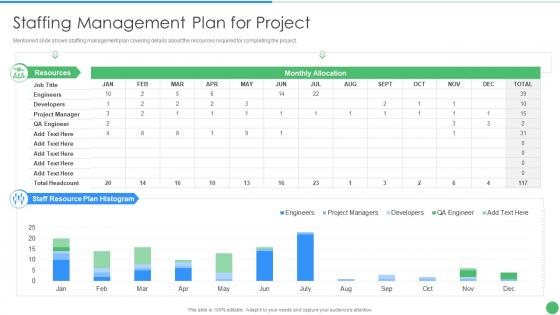
Mentioned slide shows staffing management plan covering details about the resources required for completing the project.
People who downloaded this PowerPoint presentation also viewed the following :
Pmp toolkit it staffing management plan for project with all 7 slides:
Use our Pmp Toolkit It Staffing Management Plan For Project to effectively help you save your valuable time. They are readymade to fit into any presentation structure.





FAQs for Pmp toolkit it staffing management
A PMP toolkit includes project charter templates, work breakdown structures, risk registers, communication plans, and stakeholder analysis frameworks. These components streamline project initiation, planning, and execution by standardizing documentation, enhancing team collaboration, and ensuring consistent deliverables, with many organizations finding that comprehensive toolkits significantly reduce project timelines while improving success rates.
Presentation templates enhance project communication by standardizing information delivery, ensuring consistent messaging across stakeholders, and reducing preparation time for status updates, milestone reviews, and executive briefings. These templates streamline complex project data into digestible formats, enabling project managers to communicate progress, risks, and deliverables more effectively while maintaining professional credibility with sponsors and teams.
**INPUT**: What types of templates are most helpful during the project planning phase? **OUTPUT**: Essential project planning templates include work breakdown structures, project charters, risk registers, stakeholder analysis matrices, and resource allocation spreadsheets. These tools streamline project initiation by establishing clear scope boundaries, identifying potential obstacles early, and enabling systematic resource distribution, with many project managers finding that structured templates ultimately deliver faster approvals and enhanced team alignment.
Selecting the right presentation template involves analyzing your project's complexity, audience expertise, stakeholder requirements, and communication objectives, then matching these factors with template features like data visualization capabilities, customization options, and visual hierarchy. Many project managers find that templates designed for executive summaries work best for C-suite presentations, while detailed project plans require comprehensive tracking templates that enhance stakeholder engagement.
Visual aids in templates improve stakeholder engagement by simplifying complex project information, enhancing comprehension through charts and diagrams, and creating more interactive presentation experiences. These visual elements streamline communication during project reviews, enable faster decision-making processes, and ultimately deliver stronger stakeholder buy-in, with many project managers finding that visual templates significantly reduce meeting times while improving project clarity.
A PMP toolkit can be tailored by incorporating industry-specific templates, risk registers, compliance frameworks, and stakeholder management approaches relevant to sectors like healthcare, construction, or financial services. This customization enables project managers to address unique regulatory requirements, operational constraints, and delivery methodologies, while maintaining standardized project management principles, ultimately delivering faster implementation and improved success rates across diverse organizational contexts.
Risk management serves as a cornerstone of comprehensive PMP toolkits, encompassing risk identification matrices, probability assessment frameworks, mitigation strategies, contingency planning templates, and monitoring dashboards. These tools enable project managers to proactively identify potential threats, quantify impacts, and develop response strategies, ultimately delivering greater project success rates and stakeholder confidence.
Project managers can incorporate agile methodologies by adopting iterative planning, daily standups, sprint reviews, retrospectives, and continuous stakeholder feedback loops. These practices enhance traditional project management by enabling faster adaptation to changes, improving team collaboration, and delivering incremental value, with many organizations finding that hybrid approaches streamline project delivery while maintaining strategic oversight.
Best practices for creating a project status report template include standardizing key metrics, establishing clear visual indicators, defining consistent reporting intervals, incorporating stakeholder-specific sections, and ensuring mobile accessibility. These elements streamline communication by providing at-a-glance progress updates, highlighting risk mitigation strategies, and facilitating data-driven decision making, with many organizations finding that standardized templates reduce reporting time while enhancing project transparency and accountability.
Templates support adherence to project management standards by incorporating predefined structures, mandatory fields, standardized processes, compliance checkpoints, and consistent documentation formats. Through these structured frameworks, organizations streamline project workflows, ensure regulatory compliance, and maintain quality standards across teams, while reducing errors and accelerating project delivery, ultimately delivering enhanced operational efficiency and competitive advantage.
Common pitfalls include over-customization that dilutes core messaging, using inappropriate templates for specific audiences, neglecting to update data and timelines, and failing to maintain consistent branding across project communications. These oversights often result in confused stakeholders, delayed approvals, and reduced project credibility, with many project managers finding that standardized, regularly updated templates significantly enhance communication effectiveness and stakeholder engagement.
A PMP toolkit facilitates team collaboration and communication by providing standardized templates, shared dashboards, centralized documentation systems, and structured meeting frameworks that ensure consistent information flow. These tools streamline project coordination across departments, enable real-time progress tracking, and establish clear communication protocols, ultimately delivering enhanced transparency and faster decision-making for distributed teams.
A comprehensive project scheduling template should include task breakdown structures, milestone tracking, resource allocation charts, dependency mapping, and critical path visualization. These features streamline project planning by enabling timeline management, budget oversight, and risk identification, with many project managers finding that integrated templates enhance team coordination, minimize delays, and ultimately deliver improved project outcomes across industries.
Presentation templates standardize knowledge sharing by providing consistent formats for project updates, lessons learned sessions, stakeholder briefings, and technical reviews. These structured frameworks enable teams to communicate complex project information more effectively, streamline handoffs between team members, and create reusable knowledge assets, ultimately enhancing collaboration and ensuring critical insights are captured and transferred efficiently across project phases.
Technology enhances PMP toolkit functionality through automated project tracking, real-time collaboration platforms, AI-powered risk assessment, cloud-based document management, and integrated communication systems. These digital tools streamline project workflows, enable remote team coordination, and provide data-driven insights for decision-making, with many project managers finding that technology-enhanced toolkits significantly reduce administrative overhead while improving project visibility and stakeholder engagement.
-
Innovative and attractive designs.
-
Use of icon with content is very relateable, informative and appealing.