

Procurement Spend Analysis Purchasing Analytics Tools And Techniques





Try Before you Buy Download Free Sample Product
 Impress Your
Audience
 100%
Editable
 Save Hours
of Time


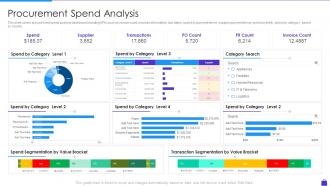
This slide covers procurement spend analysis dashboard including KPIs such as invoice count, invoices information, due dates, spend by payment terms, supplier payment terms, spend by entity, spend by category, spend by country.
People who downloaded this PowerPoint presentation also viewed the following :
Procurement Spend Analysis Purchasing Analytics Tools And Techniques with all 7 slides:
Use our Procurement Spend Analysis Purchasing Analytics Tools And Techniques to effectively help you save your valuable time. They are readymade to fit into any presentation structure.






FAQs for Procurement Spend Analysis Purchasing Analytics
Honestly, you just need four things to get procurement analytics working. Clean data from all your systems - that's the foundation everything builds on. Pick metrics that actually tie to your business goals, not random numbers that look impressive. Get visualization tools your team will use (trust me, nobody wants to live in Excel hell). Oh, and build some analytics skills in-house so you're not always bugging IT for reports. I'd start with spend analysis since it's pretty straightforward, show some wins, then expand. Way better than trying to boil the ocean from day one.
Dude, visualization is seriously a lifesaver for procurement stuff. Instead of drowning in spreadsheets, you can actually see cost trends and supplier problems right away. Heat maps show you which suppliers suck (or rock) instantly. The coolest part? Interactive dashboards let you click around and dig into whatever catches your eye. I probably spend way less time explaining things to my boss now because charts just make sense to people. You'll make decisions faster since patterns become super obvious. Honestly, just start with a basic spend dashboard - the difference is night and day.
So ML basically does all the boring spreadsheet work for you - finds spending patterns, predicts which suppliers might screw you over, catches weird transactions. It gets better over time too, which is pretty neat. You can use it for demand forecasting, picking better suppliers, fraud detection, all that stuff. Way faster than doing it manually (trust me on this one). I'd honestly just pick one thing to start with, like analyzing where your money's going. Once you see how much time it saves, you'll probably want to expand from there.
So basically, procurement analytics shows you where your money's actually going - and trust me, it's probably messier than you think. You'll find duplicate vendors, random purchases that shouldn't have happened, and contracts that are way worse than they should be. Most companies freak out when they see the real numbers. The savings come from cutting redundant suppliers and fixing terrible contract terms. Oh, and focus on your biggest 20% of suppliers first - that's where the real money is hiding. Way more impact than trying to optimize every tiny vendor.
You'll want to focus on three main data sources first. ERP systems give you all the transactional stuff - POs, invoices, contracts, the basics. Then grab supplier performance metrics showing quality and delivery trends over time. P2P systems are solid for spend analytics with category breakdowns. Market data feeds are honestly pretty great if your budget allows it - helps with benchmarking and spotting risks early. Though I'd probably clean up what you've got in those core systems first. Way easier than trying to fix messy data later. External sources can come after once you've got your analytics game stronger.
So procurement analytics is like having a crystal ball for your supply chain mess. Instead of finding out your supplier screwed up after the fact, you can spot the red flags early - late deliveries, sketchy financials, price swings. Honestly, the predictive stuff is where it gets interesting. It'll flag potential disruptions and even suggest backup suppliers automatically. My advice? Start simple - throw your supplier risks into a dashboard, then set up alerts for your most critical ones. Maybe focus on your top 20% first since those hurt the most when they go sideways.
Start with cost savings percentage, supplier performance, and procurement cycle time - these three give you the most value. Contract compliance is huge too, especially with complex vendors (I've definitely been burned by random invoices popping up). Purchase order accuracy matters for smooth operations. Don't jump straight into fancy stuff like supplier risk scores though. Four or five metrics max to start. Get your dashboards automated so you're not stuck in Excel hell every month. Once those are solid, then you can get fancier with tracking.
So basically you're feeding all your supplier data - delivery times, quality scores, contract stuff - into your analytics platform. The system spots patterns and can actually predict when a supplier's about to tank, which is super useful. What I love about it is you can finally ditch the guesswork and see which suppliers are actually worth keeping around. You'll be able to benchmark everyone against each other too. Oh, and definitely standardize your KPIs first or the comparisons won't make sense. Trust me on that one.
Honestly, the data mess is your biggest headache. Procurement info lives everywhere - different systems, half-empty spreadsheets, you name it. Makes analysis brutal. Getting buy-in from stakeholders is rough too since they're already drowning in their regular work. Oh, and figuring out which metrics actually matter? That's trickier than it sounds because every department cares about different stuff. The software options are pretty meh most of the time. My advice? Pick one small area to focus on first. Get a quick win, then people will start paying attention when you want to expand.
Honestly, procurement analytics is a game-changer for getting teams on the same page. No more of those annoying meetings where everyone's arguing about different numbers. Real-time dashboards showing spend, supplier performance, contract stuff - suddenly finance and operations are actually looking at the same data as procurement. Finally! Having one source of truth beats the hell out of everyone pulling random reports. Teams start trusting each other more because decisions aren't just based on whoever argues loudest. Figure out what metrics each group actually cares about first, then build your dashboards around that.
Honestly, I'd start with whatever ERP you've got - SAP or Oracle if you're fancy. Power BI's pretty solid for making charts that don't look terrible (stakeholders love their pretty visuals). Tableau's good too but pricier. Excel is still your best friend for quick dirty work, don't let anyone tell you otherwise. Once you get comfortable poking around the data, maybe look into procurement-specific stuff like Zycus or JAGGAER - they've got spend analysis baked right in. Build up gradually though, no need to go crazy with tools from day one.
Here's what worked for us - get your data entry standards locked down first and make someone actually own it. Nobody wants the boring audit work but it'll save you later. Set up validation rules to catch dumb mistakes like duplicate POs before they screw everything up. Training your team matters way more than people think, honestly. Cross-check with finance and inventory systems regularly to spot weird stuff early. Oh and don't dump it all on IT - make data quality everyone's job. Pick one system, nail it down, then expand from there.
Honestly, the big things to watch are data privacy, supplier fairness, and algorithmic bias. Since you're handling sensitive supplier info, get proper consent and solid data protection first. Here's what I've noticed though - companies accidentally screw this up by favoring bigger suppliers or certain regions without realizing it. Your algorithms might be doing the same thing. Be transparent about how you evaluate suppliers too, because that builds trust. I'd start by checking your current analytics for obvious biases and setting up clear data policies. It's way easier to catch this stuff early than fix it later.
So basically, procurement analytics lets you track your suppliers' actual sustainability performance - stuff like carbon footprints, ethical sourcing, environmental certs. Pretty useful for calling out greenwashing (and wow, some companies are masters at that). You'll start seeing patterns too, like certain regions or supplier types that consistently hit your ESG targets. The cool part? You can actually measure if your sustainable sourcing moves are working over time. I'd pick 3-4 key sustainability metrics first and build some simple dashboards around those to get started.
AI spend optimization is seriously worth watching - it's changing everything. Real-time supplier risk monitoring too. Predictive analytics for demand forecasting is getting insanely accurate, which helps you crush contract negotiations. Carbon footprint tracking and ESG scoring are everywhere now since everyone's obsessed with sustainability (honestly, about time). Blockchain for supply chains is finally becoming real instead of just buzzword garbage. But the biggest thing? Self-service analytics. Your team can build reports without waiting forever for IT to help. My advice - pick one area and test it out first.
-
The content is very helpful from business point of view.
-
Spacious slides, just right to include text. SlideTeam has also helped us focus on the most important points that need to be highlighted for our clients.