


Product Segmentation Powerpoint Presentation Slides




Try Before you Buy Download Free Sample Product
 Impress Your
 Audience
 100%
100% Editable
 Save Hours
 of Time


Take a flexible approach to grouping the products using ready-to-use Product Segmentation PowerPoint Presentation Slides. Understand your customer and customer needs with product segmentation PPT presentation templates. Follow step by step process, segment the product and introduce product to the market by incorporating product segmentation PowerPoint complete deck presentation. This deck covers topics such as product segmentation consumer markets, product segmentation business markets, segment size and growth potential, segmentation evaluation, company’s core competencies, understand the customer needs, customer segmentation layout, segmentation map, segmentation performance evaluation, and more. Use product segmentation PowerPoint presentation slides to identify and satisfy the needs of a group of customers with specific requirements within a market. Follow step by step product segmentation process using product usage segmentation PowerPoint presentation templates for better revenues and reduce costs. Get access to the product segmentation PPT presentation layout complete deck to have products that possess specific combination of product attributes. Investigate complex issues with our Product Segmentation Powerpoint Presentation Slides. Insist on examining every detail.
People who downloaded this PowerPoint presentation also viewed the following :
Content of this Powerpoint Presentation
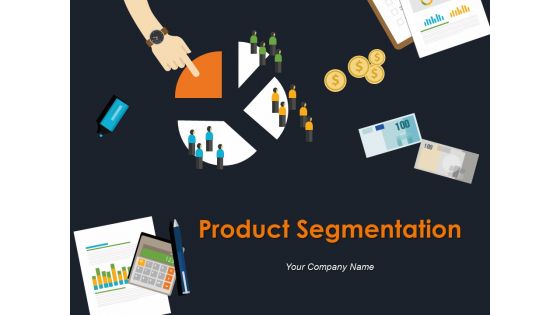
Slide 1: This slide introduces Product Segmentation. State Your Company Name and begin
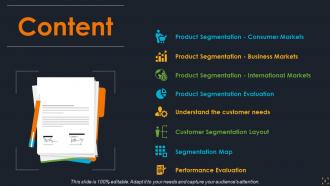
Slide 2: This slide showcases Content with these points - Product Segmentation - Consumer Markets, Product Segmentation - Business Markets, Product Segmentation - International Markets, Performance Evaluation, Customer Segmentation Layout, Segmentation Map, Understand the customer needs, Product Segmentation Evaluation.
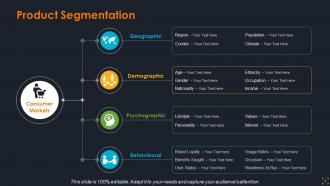
Slide 3: This slide shows Product Segmentation with these of the four characteristics- Demographic, Psychographic, Behavioural, Geographic.
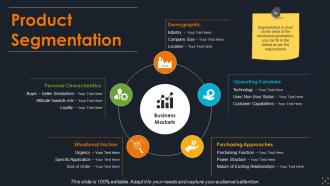
Slide 4: This slide presents Product Segmentation with these criterias we have chosen.Segmentation is done on the basis of the mentioned parameters, you can fill in the details as per the requirements
Slide 5: This slide showcases Product Segmentation – International Markets with these points- Geographic, Economic, Political- Legal, Cultural, Segmentation is done on the basis of the mentioned parameters, you can fill in the details as per the requirements
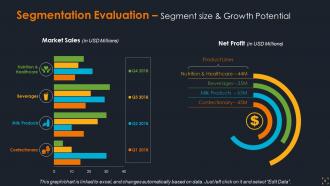
Slide 6: This slide showcases Segmentation Evaluation – Segment size & Growth Potential.
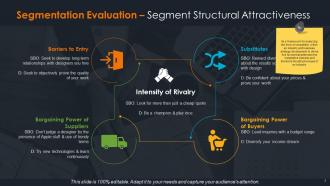
Slide 7: This slide presents Segmentation Evaluation – Segment Structural Attractiveness. Its a framework for analyzing the level of competition within an industry and business strategy development to derive five forces that determine the competitive intensity and therefore the attractiveness of an industry
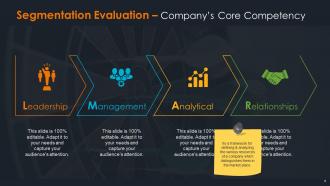
Slide 8: This slide shows Segmentation Evaluation – Company’s Core Competency with these of the factors- Leadership, Management, Analytical, Relationships, Its a framework for defining & analyzing the various resources of a company which distinguishes them in the market place.
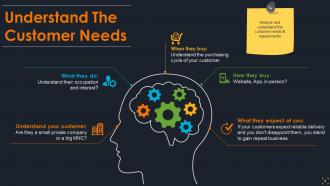
Slide 9: This slide showcases Understand The Customer Needs. With these Analyse and understand the customer needs & requirements
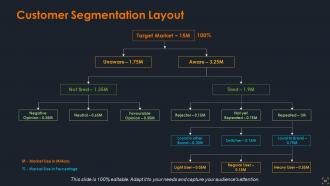
Slide 10: This slide presents Customer Segmentation Layout.
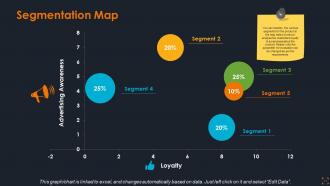
Slide 11: This slide showcases Segmentation Map. You can mention the various segments for the product in the map below to show/ analyse the customers loyalty & awareness about the product. Please note the parameter for evaluation can be changed as per the requirements.
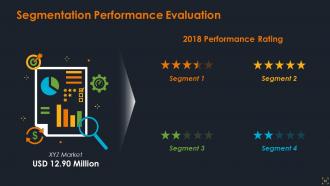
Slide 12: This slide presents Segmentation Performance Evaluation.
Slide 13: Product Segmentation Icon Slide 13
Slide 14: This is a Coffee Break slide to halt. You may change it as per requirement.
Slide 15: This slide is titled Charts & Graphs to move forward.
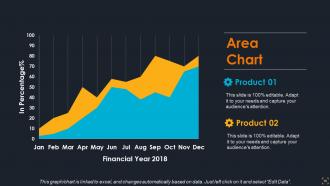
Slide 16: This is an Area Chart slide for product/entity comparison.
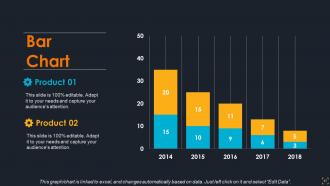
Slide 17: This is a Bar Graph image slide to show product comparison, growth etc.
Slide 18: This slide is titled Additional slides.
Slide 19: This slide contains Our Mission with text boxes.
Slide 20: This slide helps depict Our Team with text boxes.
Slide 21: This slide helps show- About Our Company. The sub headings include- Creative Design, Customer Care, Expand Company
Slide 22: This slide shows Our Goals for your company.
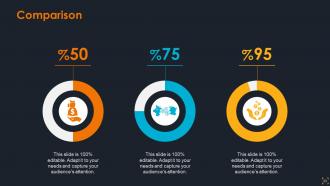
Slide 23: This slide shows Comparison of Positive Factors v/s Negative Factors with thumbsup and thumb down imagery.
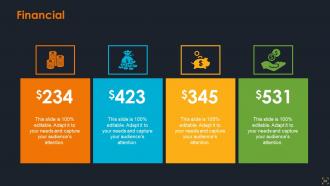
Slide 24: This is a Financial Score slide to show financial aspects here.
Slide 25: This slide shows Target image with text boxes.
Slide 26: This slide presents a Timeline to show growth, milestones etc.
Slide 27: This slide presents a Mind map with text boxes.
Slide 28: This is a Post it slide to mark reminders, events etc.
Slide 29: This is a Bulb/idea image slide to show information, ideas, innovation specific stuff etc.
Slide 30: This is a Thank You slide with Address# street number, city, state, Contact Numbers, Email Address.
Product Segmentation Powerpoint Presentation Slides with all 30 slides:
Tired of yawns at presentation time? Get your audience back in the game with the cutting edge designs of our Product Segmentation Powerpoint Presentation Slides.



FAQs for Product Segmentation
Honestly, segmentation is a game changer for targeting - you stop wasting money on people who'll never buy anyway. Instead of boring generic campaigns, you can actually speak to what different groups care about. Way better engagement when your content feels relevant, you know? Short sentences hit harder sometimes. The conversion rates will thank you later. Oh, and you'll figure out which customer segments are your goldmine so you can focus there. I'd dig into your existing data first - look for patterns in how people behave or basic demographics. That's usually where the obvious groups jump out at you.
Honestly, start by digging into your current customer data - who's buying what, their demographics, all that stuff. Survey them directly about what bugs them and what they actually want. Then look for patterns in how different groups react to your products. Don't go crazy making like 10 different segments though (been there, it's a nightmare). Stick to 3-4 solid groups. Use your analytics to see which segments actually convert and spend real money. The trick is testing your hunches with actual research instead of just winging it. Oh, and definitely start small - validate everything before you dive in headfirst.
Customer behavior is where the magic happens for product segmentation. Look at how different groups actually use your stuff - purchase patterns, how often they're active, which features they love or ignore. Way more valuable than just knowing someone's age or zip code, tbh. You'll spot your power users versus the once-in-a-while buyers pretty quickly. Figure out what makes them tick and where they bail out. Then build segments around those real behaviors instead of guessing. Makes your product decisions and marketing so much cleaner when it's based on what people actually do.
So demographics is basically the obvious stuff - age, income, where they live, gender. Easy to track down. Psychographics gets weird though, it's all about their mindset and values. Like why do they actually buy things? Think about it this way: demographics tell you she's 35, makes $75k, lives in Denver. Cool. But psychographics? That's when you find out she's obsessed with sustainability and won't work past 6pm. Way more useful honestly. I'd grab the demographic data first since it's sitting right there in your analytics, then dig into the psychology stuff to figure out what actually makes them click "buy."
Honestly, Google Analytics is your best starting point - it'll give you the basic demographic stuff without breaking the bank. For deeper user behavior, Mixpanel and Amplitude are solid choices. Don't sleep on simple surveys though (Typeform, SurveyMonkey) - I've seen fancy analytics miss things that a basic "hey, why'd you bounce?" survey catches immediately. If you want advanced segmentation later, Python/R clustering works great, or Segment and HubSpot if coding isn't your thing. Mix the numbers with actual user feedback. Start with just one tool though - trust me on this.
Check conversion rates first - are segments beating your overall average? That's the money question. Customer lifetime value and retention by segment matter too, but honestly don't get obsessed with metrics that just look pretty in reports. What you really want to see is segments actually responding differently to your campaigns. Revenue per segment is obvious but not the whole story. Pick maybe 2-3 metrics that actually tie to your goals and stick with tracking those for at least a quarter. Takes time to spot real patterns vs random noise.
Honestly, the worst thing you can do is go overboard with segments - like, suddenly you have 50 tiny groups your team can't even use. Been there, total mess! Most companies just look at basic demographics too, which is pretty useless. What actually matters is how people behave and what they need from your product. Oh, and here's what kills me - they never check if their segments actually want different things! Test everything with real customer data first. Make sure each group is big enough to justify the extra work, otherwise you're just making life harder for everyone.
Honestly, segmentation is a game-changer for customer happiness. Instead of throwing the same product at everyone, you're actually giving people what they want. Like, premium customers care about totally different stuff than bargain hunters, you know? Once you figure out who's who, you can tweak your messaging and features for each group. Makes people feel like you actually get them. Plus they'll stick around longer since they're not constantly hunting for something better elsewhere. I'd start small though - pick your top 2-3 customer types and see how your products match their biggest headaches.
Product segmentation is a game-changer for pricing strategy. You can charge wildly different amounts for the same basic product by tweaking features or targeting different groups. Software companies are masters at this - they'll charge a startup $50/month but hit enterprises for thousands. Pretty smart if you ask me. The whole point is capturing value from people willing to pay more while still getting the budget-conscious customers. Just don't make your tiers so similar that people always pick the cheap one, or so different that the premium feels like a ripoff.
Don't try to build for everyone at once - that's a recipe for mediocre products that nobody really loves. Pick your main segment first and figure out what actually matters to them. Their budgets, workflows, success metrics are all gonna be different from your other segments. Once you nail that core experience, then you can think about expanding. Maybe that means different pricing tiers, maybe separate features, hell maybe even different products entirely if the gap's too wide. I've watched so many startups add random features thinking it'll magically work for everyone. Spoiler: it won't.
Honestly, seasonal stuff completely changes how you should group products. Customer needs flip throughout the year - think summer skincare bundles or back-to-school tech packages. Your spring strategy? Might bomb during holiday season when everyone wants gift sets. I learned this the hard way watching companies stick to the same segments year-round. Map your sales against calendar events first - you'll spot patterns pretty quick. Then build flexible segments you can switch on when those seasons roll around. Weather and holidays drive way more buying behavior than most people realize.
Look, competitor analysis is huge because it shows you which market gaps you can actually jump into. Check how they're positioning stuff and what customer segments they're targeting - or totally missing. This way you don't waste time fighting in oversaturated areas. Instead, find those underserved spots where you'll actually win. Their messaging and pricing also gives you a solid reality check on your own strategy. I watched one team spend like 3 months going after the exact same segment as major competitors - total disaster. Map out 3-5 key competitors' approaches first, then build yours.
Dude, social media data is so much better than basic demographics for customer segments. Check out engagement patterns - what hashtags they use, who they follow, their comments and shares. Facebook and Instagram insights are seriously underrated for this. You'll find these tiny communities and weird niche interests that regular surveys just can't catch. Real-time sentiment stuff too, which is pretty cool. The trick is mixing this behavioral data with whatever customer info you already have. Makes way richer personas. Oh and definitely start by pulling your followers' engagement data - then group similar interaction patterns together. Trust me on this one.
Honestly, tons of companies nail this. Netflix figures out what you actually watch and suggests stuff you'll like. Nike's smart about it too - they segment by sport and skill level, plus Jordan is basically its own thing at this point. Marriott does budget hotels all the way up to fancy ones under different names. Even Apple gets it - iPhone SE for people who don't want to spend a fortune, Pro models for the tech nerds. The trick is watching how people actually use your stuff differently, then giving each group what they want instead of some boring one-size-fits-all approach.
Your customer segments need to shift as your product moves through its lifecycle - it's not a set-it-and-forget-it thing. Early on, you're chasing innovators who'll pay premium prices. Growth phase opens up broader markets since people actually know what you're selling now. Maturity gets weird though - suddenly you're fighting commoditization and scrambling for niches. By decline, just focus on whoever's still buying and making you money. Most companies screw this up by sticking with the same segments forever. I've seen it happen so many times. You gotta reassess regularly and pivot your targeting as things change.
-
Amazing product with appealing content and design.
-
Easily Understandable slides.