


Project scope management ppt clipart




Try Before you Buy Download Free Sample Product
 Impress Your
 Audience
 100%
100% Editable
 Save Hours
 of Time


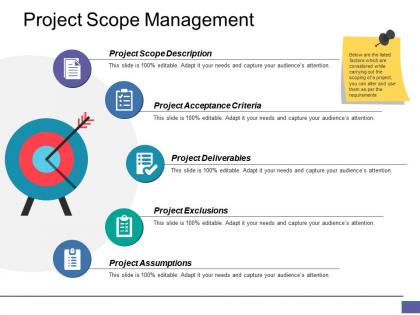
Hand them the baton with our Project Scope Management Ppt Clipart. They will begin with a big advantage.
People who downloaded this PowerPoint presentation also viewed the following :
Project scope management ppt clipart with all 5 slides:
Counsel folks to join hands with our Project Scope Management Ppt Clipart. Elaborate on the immense benefits of cohesion.



FAQs for Project scope
So basically you've got four main pieces: scope planning, definition, verification, and change control. First thing - nail down what's actually included and what isn't. Create a detailed work breakdown structure too. This is honestly where I've seen most projects completely fall apart. You'll want to constantly check deliverables against your original requirements. Oh, and set up a bulletproof change control process because scope creep is absolutely brutal on budgets. I learned that one the hard way! Bottom line: document everything and get stakeholders to sign off at every single phase.
First thing - nail down exactly what you're delivering with a solid scope statement. Break everything into smaller pieces using a work breakdown structure, and get your stakeholders to document their requirements early. Honestly, assumptions will destroy you every single time. Make sure you're super clear about what's NOT included too - that part's almost more important. Get everyone to actually sign off on the baseline scope before you do anything else. It's basically your only defense when people start asking for "just one more thing" halfway through.
Honestly, your stakeholders are the ones who decide if your project actually succeeds or not. Get them involved from day one - they'll tell you what they really need and help you set realistic boundaries. I learned this the hard way after building something completely useless once because I skipped this step! Map out who has real influence over your scope first. Then set up regular check-ins with them throughout the project. Trust me, it's way better than dealing with endless scope creep later. Oh, and don't forget the quiet stakeholders - they sometimes have the most important input.
Watch out for any work that wasn't in your original plan - that's your first red flag right there. I always set up regular check-ins now because those "quick additions" mentioned in hallway chats will absolutely destroy you (trust me on this one). Make change requests go through a formal process where you evaluate time, cost, and resources before saying yes. Document everything and show stakeholders exactly how their "small tweaks" affect timeline and budget. Oh, and catch those tiny additions early before they turn into a complete project nightmare. Being proactive beats scrambling later every single time.
Break your project into smaller chunks first - that's the bottom-up approach and honestly it's saved me so many times. Then estimate each piece separately and add it all up. Three-point estimation is clutch too - figure out your best case, worst case, and realistic scenarios. Oh, and if you've done anything similar before, definitely use that data as a starting point. That's analogous estimation. I'd run at least two different methods and see how they compare. Sometimes the numbers surprise you. Start with breaking down the work first, then apply whichever techniques make sense for your timeline and resources.
So basically, your project charter is like getting the green light and budget - pretty high-level stuff. But the scope statement? That's where you get into the weeds about what you're actually building. Charter might just say "new website," but your scope statement breaks down every single feature, what's included, what's definitely NOT included (this part saves your butt later), acceptance criteria, all that detailed stuff. I mean, the charter gets you permission to start, but honestly you can't plan jack without a solid scope statement. Use the charter for executive buy-in, then hammer out your scope statement before you touch any real work.
Ugh, scope creep is the absolute worst - stakeholders always want "just one tiny thing" added halfway through. You'll also deal with teams that don't talk to each other and timelines that make zero sense. Plus everyone disagrees on what's actually important. Resource constraints? Yeah, good luck doing twice the work with half the budget. Honestly, the only thing that saved me was writing everything down and making people sign off on changes. Oh, and schedule regular meetings to review scope changes - otherwise stuff just sneaks in through random hallway conversations and suddenly your project is completely different.
So WBS is basically taking your messy project and chopping it into actual manageable chunks. Think family tree but for work stuff - weird analogy but trust me on this. You start with the big deliverables, then keep breaking those down until you've got specific tasks someone can actually do. Honestly, it saves you from that nightmare where everyone's confused about what they're supposed to deliver. Plus you'll spot the gaps way earlier instead of scrambling later. Makes estimating time so much easier too.
Start with talking to people - stakeholder interviews, workshops, surveys work great. Also dig through any existing docs you can find. MoSCoW method is solid for prioritizing (Must have, Should have, etc.) or try weighted scoring matrices. User story mapping is honestly my favorite though - makes the whole customer journey way clearer. Don't prioritize stuff alone! Get your stakeholders involved in the process. I'd say kick things off with a requirements session this week. Get everyone together and figure out what's actually critical vs just nice-to-have features.
So basically change management is your lifeline when scope starts getting crazy. It gives you a real process to handle scope changes instead of just winging it. You'll evaluate requests, do impact assessments, and get proper approvals before anything gets added. Trust me, this stops stakeholders from throwing in random "quick features" halfway through - the worst! Document everything: why the scope changed, what it'll cost you, who approved it. Oh and definitely set up your change control board right away. Make the process crystal clear so people know how to actually request changes properly.
Honestly, these tools are lifesavers for keeping projects from going completely sideways. They show you exactly what's in scope vs what people *think* they agreed to - saves you from those super awkward "wait, that wasn't part of the deal" conversations. You can track changes, document everything properly, and spot scope creep before it wrecks your timeline. The automated approval workflows are clutch too since you won't be hunting people down for sign-offs. Oh, and just pick whatever plays nice with your current PM setup - no point making life harder than it needs to be.
Dude, unclear scope is basically team poison. Your developers end up redoing work constantly because nobody knows what they're actually supposed to build. Deadlines get missed left and right. People burn out fast when they feel like they're just spinning their wheels all day - and honestly, can you blame them? Everyone starts second-guessing decisions while waiting around for answers to basic questions. Plus collaboration goes to hell when the team has totally different ideas about what "finished" even means. Spend the extra time upfront getting your scope nailed down. Trust me on this one.
Oh man, this stuff trips up so many teams. Japanese clients might think certain deliverables are obvious without saying them outright, but Germans? They want every single detail written down. Some cultures see scope changes as just part of how projects evolve naturally - others think you screwed up the planning if anything shifts. I've watched entire projects go sideways because everyone had totally different ideas of what "done" actually looked like. My advice? Talk way more than feels necessary during scope planning. Use mockups or prototypes too since those cut through language barriers better than endless documentation.
Track how much your scope expanded past the original plan - that's your scope creep percentage right there. Change requests are telling too: how often they come in, approval rates, processing time. Budget and timeline variances show the real damage from scope issues. But honestly? Don't sleep on stakeholder satisfaction scores. Those numbers reveal if you're actually managing expectations or just fooling yourself. I'd check these monthly - you'll start seeing patterns pretty quick. Oh, and scope problems almost always mess with delivery dates, so that's another dead giveaway when things go sideways.
Definitely dig through your old projects - that's where the real lessons are. I keep this random spreadsheet of everything that went wrong and honestly? Best decision ever. Check where scope creep hit you hardest and which stakeholders went rogue. Those requirements meetings that totally flopped are gold mines too. Communication screwups usually cause most of the chaos anyway. Build what you learn into your next project upfront - better scope docs, tighter change processes. Trust me, you'll feel like a genius when someone tries pulling the same stuff and you're already ready for it.
-
Content of slide is easy to understand and edit.
-
Awesome presentation, really professional and easy to edit.