

Quantitative Monetary Policy Tools Of Central Bank




Try Before you Buy Download Free Sample Product
 Impress Your
 Audience
 100%
100% Editable
 Save Hours
 of Time


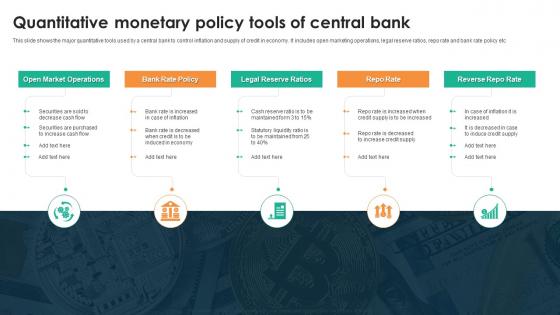
This slide shows the major quantitative tools used by a central bank to control inflation and supply of credit in economy. It includes open marketing operations, legal reserve ratios, repo rate and bank rate policy etc
People who downloaded this PowerPoint presentation also viewed the following :
Quantitative Monetary Policy Tools Of Central Bank with all 6 slides:
Use our Quantitative Monetary Policy Tools Of Central Bank to effectively help you save your valuable time. They are readymade to fit into any presentation structure.





FAQs for Quantitative Monetary Policy Tools
So QE kicks in when regular interest rate cuts can't work anymore - like when rates are already at zero. Central banks basically buy tons of bonds to flood the system with cash instead of just tweaking short-term rates. Pretty wild stuff, honestly. The whole point is pushing down long-term rates and getting asset prices up so banks lend more and people spend more. It's way more aggressive than normal monetary policy. Oh, and whenever you see "unconventional monetary policy" in headlines? That's usually just fancy talk for QE programs.
So QE basically floods the market with cash - central banks buy massive amounts of bonds, which pushes bond prices up and yields down. Borrowing gets way cheaper for everyone. Companies expand, people refinance or buy houses, and spending goes up since you're earning almost nothing on savings (which honestly sucks if you're trying to save). But that's the whole point during recessions - get people spending again. Oh, and for your portfolio? Stock prices usually rise because bonds become less appealing and companies can borrow cheap money to grow. It's pretty predictable once you get how it works.
Yeah so basically QE pumps tons of money into the system, which usually drives prices up - classic supply and demand thing. Central banks watch their inflation targets like hawks and can slam the brakes by hiking rates or selling bonds back. Though honestly, it's like steering a cruise ship with a paddle sometimes. They also do this "forward guidance" thing where they basically hint at what they're planning so markets don't freak out. Pro tip: when you hear talk about "tapering" QE programs, that's your cue they're getting nervous about inflation.
So basically, QE works because central banks buy up tons of bonds and securities - that's how they pump new money into the system. The Fed creates fresh cash and dumps it straight onto bank balance sheets. Interest rates drop everywhere, banks start lending more (in theory anyway). Size really matters here. Small purchases? Whatever. But those massive programs during 2008 and COVID? Total game changers. Pay attention to what they're actually buying too - there's a difference between government bonds and corporate debt in terms of where that money ends up flowing.
Dude, QE basically floods markets with cheap cash, which sends stocks flying. Bond yields hit rock bottom, so everyone rushes into riskier stuff for decent returns. You've seen how markets jump whenever Powell even hints at more stimulus, right? It's wild - sometimes bad economic news actually pumps stocks because traders know it means more money printing is coming. Don't get me wrong, it works for boosting markets short-term. But we're talking serious bubble territory here, plus it mainly helps people who already own assets. Things can flip fast when they start pulling back though.
QE for too long messes things up in weird ways. All that cheap money creates bubbles - stocks, housing, bonds all get pumped up way past what they're actually worth. Companies that should've died years ago stay alive just because borrowing costs nothing (looking at you, zombie corps). Meanwhile savers get totally screwed while rich people who own assets make bank. The scary part? Markets get hooked on this stuff like it's crack. When central banks finally try to pull back, it's gonna hurt. Also, corporate debt is absolutely insane right now - that's probably the thing I'd worry about most.
Yeah so basically QE floods the market with new money, which weakens your currency. Central banks create cash to buy bonds, boosting liquidity and dropping interest rates - investors hate that combo. The dollar tanked during our post-2008 QE rounds, no surprise there. Weaker currency means your exports get cheaper and more competitive, but imports cost more for regular people. Trade balances will shift around. Here's the weird part though - if everyone's doing QE at once, the effects kinda cancel out. Worth watching what other countries' central banks are up to.
So basically, the Fed kept it simple during crises - just bought government bonds and mortgage stuff. ECB had to do way more weird things because Europe's complicated, you know? They bought corporate bonds, went negative on rates, lent directly to banks. Japan though... they went totally nuts. Bought everything including ETFs, stayed negative for years, just massive scale. Honestly the BOJ was by far the most extreme and longest-running. When you're looking at QE impacts, scale and how long they kept it up is what really matters - that's where you see the biggest differences between all three.
Yeah, QE makes inequality worse for sure. Rich people own stocks and real estate, so when the Fed buys bonds and rates drop, their assets go crazy. Meanwhile wages barely budge. You're working the same job making the same money while some guy's stock portfolio doubles. Housing gets more expensive too - great if you already own, terrible if you're trying to buy. It's honestly pretty messed up how unevenly this stuff works. The whole thing basically helps people who already have money while everyone else just watches from the sidelines.
So there's basically three ways central banks unwind QE without totally freaking out markets. They can just let bonds mature naturally and not buy new ones - that's the gentle approach. Or they actively sell stuff back, but slowly. Smart ones raise rates first though, kinda like warming people up to the idea. Honestly, the communication part is way more crucial than the actual method. Fed officials basically spoonfeed the market their plans months ahead because traders lose their minds over surprises. Most successful unwinds mix gradual selling with crystal clear messaging about what's coming next. Watch Fed speeches religiously - they'll telegraph moves pretty obviously once you know what to look for.
Dude, public perception is huge for QE success. People invest and spend more when they believe it'll actually work - becomes a self-fulfilling thing. But here's the problem: if everyone thinks it's just "money printing" to help rich people, politicians freak out and pressure the Fed to back off. Markets are weird about it too - they're trying to decode what QE signals about how screwed the economy really is. The Fed spends so much time crafting their messaging, it's almost comical. When you're looking at QE policies, definitely check sentiment data alongside the boring technical stuff.
Hey! So QE is kinda complicated - the results are all over the place honestly. After 2008 it definitely helped bring down long-term rates and pumped up asset prices, probably saved us from something way worse. Japan had decent luck with it recently too. But here's the annoying part: stock markets loved it while regular people saw wages and jobs improve super slowly. It works better as an emergency brake than something you'd use when the economy's just cruising along normally. Hope that helps with whatever you're working on!
Yeah so there's a bunch of other options besides QE. Negative interest rates are one - Japan and Europe tried that but it kinda screws over banks and anyone with savings. Forward guidance is when central banks just promise to keep rates low, which works if people actually believe them. Helicopter money is probably the coolest name - it's literally just giving cash directly to people. Results are all over the place though. QE seems to work better during actual crises, while the guidance thing is decent for regular times. You should probably check out what different countries did and when, because timing matters way more than I initially thought it would.
Back in 2008-2010, QE announcements were like rocket fuel for markets. Stocks would shoot up, bonds would rally hard whenever Bernanke even whispered about more stimulus. Those were honestly the golden days of "don't fight the Fed." But after a few rounds? Markets got bored. QE became expected instead of this emergency shock treatment. The pops got smaller and traders started caring more about the actual economic data. Now when you're trading Fed announcements, don't just wait for the old automatic bounce - dig into their forward guidance instead. That's where the real moves happen these days.
So basically QE dumps tons of cheap money everywhere, which forces people into riskier stuff since bonds pay nothing. Stock prices get crazy inflated. Real estate goes nuts. Everyone's just buying whatever because they have to put their money somewhere - honestly it's kind of absurd. Picture musical chairs but with way too much cash chasing decent investments. Problem is when QE stops or rates go up, everything can crash hard. Like 2008 housing mess all over again. Just watch your P/E ratios and don't get too leveraged up when things look bubbly.
-
I really liked their customized design services. I got my desired template made by their expert team. Thank You!
-
SlideTeam is my one-stop destination for templates. Highly recommended!