

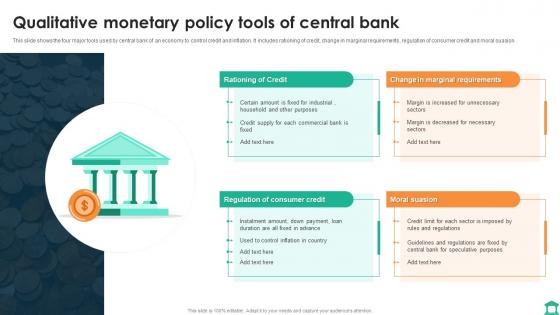
Qualitative Monetary Policy Tools Of Central Bank




Try Before you Buy Download Free Sample Product
 Impress Your
 Audience
 100%
100% Editable
 Save Hours
 of Time


This slide shows the four major tools used by central bank of an economy to control credit and inflation. It includes rationing of credit, change in marginal requirements, regulation of consumer credit and moral suasion
People who downloaded this PowerPoint presentation also viewed the following :
Qualitative Monetary Policy Tools Of Central Bank with all 6 slides:
Use our Qualitative Monetary Policy Tools Of Central Bank to effectively help you save your valuable time. They are readymade to fit into any presentation structure.





FAQs for Qualitative Monetary Policy Tools
So basically qualitative monetary policy is when the Fed gets picky about where banks lend money. Instead of changing interest rates for everyone, they'll target specific stuff - like telling banks to chill on risky real estate loans or setting margin requirements for stock buying. It's pretty smart actually, since you can pop a housing bubble without screwing over the whole economy. Way better than using a sledgehammer when you need tweezers, you know? Next time banks get "guidance" about certain sectors, that's this tool at work.
So central banks basically play mind games with markets through what they say, not just what they do. Like the Fed will drop hints in speeches or meeting notes - "we're thinking about raising rates soon" - without actually pulling the trigger yet. Their dot plot thing is perfect for this. They also pressure banks behind the scenes to change behavior without making it official policy. Honestly, it's all psychological warfare. You gotta watch their language super closely because sometimes a random comment from a Fed chair moves markets more than actual rate changes do.
Dude, communication is like 90% of how central banks actually get stuff done with their softer policy tools. The Fed puts out those dot plots? They're trying to mess with your head about where rates are going so you'll make different choices NOW. Forward guidance works the same way - they hint at future moves to shape current behavior without doing anything yet. It's weird but the words often pack more punch than the actual policy changes. Like when Powell speaks, markets move before any rates actually shift. Honestly, following what they SAY is sometimes more important than what they DO. Keep an eye on their messaging - that's where the real signals are.
Yeah definitely! WWII is probably your best bet - the Fed basically told banks to stop lending for cars and stuff so money went to war production instead. Worked pretty well too. Japan did something similar in the 70s-80s with their "window guidance" thing where they'd give banks these lending quotas that weren't technically mandatory but... you know, they were. China's been doing it more recently with housing - they'll mess with loan ratios by sector to cool things down. Honestly the WWII example has the most research behind it, so I'd start there if you're digging into this stuff.
So the Fed basically talks markets into doing what they want without changing rates. Pretty clever, right? Forward guidance reduces uncertainty - companies invest more, people spend more freely. When Powell says "we're staying dovish through 2024," markets react immediately even though nothing's actually changed yet. It's all psychological warfare with economics. Honestly, I think Fed speeches move prices way more than people realize. The communication strategy signals their commitment to whatever outcome they want. Don't just watch rate decisions - their press conferences and random comments can shift sentiment just as much.
Honestly, it's super tricky because you can't just look at hard numbers like interest rates. These policies work through psychology and market vibes - stuff that's impossible to pin down precisely. How do you measure "confidence" anyway? It's like trying to figure out if your manager's disappointed face actually makes people work harder lol. Plus there's always other economic stuff happening at the same time, so good luck isolating what's actually working. I'd probably use a mix of things - surveys, market sentiment data, maybe some behavioral metrics. No single measure will tell you everything though.
So during crises, central banks usually hit the big quantitative stuff first - massive rate cuts, QE programs, whatever gets immediate market impact. But they're also doing qualitative things at the same time, like forward guidance to manage expectations and those targeted lending facilities when specific markets break down. The qualitative tools are kind of like the steering wheel while the quantitative ones are the engine power. What they emphasize really depends on what's actually broken. Liquidity crunch? You'll see more targeted credit programs with the rate cuts. Honestly, the sequencing is pretty fascinating to watch unfold.
So here's the thing - countries with less mature banking systems usually have to be way more heavy-handed. They'll slam down strict loan-to-value caps, tell banks exactly which sectors to lend to (think infrastructure, agriculture), stuff like that. Meanwhile developed economies can be all subtle about it - forward guidance, stress tests, fancy macroprudential buffers. Their markets actually listen to hints, you know? It's basically sledgehammer vs scalpel approach. Really depends on how sophisticated your country's financial system is. The more developed the markets, the gentler you can be with policy tools.
So forward guidance is when the Fed basically gives everyone a preview of their interest rate plans. Pretty smart move honestly - markets hate surprises. If they say rates will stay low for months, people feel safer making big purchases or investments now instead of sitting on cash. This trick becomes huge when rates hit zero and the Fed's out of normal options. You should definitely watch their meeting statements though, because even hints about future moves can send markets crazy before anything actually changes. Way more dramatic than you'd expect!
So basically qualitative monetary policy is when central banks get surgical instead of just cranking interest rates up and down. They'll target specific sectors that are getting crazy - like adjusting margin requirements or loan-to-value ratios for housing when there's a bubble forming. Way smarter than nuking the whole economy, honestly. Corporate borrowing gets out of hand? They can set lending guidelines just for that sector. It's pretty clever actually - you can cool down overheated markets without screwing over everyone else. Much better than the old sledgehammer approach of rate changes across the board.
Honestly, government backing makes qualitative tools way stronger - banks actually listen when there's real enforcement behind the suggestions. It's like having your boss back you up on a difficult ask, you know? But here's the thing - too much intervention screws everything up. Creates weird market distortions and banks stop self-regulating altogether. The magic happens when regulators and central banks coordinate without getting in each other's way. Also timing matters big time - you don't want regulatory announcements clashing with your monetary policy moves. There's definitely a sweet spot here, just gotta find it.
Basically, you want to see if these policies still work without screwing you over later. Markets catch onto central bank patterns fast - they're not stupid. So check if your forward guidance or credit controls are actually changing behavior after you've used them a bunch. Watch out for asset bubbles or weird market distortions that'll come back to haunt you. Are you creating some kind of addiction to intervention? That's bad news. Make sure the policies don't clash with your other economic goals or piss off politicians enough that they mess with your independence. Run some stress tests and keep an eye on whether your transmission mechanisms are holding up over time.
So the big thing here is **credit channel theory** - you're basically targeting specific types of lending instead of just cranking interest rates around. Way more precise than the usual approach. Banks use this when they want to cool off housing bubbles or get small businesses more credit without messing with the entire economy. Works through changing how banks think about lending and risk, not just making money cheaper or more expensive. Honestly, it's pretty smart when regular rate cuts aren't working. Though I guess it requires banks to actually play along, which... yeah, good luck with that sometimes.
So basically, qualitative tools make central banks way more chatty with the public. Before, they'd just mess with interest rates quietly. Now you get "forward guidance" where they actually tell you their plans ahead of time. They also do this thing called moral suasion - fancy term for basically pressuring banks through public speeches and statements. Pretty wild how much they focus on managing what people expect to happen. What this means for you? You've gotta watch what they say just as much as what they actually do. Their words move markets now too.
Dude, qualitative indicators are seriously underrated for monetary policy. They pick up on stuff the hard numbers miss - like how confident businesses actually feel or whether people are genuinely worried about spending. The Fed's Beige Book is perfect for this, plus all those regional surveys and anecdotal reports. GDP and inflation data are great, but honestly? These softer signals usually show you where things are headed before it hits the official stats. That's why I always dig into FOMC minutes - you'll see how much weight they put on this stuff when making rate decisions.
-
Very unique and reliable designs.
-
Crisp and neat slides. Makes it fun and easier to curate presentations.