


Role And Functions Of Central Bank In Economic Development




Try Before you Buy Download Free Sample Product
 Impress Your
 Audience
 100%
100% Editable
 Save Hours
 of Time


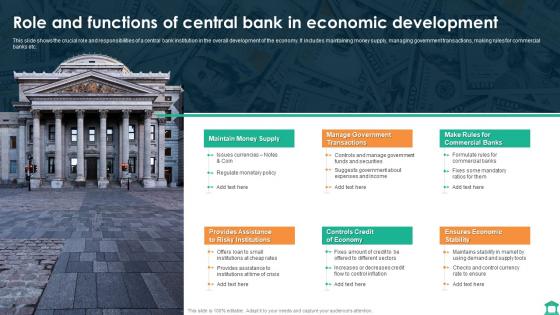
This slide shows the crucial role and responsibilities of a central bank institution in the overall development of the economy. It includes maintaining money supply, managing government transactions, making rules for commercial banks etc.
People who downloaded this PowerPoint presentation also viewed the following :
Role And Functions Of Central Bank In Economic Development with all 6 slides:
Use our Role And Functions Of Central Bank In Economic Development to effectively help you save your valuable time. They are readymade to fit into any presentation structure.





FAQs for Role And Functions Of Central Bank
Central banks perform monetary policy implementation, currency issuance, banking system regulation, financial stability maintenance, and government banking services. These institutions enhance economic stability by controlling inflation, managing interest rates, and supervising commercial banks, with many countries finding that effective central banking delivers price stability, sustainable growth, and crisis resilience in increasingly interconnected global markets.
Central banks influence interest rates through monetary policy tools like adjusting the federal funds rate, conducting open market operations, and setting reserve requirements for commercial banks. These mechanisms directly impact borrowing costs across the economy, enabling central banks to stimulate growth during recessions or cool inflation during expansion periods, ultimately maintaining economic stability and supporting sustainable financial conditions.
Central banks formulate monetary policy by setting interest rates, controlling money supply, managing inflation targets, and regulating currency stability through various financial instruments. These institutions enable economic stability by influencing borrowing costs, employment levels, and price growth, with many economies finding that strategic monetary adjustments ultimately deliver sustainable growth and competitive market conditions.
Central banks manage inflation through monetary policy tools including interest rate adjustments, open market operations, reserve requirements, and quantitative easing measures. These mechanisms work by controlling money supply and credit availability, with institutions like the Federal Reserve and European Central Bank finding that strategic rate changes, bond purchases, and banking regulations effectively stabilize prices while supporting economic growth.
Central banks significantly impact currency stability and exchange rates through monetary policy adjustments, foreign exchange interventions, interest rate modifications, and reserve management strategies. Through these mechanisms, institutions like the Federal Reserve and European Central Bank influence capital flows, investor confidence, and trade balances, while maintaining price stability, ultimately delivering economic predictability and competitive positioning in increasingly interconnected global markets.
Central banks respond to economic crises through monetary policy adjustments, emergency lending programs, quantitative easing, currency interventions, and financial system stabilization measures. These coordinated approaches enable institutions to restore market confidence, maintain liquidity flows, and support economic recovery, with many economies finding that swift central bank intervention ultimately delivers faster stabilization and enhanced financial resilience.
Central bank independence enhances effectiveness by enabling monetary policy decisions based on economic data rather than political pressures, reducing inflation bias, and maintaining credibility with financial markets. Independent central banks, like the Federal Reserve and European Central Bank, can implement unpopular but necessary measures during economic downturns, ultimately delivering more stable currencies, lower long-term interest rates, and sustained economic growth.
Central banks serve as regulators, supervisors, and lenders of last resort to commercial banks, while also setting monetary policy that directly influences commercial banking operations through interest rates, reserve requirements, and lending standards. This relationship enables central banks to maintain financial stability and control money supply, while commercial banks benefit from regulatory guidance, emergency funding access, and clear operational frameworks, ultimately delivering safer banking systems and more stable economic conditions.
Central banks ensure financial system stability by regulating commercial banks, monitoring systemic risks, and serving as lenders of last resort during crises. Through comprehensive oversight, reserve requirements, and liquidity management, they enable banks to maintain adequate capital buffers while minimizing defaults, ultimately delivering enhanced market confidence and protecting depositors across the banking sector.
Quantitative easing implications include increased money supply, lower interest rates, asset price inflation, currency devaluation, and enhanced market liquidity. While this monetary policy stimulates economic growth and supports financial markets during downturns, it also presents challenges like wealth inequality and potential bubbles, with many economies finding that strategic implementation ultimately delivers recovery momentum and competitive positioning.
Central banks regulate money supply through open market operations, reserve requirements, discount rates, and quantitative easing measures. These monetary policy tools enable central banks to influence liquidity by purchasing or selling government securities, adjusting bank reserve ratios, and setting lending rates, ultimately delivering economic stability and inflation control across financial markets.
Central banks maintain financial confidence through transparent monetary policy communication, consistent interest rate decisions, effective crisis management, and robust regulatory oversight of financial institutions. These actions reassure consumers and investors by demonstrating stability and predictability, with clear policy guidance and prompt responses to economic uncertainties ultimately fostering trust in the broader financial system.
Central bank policies in developed countries typically focus on fine-tuning inflation targets and maintaining financial stability, while developing countries prioritize exchange rate stabilization, capital flow management, and broader economic development goals. Developed economies like the US and EU emphasize monetary transmission through sophisticated financial markets, whereas emerging markets often face greater volatility and structural constraints, ultimately requiring more direct intervention tools and flexible policy frameworks to balance growth with stability.
Central banks face challenges including managing inflation volatility, navigating complex monetary policy transmission, addressing digital currency disruption, maintaining financial stability across interconnected markets, and balancing domestic priorities with global economic pressures. These evolving dynamics require increasingly sophisticated approaches to policy coordination, with many institutions finding that traditional tools must be enhanced through real-time data analytics and international cooperation to deliver effective economic stability.
Central bank communication shapes market expectations by providing forward guidance on monetary policy, signaling future interest rate changes, and explaining economic assessments through speeches, reports, and press conferences. These strategic communications enable financial institutions, investors, and businesses to make informed decisions about lending, investment, and risk management, ultimately reducing market volatility and enhancing economic stability.
-
Great quality product.
-
This visual representation is stunning and easy to understand. I like how organized it is and informative it is.