


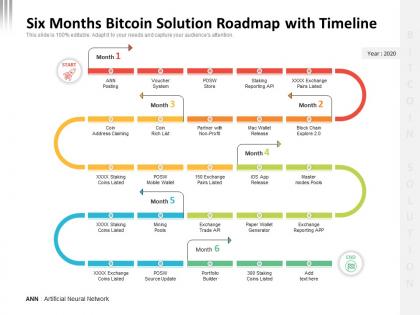
Six months bitcoin solution roadmap with timeline




Try Before you Buy Download Free Sample Product
 Impress Your
 Audience
 100%
100% Editable
 Save Hours
 of Time


A well thought out action plan makes execution easier and increases the possibility of success significantly. Ensure hitting all the milestones within the deadlines by introducing our fully customizable Six Months Bitcoin Solution Roadmap With Timeline. Streamline the work related information, budget, timeframe, key deliverable, landmarks, and major steps involved, all in one place to give an organized overview of the project by utilizing our PowerPoint theme. Minimize time lag and increase work efficiency by providing insight into the process with our comprehensively researched roadmap PowerPoint layout. Color coding helps in highlighting the process and grabs the attention of the audience. Download our handy Six Months Bitcoin Solution Roadmap With Timeline to identify the possible problem areas in a much shorter time and propose solutions. Have a productive brainstorming session with your workforce by utilizing our action plan visualization tool.
People who downloaded this PowerPoint presentation also viewed the following :
Six months bitcoin solution roadmap with timeline with all 2 slides:
Use our Six Months Bitcoin Solution Roadmap With Timeline to effectively help you save your valuable time. They are readymade to fit into any presentation structure.

FAQs for Six months bitcoin solution
Bitcoin's key milestones include the 2009 genesis block creation, 2010's first commercial transaction, 2017's SegWit activation, 2021's Lightning Network expansion, and 2024's institutional adoption surge. These developments have transformed Bitcoin by enhancing scalability, reducing transaction costs, and improving mainstream accessibility, with financial institutions increasingly finding that Bitcoin delivers portfolio diversification and inflation hedging capabilities in today's volatile economic landscape.
Bitcoin's scalability challenges limit transaction speed and increase costs, creating barriers for mainstream adoption and everyday use cases. However, these limitations drive innovation through Layer 2 solutions like Lightning Network, sidechains, and protocol upgrades, with many financial institutions and payment processors finding that hybrid approaches enable faster transactions while maintaining security, ultimately positioning Bitcoin for broader commercial viability.
Bitcoin protocol upgrades focus on enhanced cryptographic security, transaction privacy, and network resilience through implementations like Taproot, Schnorr signatures, multi-signature improvements, and Lightning Network integration. These upgrades streamline validation processes, minimize transaction costs, and strengthen against quantum computing threats, with many financial institutions finding that enhanced security protocols ultimately deliver greater institutional adoption and regulatory compliance advantages.
Bitcoin forks influence the ecosystem by creating alternative protocols, testing new features, driving innovation through competition, and expanding use cases across different market segments. While hard forks like Bitcoin Cash and Bitcoin SV have sparked debate, they ultimately accelerate technological experimentation and development, with many blockchain projects finding that fork-driven innovation enhances scalability solutions and adoption strategies.
The Lightning Network serves as Bitcoin's primary scaling solution, enabling instant, low-cost transactions through off-chain payment channels while maintaining blockchain security. This second-layer technology addresses Bitcoin's transaction throughput limitations, with many financial institutions and payment processors finding that it enables micropayments, enhances user experiences, and ultimately delivers the scalability necessary for mainstream adoption.
Regulatory changes significantly influence Bitcoin's development trajectory by shaping adoption rates, institutional investment flows, and technological priorities across global markets. While restrictive regulations in countries like China redirect development focus toward privacy and decentralization features, progressive frameworks in nations like El Salvador and Switzerland accelerate mainstream integration efforts, ultimately creating a diverse, resilient ecosystem that adapts to varied regulatory landscapes.
Bitcoin halving events, occurring approximately every four years, reduce mining rewards by half, historically creating supply scarcity that drives price appreciation. These events fundamentally reshape the ecosystem by forcing less efficient miners to exit, consolidating network security among stronger operators, while institutional investors increasingly view halvings as predictable catalysts for long-term value accumulation.
Bitcoin's roadmap emphasizes security and decentralization through gradual improvements like Lightning Network and Taproot, while other cryptocurrencies like Ethereum focus on rapid innovation with smart contracts, proof-of-stake transitions, and DeFi capabilities. This creates a strategic balance where Bitcoin delivers stability and store-of-value functionality, while altcoins enable faster transaction processing and programmable features, with many institutions finding that diversified crypto portfolios leverage both approaches.
Bitcoin energy efficiency improvements include the Lightning Network for off-chain transactions, Proof-of-Stake consensus exploration, renewable energy mining initiatives, more efficient ASIC hardware, and carbon offset programs. These advancements streamline energy consumption by reducing on-chain transaction loads, optimizing mining operations, and promoting sustainable practices, with many mining facilities increasingly adopting solar and wind power to deliver competitive advantages while addressing environmental concerns.
Bitcoin's integration with DeFi platforms can revolutionize digital finance by enabling smart contracts, yield farming, liquidity pools, and cross-chain functionality through Layer 2 solutions and wrapped Bitcoin protocols. This strategic combination streamlines financial services, enhances accessibility, and delivers programmable money capabilities, with many financial institutions finding that Bitcoin-DeFi integration ultimately provides competitive advantages in an increasingly decentralized landscape.
Bitcoin's development governance models include developer consensus through Bitcoin Improvement Proposals (BIPs), miner signaling mechanisms, user-activated soft forks, and multi-stakeholder coordination between core developers, miners, and node operators. These decentralized approaches enable transparent protocol evolution while maintaining network security and consensus, with many blockchain organizations finding that distributed governance models ultimately deliver greater resilience and community trust than centralized alternatives.
Bitcoin's roadmap addresses privacy and data security through enhanced encryption protocols, second-layer solutions like Lightning Network, and improved wallet security features. These developments enable more private transactions, reduced on-chain footprints, and stronger user control over personal data, with many financial institutions finding that these privacy enhancements deliver greater regulatory compliance and customer trust.
Key partnerships include institutional adoption by banks like JPMorgan, government collaborations for regulatory frameworks, mining partnerships with renewable energy companies, and integration with payment processors like PayPal and Visa. These strategic alliances streamline Bitcoin's mainstream acceptance by enhancing regulatory clarity, improving environmental sustainability, and expanding accessibility, with many financial institutions finding that collaborative approaches ultimately deliver greater market stability and consumer confidence.
Bitcoin's roadmap is adapting through enhanced privacy features, improved scalability solutions like the Lightning Network, and stronger decentralization protocols to differentiate from centralized CBDCs. While CBDCs offer government backing and regulatory compliance, Bitcoin developers are emphasizing censorship resistance, global accessibility, and financial sovereignty, with many institutions finding that Bitcoin's programmable, borderless nature delivers unique value propositions that complement rather than compete directly with state-controlled digital currencies.
Market trends and investor sentiment significantly influence Bitcoin's roadmap through community-driven governance, developer funding priorities, and upgrade timing considerations. While bear markets often accelerate technical development focused on scalability and efficiency improvements, bull markets emphasize user experience enhancements, with many blockchain organizations finding that balancing long-term technical goals with market expectations ultimately delivers sustainable adoption and competitive positioning.
No Reviews