


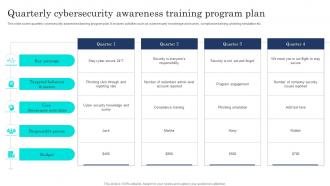
Quarterly Cybersecurity Awareness Training Program Plan





Try Before you Buy Download Free Sample Product
 Impress Your
 Audience
 100%
100% Editable
 Save Hours
 of Time


This slide covers quarterly cybersecurity awareness training program plan. It involves activities such as cybersecurity knowledge and survey, compliance training, phishing simulation etc.
People who downloaded this PowerPoint presentation also viewed the following :
Quarterly Cybersecurity Awareness Training Program Plan with all 6 slides:
Use our Quarterly Cybersecurity Awareness Training Program Plan to effectively help you save your valuable time. They are readymade to fit into any presentation structure.





FAQs for Quarterly Cybersecurity Awareness
Start with figuring out where everyone's at knowledge-wise - like a quick baseline test. Then do regular phishing sims (people hate these but they work). Keep training sessions super short, maybe 15-20 minutes tops because honestly, anything longer and people just zone out. Cover the basics like passwords and social engineering, but customize it for different teams since IT folks need different stuff than HR. Oh, and definitely train people on how to report incidents when things go sideways - which they will. Track how engaged people are and refresh content every few months. New scams pop up constantly, so you can't just set it and forget it.
Start with phishing simulations if you're not already - they'll give you the clearest picture. Track click rates before and after training sessions. Monitor security incident reports and help desk tickets too. Quiz scores help, but honestly the phishing tests are way more telling even though they feel kinda mean lol. Survey your people about confidence levels and what they actually retained. Oh, and always establish your baseline metrics first so you can compare quarterly. The incident reports dropped significantly at my last job once we got consistent with this stuff. Short answer though? Phishing sims are your best bet for measuring real behavior change.
Phishing emails are your biggest threat - start there for sure. People click on sketchy links way too easily. Also cover password basics, social engineering tricks, and ransomware since that's everywhere now. Mobile security matters too with everyone working from coffee shops and stuff. Don't skip physical security either - I swear people just abandon their laptops in public like it's nothing. Malware fundamentals should be in there. Honestly, if you nail the phishing training, you'll prevent most of your headaches right off the bat.
Your brain literally gets hooked on those little reward hits - points, badges, whatever. It's like how you still remember Nintendo cheat codes from forever ago but can't recall last week's boring training slides. The competitive stuff actually makes you want to spot phishing emails instead of just clicking through to get it over with. Short bursts of "yes, I got that right!" stick way better than hour-long lectures about cybersecurity protocols. Honestly, gamified training doesn't even feel like work. Look for platforms with leaderboards or those choose-your-own-adventure type scenarios next time.
So phishing simulations are like fake email attacks you send to your own team - sounds weird, I know, but hear me out. It's basically testing if people can spot sketchy emails before they click dangerous links or download random attachments. Think fire drills but for your inbox. Run them maybe every few months and make sure they're realistic without being total gotchas that'll piss everyone off. When someone falls for it, don't shame them - just give quick training right after. The whole point is catching mistakes before real hackers do. Way better than finding out the hard way, trust me.
Honestly? Once a year is the absolute minimum, but that's pretty outdated thinking at this point. Threats change so damn quickly now. Most places I know are doing quarterly refreshers, especially if you're dealing with anything sensitive. I'd go with a big annual training session, then squeeze in smaller updates every few months - just quick stuff about new phishing tricks or whatever scam is trending. Actually, when did your team last do training? If it's been over a year, you're already behind. Schedule something now and then figure out a regular cadence from there.
Make it actually interactive - none of that click-through slideshow nonsense. Use scenarios they'd really encounter, like sketchy emails "from the CEO" or bogus invoices. Gaming elements work better than you'd think; people get weirdly competitive about cybersecurity leaderboards. Keep sessions under 20 minutes but do them regularly instead of one giant annual dump. Oh, and tie everything back to their actual job duties. When people see how it affects their daily work (not just some abstract company policy), they actually pay attention instead of just going through the motions.
Yeah, definitely customize it by department. HR should focus on protecting employee data and spotting sketchy recruitment emails. Finance teams need wire fraud and invoice scam training - that's where the real money gets stolen. IT gets all the technical stuff, obviously. Marketing and sales people are constantly emailing outsiders, so they need solid email security knowledge. Even facilities should know about physical security risks (though honestly, they probably already do). The trick is making it relevant to their actual day-to-day work. Generic training is pretty useless - people tune out immediately. Map out each team's biggest threats first, then build training around that.
So compliance stuff is honestly kinda complicated but here's what matters. GDPR, HIPAA, SOX, and PCI DSS all have their own training rules depending on what industry you're in. Keep detailed records because some regulations want documented proof everyone actually did the training. Have your legal team look over the curriculum - they'll catch the regulatory stuff you missed. Oh, and most cyber insurance policies require regular security training now or they won't cover you. I'd audit what you have against the applicable regulations. Create a checklist to track who's completed what and when you need content updates.
Honestly, you've gotta weave cybersecurity into regular conversations instead of just doing those boring quarterly trainings. When someone spots a phishing email, celebrate them! Share real incidents during team meetings so people see why this stuff matters. Your executives need to actually follow password policies too - I've watched leadership completely tank security culture by ignoring their own rules. Pick some security champions from different departments who can answer quick questions. The whole point is making everyone feel responsible, not just dumping it on IT. Oh, and ask your team what security headaches they deal with daily - you'll probably learn something useful.
Honestly, interactive simulations are your best bet - people actually learn when they can practice spotting fake phishing emails instead of sitting through boring slides. Gamification works great too. VR's pretty sweet for this but probably expensive unless you're at a huge company. Microlearning is solid for breaking things into small chunks that won't make everyone's eyes glaze over. Some AI platforms can customize training based on people's roles, which is nice. I'd definitely go with simulations first though - they're proven and way more engaging than traditional training. Plus employees don't just zone out and click next constantly.
You know what kills me? People have this "won't happen to me" mentality that just destroys all your training efforts. Yeah, scare tactics work sometimes, but overdo it and everyone just checks out mentally. The trick is making security stuff feel normal instead of terrifying. When people see their coworkers actually following the rules, they'll copy that behavior - social proof is weirdly effective. But here's the thing - if you make your security too complicated, people will absolutely find ways around it. Keep it simple or you're fighting a losing battle.
Focus on completion rates, quiz scores, and phishing sim click-throughs as your main metrics. Time-to-completion shows engagement too, though some people just blast through without actually learning anything. The really valuable stuff is behavioral changes - like how many incidents get reported and whether people actually spot suspicious emails. I'd pull these monthly and watch for trends instead of obsessing over individual scores. Oh, and definitely set up automated dashboards if you can. Trust me, you don't want to be scrambling for reports every time your boss asks how things are going.
The main issues? You can't tell if people are actually focused or just scrolling Instagram during training sessions. Home network security is all over the place - some folks have decent setups, others are probably still using "password123." Missing those random office chats about security stuff hurts too, honestly those conversations teach more than formal training sometimes. Getting help from IT becomes this whole email chain instead of just walking over to ask a quick question. Interactive training helps way more than boring slides. Also make it super easy for people to ask security questions without feeling dumb about it.
Oh totally use real breach stories from companies like yours! Generic training is so boring - I literally watched people check their phones through the whole thing last time. Recent headlines work best. Break down exactly how hackers got in and what employees missed. Show actual phishing emails that worked on other people. Make it super relevant to what your team actually does day-to-day. The best part is ending with "here's what they could've done instead" so everyone knows the concrete steps. Way more effective than those cheesy stock examples nobody relates to.
-
It makes easy work of my work presentations. I’ve never had to be nervous about my presentations for meetings.
-
Huge collection of high-quality templates. Worth each penny.