


Recruitment weekly scorecard powerpoint presentation slides




Try Before you Buy Download Free Sample Product
 Impress Your
 Audience
 100%
100% Editable
 Save Hours
 of Time


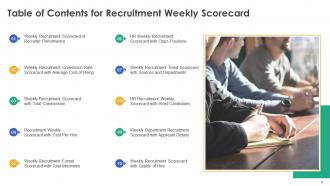
Recruitment metrics include all the attributes designed and finalized for the test of the candidate and show the ROI for the organization by evaluating their whole recruitment process. Weekly scorecards showcase how the drive is performing and the list of skills, qualifications, traits, etc., that are required in a particular candidate. Check out our efficiently designed template on the Recruitment Weekly Scorecard that will help you optimize the process of hiring candidates and track the drives success for a specific time. The PowerPoint presentation displays data and tables for the weekly recruitment scorecard of recruiter performance, weekly conversion rate scorecard with an average cost of hiring, recruitment scorecard with the total commission, etc. Our robust template also exhibits information related to weekly recruitment scorecard with cost per hire, funnel recruitment scorecard with total interviews, HR weekly scorecard with open positions, recruitment trend scorecard with sources and departments, etc. The insightful template presents details for HR weekly scorecard with hired candidates, weekly department recruitment scorecard with applicant details, recruitment scorecard with quality of hire, and more. Download this 100 percent editable template. Book a free demo with us now.
People who downloaded this PowerPoint presentation also viewed the following :
Content of this Powerpoint Presentation
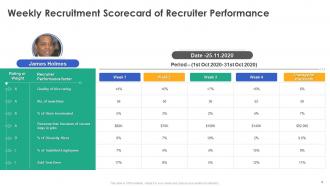
Slide 1: This slide displays 'Weekly Recruitment Scorecard of Recruiter Performance'.
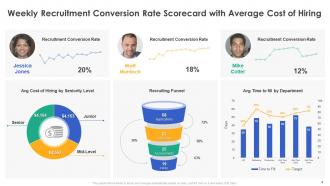
Slide 2: This slide presents 'Weekly Recruitment Conversion Rate Scorecard with Average Cost of Hiring'.
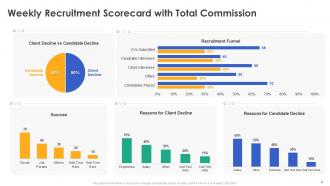
Slide 3: This slide exhibits 'Weekly Recruitment Scorecard with Total Commission'.
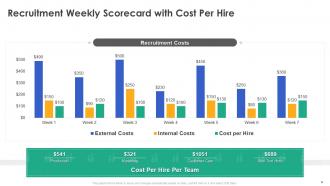
Slide 4: This slide depicts 'Recruitment Weekly Scorecard with Cost Per Hire'.
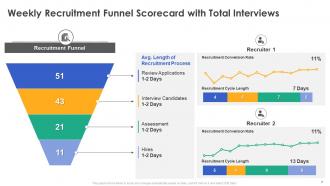
Slide 5: This slide highlights 'Weekly Recruitment Funnel Scorecard with Total Interviews'.
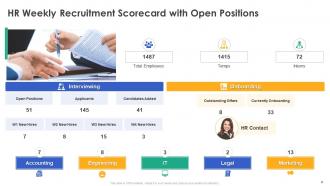
Slide 6: This slide showcases 'HR Weekly Recruitment Scorecard with Open Positions'.
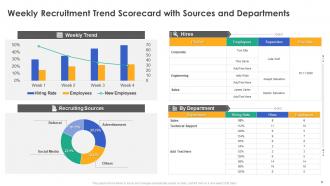
Slide 7: This slide highlights 'Weekly Recruitment Trend Scorecard with Sources and Departments'.
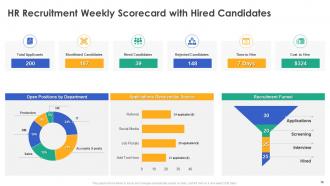
Slide 8: This slide displays 'HR Recruitment Weekly Scorecard with Hired Candidates'.
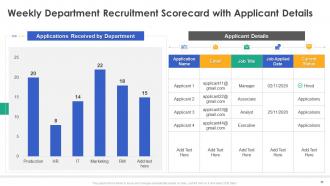
Slide 9: This slide presents 'Weekly Department Recruitment Scorecard with Applicant Details'.
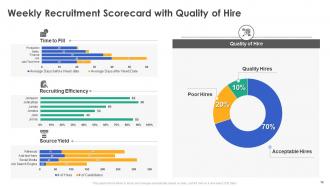
Slide 10: This slide ehibits 'Weekly Recruitment Scorecard with Quality of Hire'.
Slide 11: This is the icons slide.
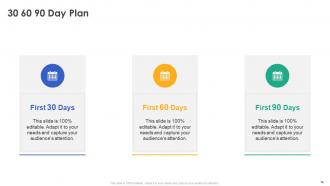
Slide 12: This slide depicts 30-60-90 days plan for projects.
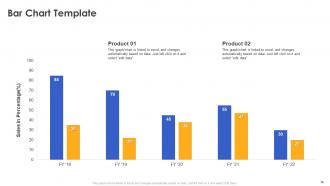
Slide 13: This slide exhibits yearly sales bar charts for different products. The charts are linked to Excel.
Slide 14: This slide shows details of team members like name, designation, etc.
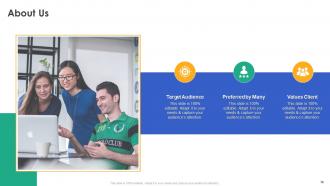
Slide 15: This slide shows about your company, target audience and its client's values.
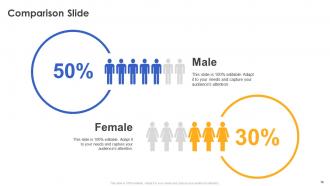
Slide 16: This slide highlights comparison of products based on selects.
Slide 17: This slide presents your company's vision, mission and goals.
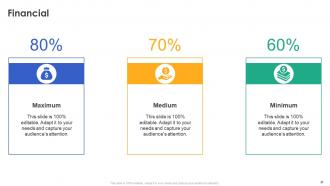
Slide 18: This slide showcases financials.
Slide 19: This is thank you slide & contains contact details of company like office address, phone no., etc.
Recruitment weekly scorecard powerpoint presentation slides with all 27 slides:
Use our Recruitment Weekly Scorecard Powerpoint Presentation Slides to effectively help you save your valuable time. They are readymade to fit into any presentation structure.





FAQs for Recruitment weekly scorecard
Start with the basics: time-to-fill, cost-per-hire, and quality-of-hire. Source effectiveness is huge too - I bet that expensive job board isn't pulling its weight like you think. Also track candidate experience scores and offer acceptance rates. Honestly, hiring manager satisfaction matters more than people realize. The real test? Look at your 90-day and 1-year retention for new hires. That'll show you if you're hiring right or just filling chairs fast. Keep it simple though - maybe 5-7 metrics tops until your team gets the hang of it.
So basically, you set up specific criteria before you start interviewing - technical skills, communication, cultural fit, whatever matters for the job. Then you score every candidate on the same stuff using like a 1-5 scale. It's wild how much we let random things influence us otherwise. Maybe someone reminds you of your college roommate or went to a fancy school - suddenly they seem "better." The scorecard forces you to actually focus on what matters instead of just going with your gut. I started doing this last year and caught myself being way more biased than I thought. Game changer, honestly.
Analytics totally flips recruitment on its head - you get predictive stuff instead of just looking backwards. Track which sourcing channels actually give you good hires long-term, not just fast fills. You'll spot interview bias patterns and predict success rates before making offers. Plus you can see how you stack up against industry benchmarks. Honestly, the candidate engagement scores are game-changers. Connect your ATS with performance systems to build those models. Way better than just measuring time-to-fill - you'll actually understand what makes quality hires tick.
Honestly? Monthly reviews if you're hiring regularly. Quarterly at the bare minimum though. Things change fast - market conditions, what roles actually need, seasonal weirdness. I've seen scorecards become totally useless because someone only checked them twice a year. Your scorecard needs to match what's actually happening right now, not whatever worked last spring. Next time you review it, first ask yourself which metrics even matter anymore. Then figure out what new problems you're dealing with that aren't being tracked yet. Makes a huge difference when you stay on top of it.
So recruitment scorecards are honestly a game changer - they let you judge every candidate on the exact same stuff instead of just vibing with whoever seems cool. You'll rate people on actual skills and culture fit rather than who happened to be charming that Tuesday morning. The best part? When your boss asks why you didn't hire their nephew's friend, you've got solid numbers to back up your choice. Makes the whole team move faster too since everyone knows what we're actually looking for. I'd start with maybe 4-5 things that matter most and score each person 1-5.
Build your scorecard around what actually matters at your company first. Like if everyone's always talking about collaboration, create interview questions that test for that specifically. I'd throw in scenarios too - say you value transparency, ask candidates how they'd handle admitting a big mistake to their team. Your interviewers need to know what to look for though, otherwise it's just random. Honestly, pilot this with just a couple roles before rolling it out everywhere. You want to find people who'll actually fit your culture, not just check boxes. The whole point is spotting who'll thrive in your specific environment.
Dude, tech totally transforms recruitment scorecards. Your ATS already tracks tons of metrics like time-to-hire automatically - no more manual spreadsheet hell. Analytics platforms help you spot weird patterns and bottlenecks you'd miss otherwise. Dashboards make everything visual so stakeholders actually understand what's happening (seriously, so much better than those awful Excel charts). You can even set up reports that update themselves, which is pretty sweet. Start with whatever tools you're already using - most systems capture way more data than people realize. Real-time insights are honestly the biggest win here.
So basically, recruitment scorecards stop those weird "how's recruiting going?" conversations where you're both just winging it. You'll actually have real data to talk about instead of vague complaints like "we need better candidates" (which drives me crazy tbh). Pick 3-4 metrics you both genuinely care about - time to fill, quality scores, whatever. The magic happens because you're forcing everyone to agree upfront on what "good" actually looks like. No more guessing games. Pipeline reviews become way less awkward since you're looking at the same numbers. Start small and review weekly together - that's honestly where most people mess up.
Honestly, the worst thing people do is track way too many metrics - I've literally seen dashboards with 20+ things that just sit there collecting dust. Pick maybe 5-7 that actually matter for your hiring goals. Skip the vanity stuff like total applications (who cares if they're all terrible?). Quality beats quantity every time. Don't forget candidate experience metrics either, not just your internal speed stuff. Oh, and make sure you can actually DO something about what you're measuring. Start small, run it for a few months, then tweak what's working.
Look, scorecards are game-changers for recruitment. They help you track stuff like time-to-hire and candidate quality over months, so you can actually see what's working. Without them? You're just guessing whether your changes made any difference. The data reveals which job boards bring in better people, where candidates drop off, and honestly - which interview methods aren't total disasters. I used to wing it with hiring decisions until I started doing monthly scorecard reviews. Now I can spot patterns I'd never catch just looking at individual hires. Trust me, once you see the trends, your recruitment strategy gets so much smarter.
Ugh, that's frustrating but totally fixable. Start by digging into where things are actually falling apart - wrong candidates applying? Weak screening process? Your hiring managers making questionable calls? Nine times out of ten it's multiple issues, not just one thing. Pick the biggest problem first and focus there. Maybe your job descriptions suck, or interviewers need better training, or you're sourcing from the wrong places. Don't try fixing everything simultaneously though - you'll just overwhelm yourself. Tackle one or two fixes, see what improves, then move on to the next issue.
Hey! So those recruitment scorecards are actually clutch for onboarding - they basically give new hires a roadmap from the get-go. You've already documented what skills matter for the role during hiring, which saves everyone from guessing what "good performance" looks like later. New employees can see exactly how they'll be measured since those same criteria become their benchmarks. Training becomes way more targeted too - you already know their weak spots from the scoring process. I'd definitely sit down with new hires in week one to walk through how you picked them and what you're expecting. Honestly makes the whole transition less awkward for everyone.
Honestly, don't just look at final hiring numbers - that's like checking your weight without looking at what you're eating. You need to track diversity at every stage of your funnel to see where people are dropping off. Pay gaps are huge too, plus retention rates by demographic (if people keep leaving, your inclusion probably sucks). Make sure your sourcing actually reaches underrepresented folks, and check if your interview panels are diverse - homogeneous panels are bias magnets. Pick maybe 4-5 metrics you'll genuinely review monthly and act on. Otherwise you'll drown in data and change nothing.
Look, just start basic - no need for fancy tools right off the bat. Track maybe 3-4 things: time-to-hire, cost per hire, and how new hires do after 90 days. Yeah, a spreadsheet is totally fine (I used one for way too long lol). Focus on one position at a time instead of trying to measure your entire process. You'll drive yourself crazy otherwise. Once you get the hang of it, you can always add more stuff. The main thing is picking something and actually sticking with it consistently.
Honestly, the best thing is getting your team to score the same candidate profiles together and compare notes - it's like calibrating everyone's brains. Define what your criteria actually mean too, because "good communication" is super vague otherwise. Practice role-playing weird scenarios that come up. We do this regularly instead of just one training session and it works way better. Also make them a quick reference sheet they can glance at during interviews. Oh, and review everyone's scorecards together every so often to catch patterns you're missing. Sounds boring but it actually helps a ton.
-
Excellent Designs.
-
Great designs, really helpful.