

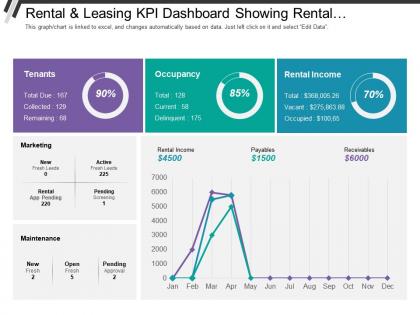
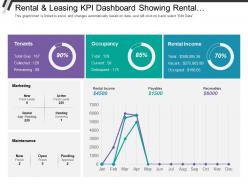
Rental and leasing kpi dashboard showing rental income occupancy tenants




Try Before you Buy Download Free Sample Product
 Impress Your
 Audience
 100%
100% Editable
 Save Hours
 of Time


SlideTeam presents to you its Rental And Leasing Kpi Dashboard Showing Rental Income Occupancy Tenants. This is perfect whenever you wish to make a comparison amongst various tenants and see as to who offers you more rent. It will present you information related to the tenants, occupancy, rental income, the maintenance charges etc. If you work in the tenancy business and find it very difficult to maintain a list and detailed description related to various expenses related to such occupancy contract, do not think any further and download this PPT, as this is a solution to your problems. This deck of slides contains six templates skillfully designed by our business professionals very proficiently for experts like you who do not have time to actually design the presentation themselves. So simply hit the download button, edit it and present it using the information of your requirement and get all the appraisals. Create demand for better facilities with our Rental And Leasing Kpi Dashboard Showing Rental Income Occupancy Tenants. Ensure infrastructure becomes the buzzword.
People who downloaded this PowerPoint presentation also viewed the following :
Rental and leasing kpi dashboard showing rental income occupancy tenants with all 6 slides:
Get folks to display consistent focus with our Rental And Leasing Kpi Dashboard Showing Rental Income Occupancy Tenants. Be able to handle intermittent attention.

FAQs for Rental and leasing kpi dashboard showing rental
Honestly, focus on occupancy rate first - that's your bread and butter. Cash flow per unit is obvious but don't sleep on rent-to-market ratio and turnover rate. Those will save your ass long-term. I always check maintenance costs per square foot too because that stuff adds up fast if you're not paying attention. Oh, and days to lease? Super telling about whether your pricing's right. Start tracking occupancy weekly, everything else monthly. You can get all nerdy with fancy metrics later, but nail these basics first.
Check your occupancy monthly and compare to local averages - you want 95%+ in most areas. Set alerts when units hit 30+ days vacant (learned this one the hard way after missing a 60-day empty once, ugh). Your property software should generate reports showing trends and seasonal patterns automatically. Pull these weekly at first until it's routine. The trick is catching drops early before they wreck your cash flow. Maybe rent's too high, marketing sucks, or something's broken. Oh and certain unit types always fill faster - track that too so you know what works.
So rental yield is just your annual rent divided by what the property's worth, times 100. Like if you're pulling in $24k a year on a $400k place, that's 6%. Super basic math. You can do it gross (just the rent) or net after you factor in repairs, taxes, all that fun stuff. Most people shoot for 4-10% but honestly depends where you're investing. I'd check it monthly though - some properties look good on paper but end up being total money pits. Better to know sooner than later, right?
I'd check monthly if you can swing it, quarterly at bare minimum. Turnover costs are brutal - lost rent, cleaning, repairs, the whole mess. Monthly tracking helps you catch patterns before they bite you. Like maybe your 6-month leases aren't working out, or winter always tanks your retention rates. Honestly, I just use a basic spreadsheet but property management software works too if you're fancy. The goal is spotting problems early instead of scrambling after half your tenants bounce.
So tenant acquisition cost is just how much you're spending to fill each vacancy - super important for your bottom line. Take all your marketing, screening, and leasing expenses and divide by how many leases you actually signed. Honestly, most landlords don't track this and wonder why their profits suck. You want to compare it against what each tenant brings in over their lease term. I always tell people to aim for under 8-10% of that unit's annual rent, though that's harder in competitive markets. Track it monthly so you can catch problems before they get expensive.
Honestly, preventive maintenance will save you so much money - like changing HVAC filters instead of waiting for the whole system to die. I'd track your spending by property and category first, see which units are bleeding you dry. Finding good contractors who don't screw you over is huge too. Oh and definitely stash away 1-2% of rental income each month for repairs. Nothing worse than scrambling for cash when your water heater explodes at 2am. Start by looking at last year's expenses - you'll probably find some patterns that'll surprise you.
Set up aging buckets - 30, 60, 90+ days - and check your collection rates every month. That's your baseline. Get automated reminders going and have a solid escalation plan, because being consistent is literally everything. I'd start reaching out at day 5 past due, not waiting until day 30. Early action works way better. Look for patterns too - maybe certain property types or tenant groups default more often? Document every single conversation and payment deal you make. Focus on catching problems early instead of chasing huge balances later when it's honestly too late.
Every empty day is basically money walking out the door. You'll need to charge future tenants more just to make up for what you've already lost, which sucks because then you're less competitive. Vacant properties are expensive too - you're still paying utilities, doing maintenance, advertising for new tenants. That stuff adds up fast. A few extra weeks without rent can really mess with your whole year's numbers, especially if you've got a mortgage on the place. Honestly, I'd rather drop rent by $50-100 than sit empty for months. Quick turnovers and realistic pricing are your best friends here.
Renewal rates are your best bet - that's the most straightforward way to measure if tenants are actually happy. Also look at how fast you handle maintenance requests, how often people complain, and rent collection rates. Getting survey responses is brutal honestly, but try anyway. I'd also track average lease length and whether people leave by choice or get evicted. Oh, and don't ignore online reviews - those matter way more than landlords think. Happy tenants definitely refer their friends too. Pull your renewal data from last year first and see how you stack up against other properties nearby.
Check rental sites monthly to see what similar places are going for - price per square foot, how long they sit empty, that stuff. Local market reports help too if you can find them. Honestly, the market moves so damn fast these days. If your place is vacant way longer than others nearby, or you're charging way less, time to adjust. Set up alerts for new listings so you catch trends early. Don't want to leave money sitting there, but also don't want to price yourself out of renters.
Ugh, late payments are the worst for cash flow. You think you'll have rent money on the 1st, but then it's scattered all over the month instead. Makes it super hard to budget for anything - like, can I even cover my mortgage this month? Some tenants pay on time, others show up weeks later. I'd definitely track when people actually pay vs when they're supposed to. That way you can plan around the chaos and maybe keep some extra cash as a buffer. Trust me, predictable income is way better than playing guessing games every month.
Look, demographics are everything when you're setting rent prices. Pull the census data for your area first - you need median income, age groups, family sizes, that stuff. Young professionals will throw money at different things than families will, you know? Like they might pay extra for a gym but families care more about schools nearby. Don't price yourself out of what people can actually afford or you'll just sit there with empty units. But also don't go too low and miss out on money. I learned this the hard way honestly - had a place sit vacant for months because I got greedy with pricing.
Honestly, work both ends - pump up income and slash expenses. Raise rents to what the market's actually paying, market vacant units better so they don't sit empty forever. Also add little revenue streams like charging for parking or pet fees. For costs, shop around for cheaper insurance (seriously, most people never do this), make your building more energy efficient, and - this is big - stay ahead of maintenance issues. I swear, fixing small stuff early saves you from those brutal emergency repair bills later. Just go through your expenses line by line first though. You'll spot the worst offenders pretty quick.
So I'd definitely start with property management software - AppFolio, Buildium, or Yardi are solid options. They handle all the tracking automatically (occupancy rates, rent roll, collections) which beats dealing with spreadsheets any day. Most connect with your accounting software too, and trust me, that saves hours during month-end. For the visual dashboard stuff, Tableau or Power BI work great since they pull from multiple sources. Oh, and Zapier's pretty handy for connecting different apps if you want to get fancy with automation. Honestly though, your property management platform should be step one since that's where all your rental data lives anyway.
Honestly, just look at your numbers and they'll tell you everything. Check occupancy rates, rent-to-market ratios, net operating income - the usual stuff. Properties making good money? Buy more like those in similar areas. The ones constantly empty or barely breaking even are probably worth selling. I mean, some people get too attached to their first properties, but if the math sucks, it sucks. Rank everything by ROI and cash flow first. Then it's pretty obvious which property types and locations you should double down on. The patterns become super clear once you actually sit down and compare them all.
-
I discovered this website through a google search, the services matched my needs perfectly and the pricing was very reasonable. I was thrilled with the product and the customer service. I will definitely use their slides again for my presentations and recommend them to other colleagues.
-
Understandable and informative presentation.