

Revenue model business plan powerpoint guide





Try Before you Buy Download Free Sample Product
 Impress Your
Audience
 100%
Editable
 Save Hours
of Time


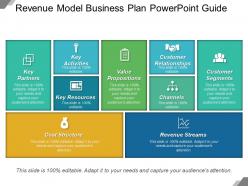
Manage your organizational strategies for existing business with Revenue Model Business Plan PowerPoint Guide. Identify the key activities that influence your company’s revenue and costs. Mention your business’s key partners and resources in this revenue model. Help your company clarify and monitor the revenue drivers. Realign your resources, processes and profit formula to fetch your company’s value proposition. Tap into an entirely new customer opportunity with this revenue PPT framework. Design a plan that fulfils the jobs customers need to get done more efficiently and profitably using effective revenue strategies. Organize your business plan with more accuracy. Implement the strategic plans without any trouble with the help of this PowerPoint business layout. Give a profit formula that lays out how your company makes money delivering the value proposition. Put across your agendas to boost your business easily. With high-quality graphics and content, this revenue model for business PPT slide is readily available. Invest less time to prepare an impressive business PowerPoint presentation.
People who downloaded this PowerPoint presentation also viewed the following :
Revenue model business plan powerpoint guide with all 5 slides:
Combat competition with our Revenue Model Business Plan Powerpoint Guide. They help you fight commercial battles.


FAQs for Revenue model business
Key components include diversified pricing tiers, subscription-based access, enterprise licensing, individual template sales, and premium design collections. These revenue streams work by targeting different customer segments, from freelancers to corporations, while subscription models ensure recurring revenue and enterprise partnerships deliver higher-value contracts, ultimately enabling scalable growth and predictable income streams.
Subscription-based pricing enhances customer retention by providing continuous value through regular template updates, exclusive content access, and cost predictability that encourages ongoing engagement. This model creates deeper customer relationships compared to one-time purchases, with many presentation marketplaces finding that subscribers utilize templates more frequently, ultimately delivering higher lifetime value and sustained revenue growth.
Product differentiation enables template providers to command premium pricing through unique design elements, specialized industry focus, advanced customization features, and exclusive content offerings. By creating distinct value propositions across different market segments, companies can capture higher margins while reducing direct price competition, ultimately delivering enhanced customer loyalty and sustainable revenue growth in an increasingly competitive marketplace.
Tiered pricing strategies attract different customer segments by offering basic templates for budget-conscious users, premium designs for growing businesses, and enterprise solutions for large organizations with advanced customization needs. This approach enables presentation template companies to capture broader market share while maximizing revenue per segment, with many finding that clear value differentiation between tiers drives customer upgrades and enhances long-term retention.
Effective methods include sentiment analysis tools, usage pattern tracking, pricing sensitivity surveys, feature request categorization, and conversion funnel analysis. These approaches help template providers understand customer preferences, identify high-value features, and optimize pricing tiers, with many digital content businesses finding that systematic feedback analysis enables more targeted product development and ultimately delivers improved customer satisfaction and revenue growth.
Partnerships with businesses and educational institutions create revenue streams through joint program development, resource sharing, licensing agreements, co-branded offerings, and cross-promotional opportunities. These strategic collaborations enable organizations to access new markets, reduce development costs, and leverage complementary expertise, with many institutions finding that partnership-based models deliver enhanced credibility and accelerated growth.
Seasonal demand significantly influences presentation template pricing through dynamic adjustments, limited-time promotions, bundled offerings, and premium seasonal collections. During peak business quarters like Q4 planning cycles or back-to-school periods, companies often increase prices for high-demand templates while offering strategic discounts during slower months, ultimately maximizing revenue while maintaining market competitiveness and customer acquisition momentum.
Affiliate marketing integrates into presentation template revenue models through partnership commissions, sponsored template features, tool recommendations, and branded content collaborations. Template creators can monetize by promoting complementary design software, stock photo services, and business tools within their presentations, while maintaining content quality and user trust, ultimately delivering additional revenue streams alongside traditional sales.
**INPUT**: What techniques can be employed to upsell premium features within a standard template offering? **OUTPUT**: Effective upselling techniques include feature comparison charts, limited-time upgrade offers, usage-based triggers, personalized recommendations, and strategic feature restrictions in basic tiers. These approaches work by demonstrating clear value differentiation, creating urgency through scarcity, and timing upgrade prompts when users encounter limitations, with many SaaS companies finding that contextual upselling during peak engagement delivers significantly higher conversion rates.
Data analytics informs pricing decisions by analyzing customer behavior patterns, competitor pricing strategies, market demand fluctuations, and template performance metrics. Through comprehensive data analysis, presentation template providers can optimize price points for different customer segments, identify high-value features that justify premium pricing, and adjust strategies based on seasonal trends, ultimately delivering competitive advantage and maximized revenue growth.
Freemium models present both challenges and opportunities, including user acquisition costs, conversion rate optimization, feature differentiation, and sustainable revenue streams. While many template providers struggle with balancing free value against premium incentives, successful platforms like Canva and Figma demonstrate that strategic feature limitations, advanced design tools, and collaborative capabilities can drive conversions, ultimately delivering scalable growth and competitive market positioning.
Customer lifetime value in presentation template businesses increases through subscription tiers, premium design collections, add-on services like custom branding, and complementary products such as icons or infographics. By offering enterprise packages, regular content updates, and personalized customer support, companies enhance user engagement and retention, with many finding that bundled services and loyalty programs ultimately deliver higher recurring revenue and stronger customer relationships.
Licensing agreements can be structured through tiered pricing models, usage-based fees, subscription plans, white-label partnerships, and exclusive industry licenses. These approaches enable template creators to monetize across multiple customer segments, from individual users to enterprise clients, while generating recurring revenue streams, expanding market reach, and ultimately delivering scalable income growth with many businesses finding that diversified licensing maximizes both accessibility and profitability.
Social media marketing enhances presentation template visibility through targeted content showcasing, strategic hashtag utilization, influencer partnerships, and community engagement across platforms like LinkedIn, Instagram, and Pinterest. These approaches streamline customer acquisition by demonstrating template applications in real business scenarios, ultimately driving traffic to template libraries and converting followers into paying customers, with many template businesses finding that consistent social presence significantly increases both brand recognition and sales conversions.
AI-generated presentation templates could unlock subscription-based access to personalized designs, dynamic pricing models based on customization complexity, and white-label licensing to corporations for branded template libraries. These revenue streams enable businesses to monetize design automation while offering tiered services, ultimately delivering scalable income through intelligent template personalization and enterprise partnerships.
-
Very unique, user-friendly presentation interface.
-
Enough space for editing and adding your own content.