


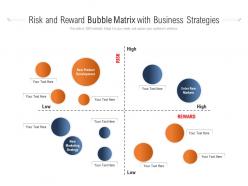
Risk and reward bubble matrix with business strategies





Try Before you Buy Download Free Sample Product
 Impress Your
 Audience
 100%
100% Editable
 Save Hours
 of Time


Our Risk And Reward Bubble Matrix With Business Strategies are topically designed to provide an attractive backdrop to any subject. Use them to look like a presentation pro.
People who downloaded this PowerPoint presentation also viewed the following :
Risk and reward bubble matrix with business strategies with all 2 slides:
Use our Risk And Reward Bubble Matrix With Business Strategies to effectively help you save your valuable time. They are readymade to fit into any presentation structure.

FAQs for Risk and reward bubble matrix
You need four main things: figure out what risks you're facing, guess how likely each one is, calculate the damage vs potential gains, and know your own risk tolerance. Most people just think about worst-case stuff and skip the probability part, which honestly isn't that useful. Map out your top 3-5 risks first - that'll cover like 80% of what actually matters. Don't overthink it beyond that. Also factor in your timeline since that changes everything. Oh, and be real about how much uncertainty you can actually handle before you stress out.
So there's a few ways to measure this stuff. Standard deviation and beta are pretty common for risk, while returns get measured through IRR or the Sharpe ratio. I'd start by looking at historical volatility - yeah I know, past performance doesn't guarantee anything, but it's still useful. Then compare that to your projected returns to get a risk-reward ratio. Most people shoot for at least 3:1 as a baseline, though honestly that's pretty conservative depending on what you're investing in. Run some scenarios with different timeframes and see how the numbers change. That'll give you a better sense of whether it's actually worth it.
So volatility basically controls your whole risk-reward game, right? Bigger swings mean you could make more money, but you'll also face bigger losses. It's honestly like riding a rollercoaster - thrilling but terrifying. You've got to look at how wild the price movements have been historically, plus what's happening now in the markets. That helps you figure out realistic expectations for both winning and losing scenarios. The trick is matching how much craziness you can handle with your timeline. If you're investing for 20 years, short-term volatility doesn't matter as much.
Dude, our brains are seriously bad at money decisions. You'll probably obsess over recent losses while ignoring the bigger picture. Or get way too attached to crappy investments because admitting you screwed up feels awful - I do this constantly with my dumb crypto buys. People chase whatever's hot instead of sticking to fundamentals. Here's what actually works: set up rules before you invest, like "I'll sell if it drops 20%." Don't trust your emotions when real money's involved. Having a system beats going with your gut every single time.
Scatter plots are your best bet here - they show expected returns vs risk super clearly. Risk-reward matrices are solid too, breaks everything into neat quadrants. If you've got multiple variables, heat maps work well (just don't go crazy with the data or it gets overwhelming). For portfolio stuff, efficient frontier curves are the go-to classic. Tornado diagrams are perfect when you're doing sensitivity analysis. Monte Carlo with histograms gives you the whole probability picture, though honestly that might be overkill depending on your audience. I'd start simple with scatter plots - easiest to explain and people actually get them.
So each industry basically plays by totally different rules when it comes to risk stuff. Tech companies? They're all about those crazy high-risk bets because failing fast is like their whole thing. Healthcare and pharma are the exact opposite - they'll test something for literally years before putting it out there because, you know, people could die. Finance used to be more aggressive but got spooked after 2008, so now they're way more careful. Manufacturing mostly cares about keeping operations smooth and getting steady returns rather than swinging for the fences. Honestly, your industry's regulations and how much failure you can stomach will basically tell you which approach to use.
So the main ones you'll run into are ROI, NPV, and IRR. ROI is dead simple - just divide your gains by what you put in. NPV takes your future cash flows and figures out what they're worth today, minus your upfront costs. IRR gives you the percentage return, though honestly it gets funky when cash flows are all over the place. I'd also throw in payback period if you're doing straightforward projects. Start with ROI and NPV though - they'll handle most situations without making your head spin.
So your risk tolerance is basically your filter for what feels rewarding, you know? Risk-averse people get genuinely excited about preserving their money - like a 5% return actually feels pretty good to them. Meanwhile, high-risk folks need way bigger numbers to even care. They'll see that same 5% and think "whatever." I've noticed this with my friends too - some celebrate any gain while others won't even mention returns under 15%. The trick is matching your expectations to what you can actually stomach losing. Don't chase what sounds cool if it'll keep you up at night.
Honestly, most people fall into the optimism trap - they downplay risks and get too excited about potential rewards. Don't look at these things separately either, because they're totally connected. Like during 2008, everything went south at once (learned that one the hard way). Historical data helps but it's not crystal ball material - markets love throwing curveballs. What works for me? I always run worst-case scenarios first. Sounds paranoid but it saves your ass. Also grab someone else to check your work because you'll miss stuff when you're too close to it.
Dude, macro stuff completely changes the game for investing. Rising rates make bonds way more appealing while stocks start looking riskier in comparison. Inflation's the worst though - you need way higher returns just to stay even after it eats your gains. GDP numbers, job reports, Fed announcements... all that noise shifts what counts as decent compensation for risk. You can't just look at stocks individually anymore, honestly. I've been watching Powell's speeches religiously lately. Just bump up your return expectations when the economic backdrop gets messy.
Honestly, the biggest issue is treating people like spreadsheet entries. Risk-reward analysis can max out profits while completely screwing over employees or customers - and that damage doesn't always show up in your quarterly reports, you know? It's pretty dehumanizing when you break it down. Instead of just asking "what's our ROI gonna be?" try adding "who's getting hurt here?" Build some moral criteria right into your decision process. Weight ethical costs the same way you'd weight financial ones. Sounds obvious but most companies totally skip this step.
Build risk-reward analysis into your planning right from the start - don't just slap it on later. Map out potential risks next to expected returns for each initiative, then assign probability scores to different scenarios. Honestly, I've watched so many teams skip this and kick themselves afterward! Simple matrices work great for weighing costs, benefits, and success likelihood. Review these every quarter since things change fast. The trick is making it routine rather than a one-off thing. That way your team naturally starts thinking this way instead of having to force it.
Honestly just start with Excel or Google Sheets - they're perfect for most stuff and you already know how to use them. Python's solid too if you code (NumPy and pandas are clutch). Monte Carlo tools like @RISK are actually pretty sweet for complex probability work, though maybe overkill at first. Bloomberg and Morningstar are obviously the best for investments but crazy expensive. I'd probably just stick with spreadsheets initially - better to use something simple consistently than get some fancy tool that sits there collecting digital dust, you know? You can always upgrade later once you figure out what you actually need.
Honestly, time horizon changes everything when it comes to investing. Got 20+ years? You can handle the bumps because stocks historically bounce back, even after major crashes. But if you need the money soon, you're basically forced into boring stuff like bonds or savings accounts - which sucks but beats losing your shirt right before you need to cash out. The wild part is how much compound growth you miss with short timelines. I learned this the hard way with my house down payment fund. Look, your timeline matters way more than whether you think you're a "risk taker" or not.
Look, historical data beats shooting in the dark every time. You can spot patterns from similar investments, see what risk factors keep popping up, and figure out realistic return ranges. Past performance gives you something concrete - like "hey, the last 15 times this happened, here's how it went." Way better than pure guesswork, honestly. Just don't get too carried away thinking history will repeat itself exactly. Markets change, conditions shift. But having that baseline? Super helpful for making smarter calls instead of just winging it completely.
No Reviews