

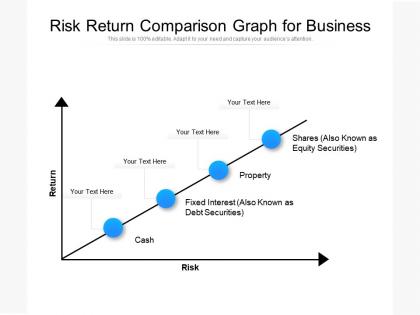
Risk return comparison graph for business




Try Before you Buy Download Free Sample Product
 Impress Your
 Audience
 100%
100% Editable
 Save Hours
 of Time


Engage folks with an intelligent display due to our Risk Return Comparison Graph For Business. It will hold their interest.
People who downloaded this PowerPoint presentation also viewed the following :
Risk return comparison graph for business with all 2 slides:
Indicate your interest with our Risk Return Comparison Graph For Business. Convince folks of your intense concern.

FAQs for Risk return comparison
Look, the risk-return thing is pretty straightforward - you want higher returns? You're gonna deal with more risk. Period. There's no free lunch here. So when you're looking at investments, always ask yourself if the potential gain is worth the potential headache. Like, chasing that 10% return means way more ups and downs than just parking money in a boring savings account. This concept basically shapes every money decision you'll make. Honestly, most people skip this step and wonder why they panic-sold during a market dip. Figure out how much volatility you can actually stomach first.
So basically it's like a sliding scale - government bonds are super safe but you'll barely make anything. Stocks are way more volatile but they've always done better over time. Real estate sits in between, though honestly the maintenance headaches can be brutal. Then there's the wild stuff like crypto and commodities that'll either make you rich or break your heart. Really depends on when you need the cash though. If it's soon, don't mess around with risky investments. Stick with boring stable stuff instead.
Look, investor profiles are just fancy ways to figure out how much risk you can actually handle. Your age matters - being 25 with steady income means you can ride out market swings way better than someone who's about to retire. But honestly? It's not just about the numbers. Some people freak out every time the market drops while others see it as a chance to buy more. You've gotta be real with yourself about both your finances AND how you'll react emotionally. Don't let any advisor pressure you into investments that'll have you obsessively checking your phone at weird hours.
So diversification is basically that "don't put all your eggs in one basket" advice, but there's actually solid math backing it up. You spread your money across different investments that don't all tank at the same time. Some go up while others go down, which smooths out your overall risk without killing your returns. The trick is picking stuff that doesn't move together - like if tech stocks crash, maybe your bonds or real estate stays steady. Start with mixing different types (stocks, bonds, REITs) then branch out within each category. Honestly beats stressing about one stock tanking your whole portfolio.
Look, people think high returns always equal high risk, but that's not the whole story. Sometimes you get great returns from a smart manager or catching the market at the right time - doesn't mean it's super risky. Here's what bugs me though: everyone assumes past big gains mean future danger, which is kinda backwards if you think about it. The trick is figuring out WHY those returns happened. Don't just stare at the numbers. Was it skill? Lucky timing? Did they bet everything on one stock? That's what actually tells you if you're walking into trouble or not.
Market conditions completely change how risk and returns work together. Bull markets are pretty sweet - you can get decent returns without taking crazy risks since everything's generally going up. Bear markets though? You'll need way more risk to hit those same returns. I've noticed that when there's economic uncertainty or interest rates are bouncing around, the whole risk-reward balance gets thrown off. Market sentiment matters too - people get weird when they're scared. So don't base your strategy on what worked five years ago, you know? Look at what's actually happening now.
Look at standard deviation first - that's your volatility measure. Beta shows how much your stuff moves with the market overall. Maximum drawdown tells you the worst peak-to-valley loss you'd face, which honestly can be pretty brutal to watch happen in real time. For expected returns, nobody really knows the future but you can dig into historical returns and dividend yields. The Sharpe ratio is clutch - it's return per unit of risk. Sortino ratio's similar but only cares about downside moves. Compare these across similar assets to see what's actually giving you decent risk-adjusted returns.
Dude, your brain will totally sabotage your investment math without you knowing. Overconfidence makes you take stupid risks. Loss aversion? You'll be so scared of losing money that you miss solid opportunities. People get anchored to whatever happened last year instead of looking at real data. Following the crowd is another trap - I swear, half my coworkers buy whatever stock is trending on social media. When markets crash, everyone panics and sells at the worst time. Try to catch yourself doing this stuff and stick to some kind of system based on actual numbers, not whatever you're feeling that day.
Look at 2008 - everyone thought mortgage-backed securities were rock solid until they completely blew up overnight. Same thing happened with tech stocks during the dot-com crash. People got way too comfortable with those crazy valuations, then boom - 2000 hit like a truck. Bonds used to be the boring, safe choice for decades, right? But now with interest rates climbing, your "safe" bond portfolio might actually be riskier than stocks. Wild how that flips. Bottom line - what feels safe today won't necessarily stay that way. I've learned to question my assumptions about investments way more often than I used to.
So derivatives are basically insurance for your investments - you can hedge against losses while still keeping your upside. Options let you protect your whole portfolio from crashes without actually selling anything. Futures help you lock in prices ahead of time. Pretty neat setup, right? The cool thing is you're separating risk management from your actual investment strategy. You stay invested for growth but limit how much you can lose. Though honestly, I've seen people get too clever with these and mess up. Use them as tools, not gambling chips.
So basically, when economic stuff gets messy - GDP drops, unemployment jumps, inflation goes crazy - investors freak out and want bigger returns to make up for all that uncertainty. Fed rate changes are probably the biggest factor though. Raise rates and suddenly bonds look way better than stocks, so stock risk premiums have to shift. Even good economic news can backfire if people think we're heading for a bubble. My advice? Watch employment numbers and Fed announcements religiously. Those will clue you in when everyone's risk appetite is about to change. Trust me on this one.
Dude, the tech stuff available now for analyzing investments is honestly insane. Machine learning can catch patterns we'd never see, and those robo-advisors will rebalance your portfolio automatically when your risk tolerance shifts. What really blows my mind is running thousands of "what if" scenarios in seconds - like testing how your portfolio would've handled 2008 or whatever. You can stress-test against any historical market conditions instantly. Free risk assessment tools are everywhere now too, which is cool because that analysis used to cost serious money with financial advisors. My buddy was just showing me one last week and the insights were actually pretty solid.
Your time horizon is huge for this stuff. Got years before you need the cash? You can handle way more volatility and go heavier on stocks since there's time to recover from downturns. But if you're pulling money out soon, stick with boring safe options like bonds. I learned this the hard way honestly - had to sell during 2020's crash because I didn't plan right. Short money needs low risk, period. Long money can chase better returns. Just match your timeline to how much crazy you can stomach.
New regulations totally flip the risk-return game by changing what's legal, profitable, and dangerous. Banking rules after 2008? Perfect example - banks got pushed into boring safe stuff, which cut their returns but also made them way less risky. Crypto's even crazier right now. Just whispers about new rules send prices crashing overnight. Honestly, the uncertainty hurts more than actual regulations sometimes. Policy changes mess with volatility and liquidity across whole markets. So yeah, definitely watch what's coming down the pipeline and build that regulatory weirdness into your investment timeline.
Honestly, diversification is your best friend here - just spread stuff across different sectors and countries so you're not putting all your eggs in one basket. If you're young, load up on more stocks. Getting closer to retirement? Maybe shift toward bonds. I always tell people to do dollar-cost averaging because let's be real, none of us can predict when the market will tank or boom. Oh and definitely rebalance every so often to keep things aligned with how much risk you can actually stomach. The tricky part is figuring out what you can handle emotionally versus what looks good on paper.
No Reviews