


Market risk and return powerpoint presentation slides





Try Before you Buy Download Free Sample Product
 Impress Your
 Audience
 100%
100% Editable
 Save Hours
 of Time


Download our Market Risk and Return PowerPoint Presentation Slides to showcase investment Strategies of predefined portfolios. The content ready risk and return trade-off PowerPoint compete deck comprises of templates like risk and return of company assets, stock bonds, and T-bills, risk and return of portfolio manager, proportionate investment in stocks and bonds, portfolio return analysis, calculating asset beta, portfolio value at risk, ranking the passive income streams to name a few. Furthermore, investment management PPT visuals are completely customizable. You can add or delete the content if needed. Balance of risk and return varies by the type of investment. Demonstrate ways to increase returns and control market risk using security analysis and portfolio management presentation templates. Get access to this tailor-made portfolio risk and return analysis PowerPoint Slides to analyze the relationship between risk and expected return.
People who downloaded this PowerPoint presentation also viewed the following :
Content of this Powerpoint Presentation
Slide 1: This slide introduces Market Risk and Return. State Your Company Name and begin.
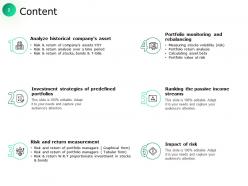
Slide 2: This slide shows Content of the presentation.
Slide 3: This is another slide continuing Content of the presentation.
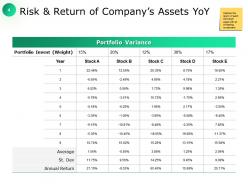
Slide 4: This slide presents Risk & Return of Company’s Assets YoY capturing the return of each individual asset with an offsetting investment.
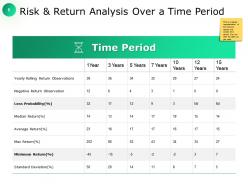
Slide 5: This slide displays Risk & Return Analysis Over a Time Period in a tabular form to represent financial assets over certain time period.
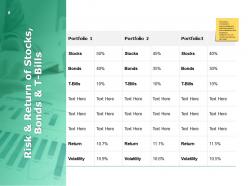
Slide 6: This slide represents Risk & Return of Stocks, Bonds & T-Bills, comparing the alternate portfolio that outperforms the traditional portfolio.You can modify the table as per need.
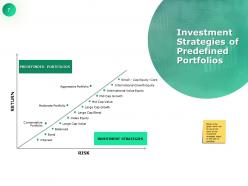
Slide 7: This slide showcases Investment Strategies of Predefined Portfolios in a graphical form to list down all the investment strategies based on the type of portfolios.
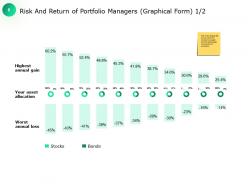
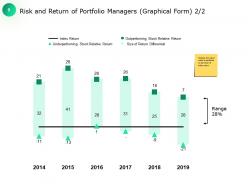
Slide 8: This slide shows Risk and Return of Portfolio Managers to measure the annual return for company’s assets with the percentage composition of allocation.
Slide 9: This is another slide presenting Risk and Return of Portfolio Managers.
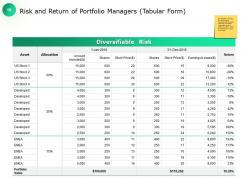
Slide 10: This slide displays Risk and Return of Portfolio Managers in a tabular form to track the record of fund investment with the return value and percentage composition of stock holding in portfolio.
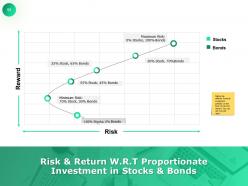
Slide 11: This slide represents Risk & Return W.R.T Proportionate Investment in Stocks & Bonds.
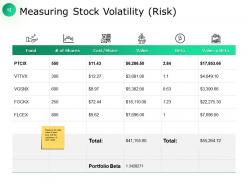
Slide 12: This slide is titled as Measuring Stock Volatility with categories as Funds, No. of Shares, Cost/Share, Value, Beta, Value x Beta.
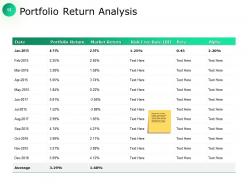
Slide 13: This slide showcases Portfolio Return Analysis to measure the average portfolio return and Avg. market return with the value of alpha and beta, given the level of risk undertaken in portfolio.
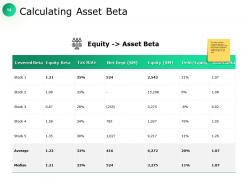
Slide 14: The slide provide the composite measure of portfolio’s performance that also include average and median value. You can modify the table as per need.
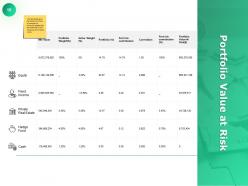
Slide 15: This slide shows Portfolio Value at Risk to give the broad summary of company’s financial assets with the estimate of risk measure and market value.
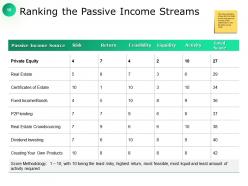
Slide 16: This slide presents Ranking the Passive Income Streams in a tabular form describing the five factors to rank the passive income of the organisation.
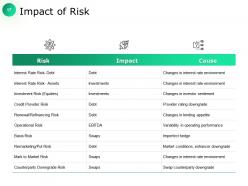
Slide 17: This slide displays Impact of Risk showing risk, impact and cause.
Slide 18: This slide is titled as Additional Slides for moving forward.
Slide 19: This is Our Mission with imagery and text boxes.
Slide 20: This is a Comparison slide to state comparison between commodities, entities etc.
Slide 21: This is a Quotes slide to convey message, beliefs etc.
Slide 22: This slide is titled as Post It. Post your important notes here.
Slide 23: This is a Bulb or Idea slide to state a new idea or highlight information, specifications etc.
Slide 24: This is About us slide to show company specifications etc.
Slide 25: This is Our Team slide with names and designation.
Slide 26: This is a Timeline slide to show information related with time period.
Slide 27: This is another slide continuing timeline.
Slide 28: This is a Thank You slide with address, contact number and email address.
Market risk and return powerpoint presentation slides with all 28 slides:
Out Market Risk And Return Powerpoint Presentation Slides are apt for any generation. X or Y is of little concern.











FAQs for Market risk and return
The fundamental relationship between market risk and expected returns follows a positive correlation, where higher-risk investments typically offer greater potential returns to compensate investors for accepting increased uncertainty. This risk-return tradeoff enables portfolio managers, pension funds, and institutional investors to strategically balance conservative bonds with volatile equities, ultimately delivering diversified portfolios that align with specific risk tolerance levels and long-term financial objectives.
Asset classes respond differently to market risk changes, with equities typically experiencing higher volatility, bonds showing inverse relationships to interest rates, commodities serving as inflation hedges, and real estate providing stability. While growth stocks amplify market movements and defensive assets like government bonds offer protection during volatility, diversified portfolios ultimately deliver balanced returns, enabling investors to manage risk exposure strategically.
Investors can quantify market risk through Value at Risk (VaR) calculations, beta measurements, standard deviation analysis, correlation assessments, and stress testing scenarios. These methods enable portfolio managers to evaluate potential losses, measure volatility against market benchmarks, and simulate adverse conditions, with many financial institutions finding that comprehensive risk quantification ultimately delivers better asset allocation decisions and enhanced portfolio performance.
CAPM explains the risk-return trade-off by demonstrating that expected returns increase proportionally with systematic risk, measured by beta, while accounting for the risk-free rate and market risk premium. Through this framework, investors and portfolio managers can quantify expected returns for assets based on their market sensitivity, enabling strategic asset allocation decisions that balance risk tolerance with return objectives, ultimately delivering more informed investment strategies across diversified portfolios.
Market volatility significantly influences investment returns by creating price fluctuations that generate both opportunities and risks for investors seeking higher yields. While increased volatility typically correlates with greater potential returns, it also amplifies uncertainty, with many portfolio managers finding that strategic diversification across sectors like technology, healthcare, and emerging markets ultimately delivers enhanced long-term performance despite short-term fluctuations.
Diversification mitigates market risk by spreading investments across different asset classes, sectors, geographic regions, and company sizes, reducing exposure to any single investment's volatility. Through strategic asset allocation, investors achieve more stable returns while maintaining growth potential, with many portfolio managers finding that diversified portfolios deliver consistent performance even during market downturns, ultimately enhancing long-term wealth accumulation.
Key indicators of changing market risk include volatility indices like VIX, credit spreads, yield curve movements, correlation patterns between asset classes, and liquidity measures. These indicators help financial institutions, investment firms, and portfolio managers anticipate market shifts by revealing stress levels, investor sentiment, and systemic vulnerabilities, ultimately enabling more strategic risk management decisions.
Macroeconomic factors influence market risk by affecting interest rates, inflation, currency fluctuations, and economic growth, which directly impact asset valuations and portfolio performance. During economic uncertainty, sectors like banking and manufacturing experience heightened volatility, while investors often seek defensive positions, ultimately creating both challenges and opportunities for strategic portfolio allocation across different market cycles.
Behavioral finance significantly distorts risk perceptions through cognitive biases like loss aversion, overconfidence, and recency bias, causing investors to misinterpret actual market data and return probabilities. These psychological factors lead to systematic mispricing of assets, with many financial institutions finding that behavioral-aware investment strategies deliver superior risk-adjusted returns by capitalizing on predictable investor irrationality.
Interest rates significantly impact market risk and expected returns by influencing bond prices, equity valuations, and sector performance across different securities. When rates rise, bond prices decline while dividend-paying stocks face pressure, though financial institutions often benefit from improved lending margins, ultimately creating varied risk-return profiles that require strategic portfolio adjustments.
The Sharpe ratio measures investment performance by calculating excess return per unit of risk, enabling investors to compare different assets on a risk-adjusted basis. This metric helps portfolio managers, financial advisors, and institutional investors optimize asset allocation by identifying securities that deliver superior returns relative to their volatility, ultimately enhancing portfolio efficiency and strategic decision-making.
Historical market data informs future expectations by revealing long-term patterns, volatility cycles, correlation relationships, and risk-return profiles across different asset classes and market conditions. While past performance doesn't guarantee future results, financial institutions and investment firms increasingly use this data to model scenarios, calibrate risk management systems, and set realistic return expectations, ultimately delivering more informed portfolio strategies and enhanced client outcomes.
Institutional investors employ diversification across asset classes, hedging through derivatives, strategic asset allocation models, and alternative investments like private equity and real estate. These approaches enable pension funds, insurance companies, and endowments to minimize volatility while targeting specific return thresholds, ultimately delivering consistent performance and protecting beneficiary interests in increasingly complex markets.
Geopolitical risk significantly influences market risk and return assessments by creating volatility through policy uncertainty, trade disruptions, and currency fluctuations that affect asset valuations and investment flows. Financial institutions and portfolio managers increasingly incorporate geopolitical analysis into their risk models, using scenario planning and stress testing to evaluate potential impacts on global markets, ultimately enabling more resilient investment strategies and better-informed allocation decisions.
Emerging markets present heightened market risk through increased volatility, currency fluctuations, political instability, and liquidity constraints compared to developed markets, while offering potentially higher returns. These markets deliver greater growth opportunities and portfolio diversification benefits, with many institutional investors finding that strategic allocation to emerging markets, despite elevated risk profiles, ultimately enhances long-term returns.
No Reviews