


Risk And Return Relationship Powerpoint Presentation Slides




Try Before you Buy Download Free Sample Product
 Impress Your
 Audience
 100%
100% Editable
 Save Hours
 of Time


While building a diversified portfolio it is important to balance risk and returns, plan your investment strategy with our content ready easy to understand Risk and Return Relationship PowerPoint Presentation Slides. The visually appealing portfolio risk-return trade-off PowerPoint compete deck includes a set of pre-made PPT slides such as risk and return of stock bonds, and T-bills, investment strategies of predefined portfolios, risk and return of portfolio manager, measuring stock volatility proportionate, portfolio return analysis, calculating asset beta, portfolio value at risk, ranking the passive income streams impact and many more. Discuss the relationship between risk and return using security analysis and portfolio management PPT visuals. Utilize the professionally designed risk-return trade-off to structure your financial presentation. Furthermore, risk and return equation PPT visuals are completely customizable. You can add or delete the content if needed. Download this easy to use security analysis and portfolio management presentation deck to illustrate the risk-return relationship. Halt the growth of cultural differences with our Risk And Return Relationship Powerpoint Presentation Slides. Focus on bringing about acceptance.
People who downloaded this PowerPoint presentation also viewed the following :
Content of this Powerpoint Presentation
Slide 1: This slide introduces Risk and Return Relationship. State Your Company Name and begin.
Slide 2: This slide shows Content of the presentation.
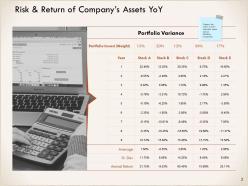
Slide 3: This slide presents Risk & Return of Company’s Assets YoY capturing the return of each individual asset with an offsetting investment.
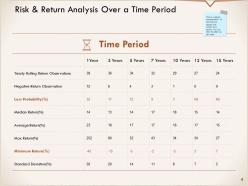
Slide 4: This slide displays Risk & Return Analysis Over a Time Period in a tabular form to represent financial assets over certain time period.
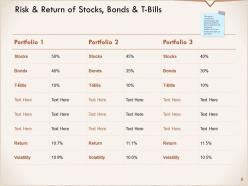
Slide 5: This slide represents Risk & Return of Stocks, Bonds & T-Bills, comparing the alternate portfolio that outperforms the traditional portfolio.You can modify the table as per need.
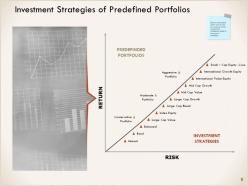
Slide 6: This slide showcases Investment Strategies of Predefined Portfolios in a graphical form to list down all the investment strategies based on the type of portfolios.
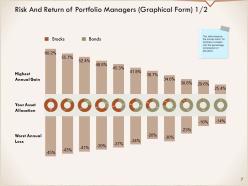
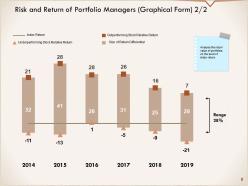
Slide 7: This slide shows Risk and Return of Portfolio Managers to measure the annual return for company’s assets with the percentage composition of allocation.
Slide 8: This is another slide presenting Risk and Return of Portfolio Managers.
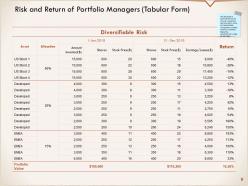
Slide 9: This slide displays Risk and Return of Portfolio Managers in a tabular form to track the record of fund investment with the return value and percentage composition of stock holding in portfolio.
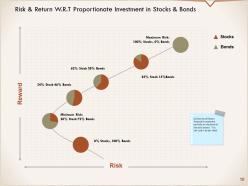
Slide 10: This slide represents Risk & Return W.R.T Proportionate Investment in Stocks & Bonds.
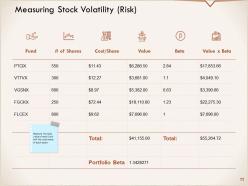
Slide 11: This slide is titled as Measuring Stock Volatility with categories as Funds, No. of Shares, Cost/Share, Value, Beta, Value x Beta.
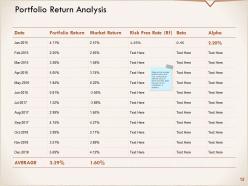
Slide 12: This slide showcases Portfolio Return Analysis to measure the average portfolio return and Avg. market return with the value of alpha and beta, given the level of risk undertaken in portfolio.
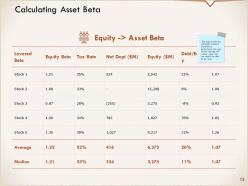
Slide 13: The slide provide the composite measure of portfolio’s performance that also include average and median value. You can modify the table as per need.
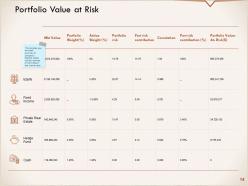
Slide 14: This slide shows Portfolio Value at Risk to give the broad summary of company’s financial assets with the estimate of risk measure and market value.
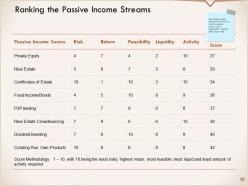
Slide 15: This slide presents Ranking the Passive Income Streams in a tabular form describing the five factors to rank the passive income of the organisation.
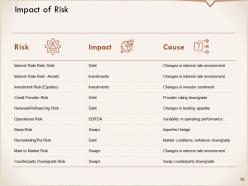
Slide 16: This slide displays Impact of Risk showing risk, impact and cause.
Slide 17: This slide showcases Risk and Return Relationship icons.
Slide 18: This slide is titled as Additional Slides for moving forward.
Slide 19: This is Our Mission slide with related imagery and text boxes.
Slide 20: This is About Us slide to show company specifications etc.
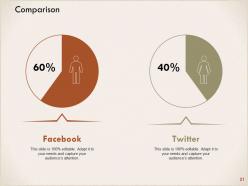
Slide 21: This is a Comparison slide to state comparison between commodities, entities etc.
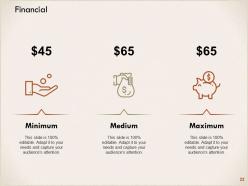
Slide 22: This is a Financial slide. Show your finance related stuff here.
Slide 23: This is Meet Our Team slide with names and designation.
Slide 24: This slide is titled as Post it. Post your important notes here.
Slide 25: This is Our Target slide. State your targets here.
Slide 26: This slide shows Magnifying glass to highlight information.
Slide 27: This is Meet Our Team slide with names and designation.
Slide 28: This is Thank you slide with address, contact numbers and email address.
Risk And Return Relationship Powerpoint Presentation Slides with all 28 slides:
Our Risk And Return Relationship Powerpoint Presentation Slides have great character. They will give prominence to your thoughts.








FAQs for Risk And Return Relationship
So basically, you can't have amazing returns without taking on more risk - that's just how markets work. Government bonds are super safe but only give you like 3-4%. Stocks? They might hit 10% but could also tank 20% when things go south. Your timeline matters a ton here. Need the cash soon? Play it safe with boring stuff. But if you're young and won't touch it for decades, you can ride out the crazy ups and downs. I mean, time is honestly your biggest advantage when you're investing long-term. Just figure out how much volatility you can actually stomach without losing sleep.
So basically, stocks can make you the most money but they're also gonna stress you out with all the ups and downs. Bonds are way more chill - steady income, not too crazy risky. Real estate sits somewhere in between, though honestly that depends on if you get stuck with tenants who never pay rent lol. Here's the thing though - you can't expect huge returns without dealing with the anxiety of watching your money bounce around. That's just how it works. When you're putting together your portfolio, be real about how much crazy you can handle before you panic sell everything.
Honestly, diversification is like the golden rule of investing - don't put everything in one place because if that tanks, you're screwed. Mix up your portfolio with different stocks, bonds, maybe some international stuff. You'll still have risk (nothing's foolproof), but at least when one investment goes south, others might balance it out. The trick is finding the right balance - too scattered and you won't see great returns, but too concentrated is risky as hell. I learned this the hard way during my first year investing lol. Start simple with basic asset classes and build from there.
Look at three main things: how long until you need the money, your current financial situation, and honestly how you handle stress. Young with stable income? You can probably take more risks. But here's the thing - if watching your investments tank makes you lose sleep or sell everything in a panic, then age doesn't matter much. Think about losing 20% overnight. Could you handle that? I'd start with one of those online risk quizzes, then maybe put just a little into something riskier first. See how you actually feel when it's your real money moving around.
Start with Sharpe ratios - they're pretty straightforward and show how much return you get for the risk you're taking. Standard deviation measures volatility (aka your stress level), while expected return is... well, what you'd expect to make. CAPM is the old-school model everyone learns - uses beta to compare stuff against the market. VaR is another one for measuring downside risk, though honestly it can get pretty complicated. Sharpe ratios are your best friend for comparing different investments quickly. My finance prof was obsessed with them, but they really do make sense once you get the hang of it.
Volatile markets are wild - they basically stretch everything wider, so your potential losses AND gains get bigger. Most people freak out and make dumb moves when things get choppy, which kills their returns. But honestly? Those scary times are often when you'll find the best deals. I learned this the hard way in 2020 when I almost panic-sold everything. The trick is staying calm and sticking to whatever plan you had before the chaos started. Don't let short-term craziness mess with your long-term strategy - that's where people usually screw themselves over.
So here's the thing about inflation - it literally steals your returns. Like if you're making 7% on something but inflation's at 3%, you're only actually gaining 4% in buying power. It gets weird too. Sometimes "safe" stuff like savings accounts are actually the riskiest move when inflation's high. You think you're playing it safe but you're basically losing money. I always look at real returns now, not just the number they show you. Makes way more sense when you're trying to figure out if an investment's actually worth it or just looks good on paper.
Dude, biggest myth? That higher risk = guaranteed higher returns. Nah, you just get higher *potential* returns - could totally tank instead. People think diversifying makes you bulletproof (spoiler: it doesn't), and everyone assumes past wins predict future ones. The worst part? Thinking you can time everything perfectly - like, avoid crashes but catch all the good stuff. I've tried this before, it's basically impossible unless you're psychic. Honestly, figure out what risk you can actually stomach first. Then build around that instead of chasing crazy returns.
Your brain plays tricks on you when investing, and it's honestly pretty predictable. Recent losses feel way worse than they should, so you might panic sell. Or you'll hold onto losers forever thinking they'll recover eventually. Chasing last year's hot stocks? Yeah, that usually backfires too. We're terrible at spotting real patterns vs random noise - I do this all the time. The fix is pretty straightforward though: set up rules ahead of time. Rebalance quarterly no matter what. Decide your exit strategy before you buy. Takes the emotions out of it.
Honestly, diversification is your best friend here - spread across different assets, regions, and timeframes. If you're young, load up on stocks. Getting closer to retirement? Bonds become more important. Dollar-cost averaging is clutch because it basically puts investing on autopilot and smooths out those crazy market swings. I'd rebalance every quarter or so to stay on track. Your risk tolerance will probably shift as life happens (mine definitely has), so check in with yourself regularly. But first things first - figure out what you're actually saving for and when you need the money. That's gonna shape everything else you do.
So geopolitical stuff basically makes markets freak out because nobody likes uncertainty. When tensions spike, money rushes into safe bets like US bonds, driving their yields down. Meanwhile emerging markets get crushed with higher risk premiums. Currency swings can be nuts too - I've watched portfolios move 15% just from exchange rate chaos during major conflicts. Here's the thing though: these disruptions usually don't match the actual long-term picture. Keep some cash on the sidelines and think of it as a chance to rebalance when everyone else is losing their minds.
So here's the deal with bonds and interest rates - they're basically enemies. Your old bonds lose value when rates go up because why would anyone want your crappy 3% bond when new ones pay 5%? But flip side, you can now buy those higher-paying bonds yourself. Longer bonds get hammered way worse than short ones during rate changes. I honestly think most people should just stick with shorter durations unless you're planning to hold forever. The volatility on long bonds can be brutal. Match whatever you buy to when you'll actually need the money back.
Looking at historical data gives you a solid starting point - you can see what different assets have actually returned over time and how bumpy the ride was. I always check how investments correlated with each other and what happened during market crashes. Obviously past performance doesn't mean future results will be the same (markets change constantly), but it helps you get realistic about risk-return relationships. You'll want to adjust those expectations based on what's happening now economically. Sometimes I get a bit obsessed with the data, but honestly it beats going in blind.
ESG investing basically adds another layer to the whole risk-return thing. You might be okay with slightly lower returns if it matches your values - though honestly, some ESG funds are crushing traditional ones lately. Weird, right? The tradeoff isn't as brutal as people used to think. But here's the thing: higher returns still mean more risk, that's just how it works. Your "return" now includes the feel-good factor too though. So when you're deciding if the risk is worth it, you've got to weigh both the money you might make AND the impact you're having.
So alternative investments are basically anything outside stocks and bonds - think real estate, private equity, commodities, that kind of stuff. The cool thing is they don't usually move with regular markets, so you get better diversification. Some can give you higher returns too. But heads up - a lot of these are super illiquid, meaning your money's tied up for years sometimes. Oh and the fees can be brutal. I learned that the hard way with my first REIT investment lol. Just make sure you actually understand what you're getting into before you commit.
No Reviews