

Business Risk Analysis Powerpoint Presentation Slides




Try Before you Buy Download Free Sample Product
 Impress Your
 Audience
 100%
100% Editable
 Save Hours
 of Time


Introducing Business Risk Analysis PowerPoint Presentation Slides. With the help of this mitigation plan PPT template, you can handle the issues that decrease your key business growth. By using a business threat assessment PowerPoint presentation complete deck, you can create risk assessment programs which helps you to identify the major challenges. You can control the activities while launching a new product using a hazards management PPT template. There are numerous hazards like inadequate planning, absence of leadership, poor cost estimates, low definition scopes, etc. which you can focus on using our professionally designed risk resolution PowerPoint presentation slides. With the help of a financial risk PowerPoint presentation template, you can track the errors. This risk management PPT includes diagrams and high-quality icons with which you can make your presentation even more engaging. Therefore, download this ready-to-use risk analysis PowerPoint presentation deck and detect the business threats you face.
People who downloaded this PowerPoint presentation also viewed the following :
Content of this Powerpoint Presentation
Slide 1: This slide introduces Business Risk Analysis. State Your Company Name and begin.
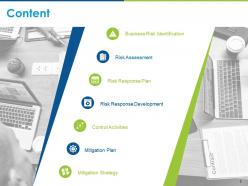
Slide 2: This slide shows content of the presentation.
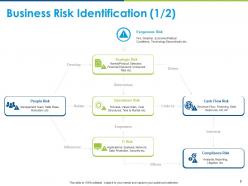
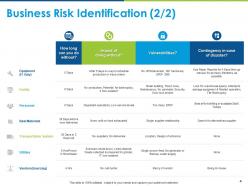
Slide 3: This slide presents Business Risk Identification describing- People Risk, Strategic Risk, Operations Risk, IT Risk, Cash Flow Risk, Compliance Risk, Exogenous Risk.
Slide 4: This slide displays Business Risk Identification in tabular form.
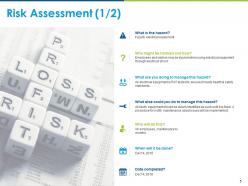
Slide 5: This slide represents Risk Assessment with related imagery.
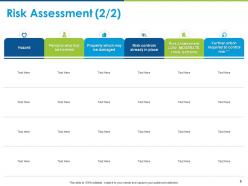
Slide 6: This is another slide on Risk Assessment with categories as- Hazard, Persons who may be harmed, Property which may be damaged, Risk controls already in place, Risk Assessment LOW, MODERATE, HIGH, Extreme, Further action required to control risk.
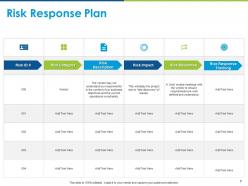
Slide 7: This slide showcases Risk Response Plan describing- Risk ID, Risk Category, Risk Description, Risk Response, Risk Impact, Risk Response Tracking.
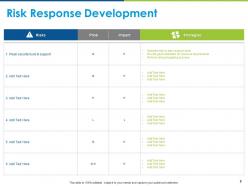
Slide 8: This slide shows Risk Response Development in tabular form.
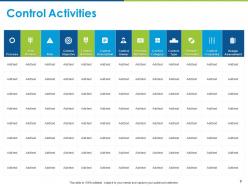
Slide 9: This slide presents Control Activities describing- Process, Risk number, risk, control objective, control number, control description etc.
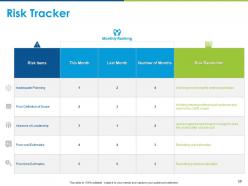
Slide 10: This slide displays Risk Tracker with risk items, risk resolution and number of months.
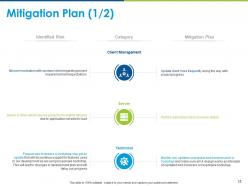
Slide 11: This slide represents Mitigation Plan with categories as- Client Management, Server and Technical.
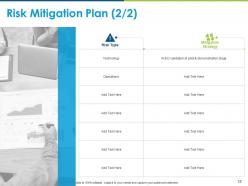
Slide 12: This is another slide on Risk Mitigation Plan.
Slide 13: This slide displays Business Risk Analysis Icons.
Slide 14: This slide is titled Additional slides for moving forward.
Slide 15: This is About Us slide to show company specifications etc.
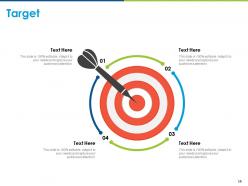
Slide 16: This is a Target slide. State your targets here.
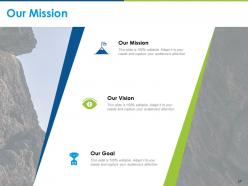
Slide 17: This is Our Mission slide with related imagery and text.
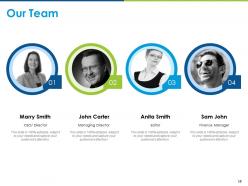
Slide 18: This is Our team slide with names and designation.
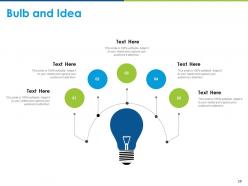
Slide 19: This is a Bulb and Idea slide to state a new idea or highlight information, specifications etc.
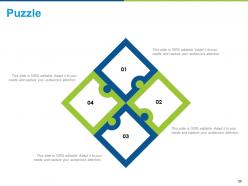
Slide 20: This is a Puzzle slide with text boxes.
Slide 21: This is a Venn slide with text boxes to show information.
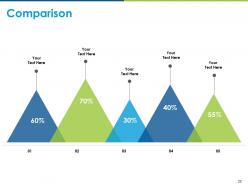
Slide 22: This is a Comparison slide to state comparison between commodities, entities etc.
Slide 23: This slide shows Magnifying Glass to highlight information, specifications etc.
Slide 24: This is a Thank You slide with address, contact numbers and email address.
Business Risk Analysis Powerpoint Presentation Slides with all 24 slides:
Docket it on our Business Risk Analysis Powerpoint Presentation Slides. Explain all the key ingredients.


FAQs for Business Risk Analysis
You'll want to cover four main things: identifying threats, figuring out how likely they are, analyzing potential damage, and planning how to handle them. Map out everything that could mess with your business - money problems, operational stuff, regulatory issues, you name it. Then rate each risk by probability and potential impact on your operations and profits. Honestly, this part always feels like a nightmare at first, but just tackle it piece by piece. Create actual action plans for your biggest risks. The whole thing's pretty useless though if you don't actually refer back to it and keep updating as things change.
Look at this from different angles - money stuff, day-to-day operations, regulations, market changes. Map out your main processes and ask "what breaks here?" at every step. Get people from other departments involved because honestly, they'll catch things you never thought of. Check what went wrong before, watch industry news, and yeah - cyber attacks and supply chain issues are huge now. I'd do these reviews every quarter and keep a simple spreadsheet tracking everything. Sounds boring but it works. Don't overthink the format - just get the risks down on paper first.
So data analytics is like having x-ray vision for risk stuff. You can actually see patterns in all that historical data instead of just winging it with spreadsheets. The cool part? Algorithms crunch way more variables than we ever could and spit out probability scores for different scenarios. Real-time dashboards keep you current too - no more working with last month's numbers. Honestly, I'd start small though. Pick one area where your data doesn't suck and build from there. Don't try analyzing everything right away or you'll just overwhelm yourself.
Go with hard numbers when you've got solid data - financial losses, probability stuff, the usual suspects. Reputation damage though? Good luck putting a number on that mess. Same goes for regulatory changes. That's where you need the qualitative stuff from your team's gut feelings and experience. Start with whatever numbers you can actually trust, then build in the human judgment part. I'm big on creating some kind of scoring matrix that mixes both approaches. Don't just rely on spreadsheets OR hunches alone - use the numbers to check your instincts and let your instincts question the math.
Honestly, the usual suspects are operational stuff - supply chain breakdowns, tech crashes, that kind of mess. Financial risks too like cash flow getting tight or credit issues. Cybersecurity is probably the scariest right now, feels like there's a new breach every week. Market shifts can kill you - competitors swooping in or demand just vanishing. Regulatory changes blindside companies all the time. Oh, and social media can torch your reputation overnight, which is wild. Strategic risks happen when your whole business model goes stale. Maybe do a quarterly check where you rank what's most likely to hit your specific situation?
So basically you want a risk matrix - just plot everything on a grid with likelihood vs impact. The stuff that's both high impact AND high probability? That's your fire drill material right there. Medium risks come after that. Honestly, the best thing I ever did was loop in other departments for the scoring part. They catch blind spots you'd never think of. Don't get stuck in worst-case-scenario mode though - be realistic about what could actually happen. Focus your energy on that top-right corner first, then work down from there.
For risk management frameworks, I'd go with COSO ERM, ISO 31000, or just good old SWOT analysis. COSO's super comprehensive but honestly overkill unless you're at some massive corporation. ISO 31000 works great for mid-size companies - gives you that systematic approach without being crazy complicated. SWOT's perfect for quick strategic stuff since literally everyone gets it. Oh, and bow-tie analysis is solid if you're dealing with operational risks specifically. Really depends on your company's size though. Don't make it harder than it needs to be from day one - you can always scale up the complexity later.
So tech can actually save your ass from major business headaches. Automation cuts out those stupid human mistakes in important stuff. AI analytics help spot problems before they blow up - which honestly saves so much stress. Cybersecurity tools are obvious but super necessary for protecting your data. Cloud backup is huge for disaster recovery too. Most people don't realize how expensive downtime gets until it hits them. Real-time monitoring catches issues right away instead of finding out weeks later when everything's already screwed. I'd start by figuring out your worst risks first, then see what tech fixes those specific problems.
Honestly, annual risk reviews are pretty much useless now - everything moves too fast. I'd switch to quarterly checks, maybe even monthly if things get really crazy. Stop trying to predict every possible disaster and focus more on "what if" scenarios instead. Like, what happens if your biggest client disappears tomorrow? Build bigger cash cushions too, because surprises always cost more than you think they will. The whole goal is staying flexible rather than having some perfect master plan. Oh, and stress-test your assumptions constantly - that's where most people get blindsided.
Map out which regulations hit your business first - SOX for public companies, GDPR for data stuff, HIPAA if you're in healthcare. The list goes crazy depending on your sector. Build monitoring into your regular risk reviews because regulations change faster than most companies can handle (it's honestly ridiculous). Your risk assessments need to catch where regulatory shifts could mess with operations. Document everything for audits - trust me on this one. Make sure your controls actually match what's legally required. Don't just check boxes; regulations will bite you if your framework doesn't align with real requirements.
Getting different people involved in risk assessment is a game changer - you'll catch way more stuff. Your finance folks might spot cash flow issues that ops completely misses. Meanwhile, frontline workers see day-to-day problems that executives are totally blind to. It's basically like having extra eyes on everything, which you definitely want. Different perspectives mean you get the full picture instead of just one angle. Oh, and here's what works: figure out who's involved in each process, then literally just ask them what worries them most about their job. You'd be surprised what comes up.
Set up monthly or quarterly risk meetings - depends how fast your industry moves. Build a risk register tracking status, probability, and impact for each risk. Executives eat up dashboard visuals, so lean into that. Make sure you assign actual risk owners who give a damn, not someone who just got stuck with it. Automated alerts for key indicators are clutch when things start going sideways. Honestly, the biggest thing is making this part of your regular routine. Nothing worse than scrambling to pull risk data together when leadership suddenly wants answers and you've got nothing ready.
Oh man, culture totally changes how teams handle risk. Some groups want every detail planned out - they hate uncertainty. Others? They're cool with winging it and changing course fast. Your company's vibe matters too. Startups love that "fail fast" mentality, but bigger companies usually want stability first. I've watched this mess up so many projects honestly. People from different countries, age groups, even departments (sales people vs compliance folks) see the same risk completely differently. Some think it's scary, others see opportunity. You gotta figure out these differences before building any risk strategy.
Okay so basically you've got to speak different languages to different people. Executives want the big picture stuff - how much money we're talking, what's the timeline. But your ops teams need the actual step-by-step fixes. Skip the corporate buzzwords though, nobody has time for that. Numbers are your friend - throw in percentages and dollar amounts whenever you can. Heat maps are clutch because honestly, half these people won't read a full report anyway. Stay consistent with how you rate everything across the board. Oh and here's the thing - never just dump problems on people. Always give them the "so what do we do now" part. That's what separates useful risk reports from useless ones.
So here's the thing - scenario planning makes you think way beyond what you'd normally consider. You take your risks and run them through different "what if" situations. Economic crash, supply chain mess, market going crazy, whatever. It's like stress-testing but for your whole risk analysis. Honestly, this is where you'll catch stuff you totally missed before - like how risks connect to each other in weird ways. I'd start with maybe 3-4 scenarios that could actually happen to your business. Then see which ones make your key risks look really bad. That's where you're most screwed if things go sideways.
No Reviews