


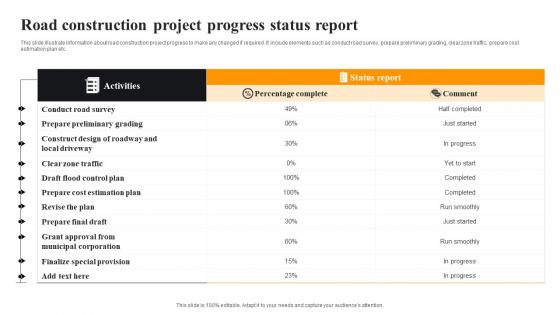
Road Construction Project Progress Status Report




Try Before you Buy Download Free Sample Product
 Impress Your
 Audience
 100%
100% Editable
 Save Hours
 of Time


This slide illustrate information about road construction project progress to make any changed if required. It include elements such as conduct road survey, prepare preliminary grading, clear zone traffic, prepare cost estimation plan etc.
People who downloaded this PowerPoint presentation also viewed the following :
Road Construction Project Progress Status Report with all 6 slides:
Use our Road Construction Project Progress Status Report to effectively help you save your valuable time. They are readymade to fit into any presentation structure.





FAQs for Road Construction Project
So road construction basically has five main phases that'll impact your timeline. Planning and design can drag on for months - honestly the most boring part but whatever. Then you've got site prep and moving utilities around, earthwork/grading, actual paving, and finishing touches like striping. Earthwork usually takes forever, especially if they hit weird soil or bad weather. Site prep gets messy too when there's more underground stuff than expected. Each phase depends on the last one, so delays just keep snowballing. I'd definitely pad your timeline by 20-30% for weather and random surprises. Also, figure out where utilities are located ASAP - trust me, you don't want expensive do-overs later.
Dude, weather will absolutely wreck your timeline if you don't plan for it. You can't pour concrete or lay asphalt when it's raining - needs to be dry or it won't set right. Once temps drop below 40°F, paving work basically stops. Wind's a pain too since it messes with cranes and moving materials around. I swear some crews act like 15mph gusts are the end of the world, but whatever. Hot days mean more breaks for workers, which slows everything down. Snow obviously kills productivity completely. Spring's the worst since weather changes every five minutes, so definitely pad your schedule with extra time.
You'll mostly see asphalt, concrete, and aggregates like gravel for the base. Asphalt's cheaper upfront and flexible, but honestly it's kind of high-maintenance - needs resurfacing every 15-20 years. Concrete costs more initially but lasts 30+ years if you're lucky. That aggregate foundation layer is huge though, gives everything its strength. Climate's a big factor too. Hot weather destroys asphalt faster, and those freeze-thaw cycles are brutal on concrete. Oh, definitely check your local DOT specs - they know what works best for your area's traffic and weather patterns.
Dude, permits will absolutely wreck your timeline if you don't get ahead of them. I'm talking weeks or months just sitting around waiting - environmental stuff, utility approvals, traffic permits, all that bureaucratic nonsense. Some places are ridiculously slow (our county office is basically where time goes to die), but others actually have their act together. Submit everything super early and just assume it'll take forever when you're planning. Oh, and befriend whoever works at the permit office. Seriously, being nice to those people can cut your wait time in half.
Dude, the tech stuff happening right now is wild. AI project management tools are everywhere, plus you've got automated paving machines and IoT sensors tracking concrete curing and traffic patterns. Surveying with drones is so much faster than the old-school way - honestly, it's kind of a no-brainer at this point. 3D modeling catches design screwups before they cost you big money. There's also smart compaction that adjusts itself based on soil conditions, which is pretty neat. All this can slash your timelines by 20-30% and cut down on expensive do-overs. Start with drone surveying - easiest upgrade and you'll see returns immediately.
Honestly, getting the community involved early saves you so much headache later. People will tell you about weird utility lines or parking issues your engineers never would've spotted. Start this during planning though - not after you've designed everything, because that's just asking for trouble. When residents feel heard from the beginning, they're way less likely to file complaints that bog you down legally. I learned this the hard way on a project once. You'll catch expensive problems before they become change orders. Plus locals know traffic patterns and stuff that outsiders miss completely.
So construction crews have tons of safety stuff they do. They throw up barriers and cones everywhere to route traffic around the work areas. All the workers have to wear those bright orange vests and hard hats - honestly those vests are lifesavers. Flaggers control traffic flow and keep speeds down too. OSHA has strict rules they follow for running equipment and managing sites. Oh and if you're driving through - just slow down and pay attention. I swear some people drive like idiots through construction zones. Those workers really depend on drivers being careful.
Dude, get your environmental impact assessment done first - trust me on this one. Water runoff is massive - sediment can't hit streams or storm drains. Dust control and equipment emissions matter for air quality. Wildlife corridors get complicated if you're cutting through habitats (Route 9 was a nightmare for that reason). Noise restrictions apply near residential zones, obviously. Oh, and contaminated soil disposal - you might dig up some nasty stuff. Honestly, tackling the environmental stuff early saves you from wanting to pull your hair out later.
Money controls literally everything on these projects. Got a big budget? You can spring for the good asphalt and faster methods that don't mess up traffic as much. Tight budget means you're stuck with basic materials and slower traditional approaches - which honestly sucks but that's reality. The whole thing becomes this annoying balancing act between what you want long-term versus what you can actually afford right now. I always tell people to be super clear with everyone involved about what they're actually getting for their money. Nobody wants those awkward conversations mid-construction when expectations don't match reality.
City projects are such a nightmare - traffic everywhere, utilities criss-crossing underground, and you're basically working in a shoebox. Residents hate the noise too, which I totally get. Rural stuff has different problems though. Weather screws you over way more often. Getting materials out there takes forever, and sometimes the soil is garbage but you don't know until you're already digging. Urban jobs are all about juggling utilities and keeping traffic flowing. Rural ones? You better have backup plans for when everything goes sideways with weather and logistics.
Big projects are basically coordination nightmares - you've got environmental reviews, public hearings, multiple agencies all wanting their say. Small road jobs? Way simpler. Just basic tracking tools and maybe 3-4 people calling the shots. Honestly the paperwork difference is insane. Large-scale stuff needs formal governance structures while smaller ones can wing it more. Oh and budget way more time than you think for approvals on anything big - I learned that the hard way on my last project. Stakeholder management alone will eat months.
Dude, traffic management can make or break your whole project. Plan it as seriously as the actual construction - trust me on this one. Phased construction works best, where you tackle sections instead of the whole mess at once. Good signage and barriers are obvious but people still screw it up. Flaggers or temp signals help at busy spots. Oh, and definitely give local businesses a heads up beforehand or they'll hate you forever. I learned that the hard way on my last job. Keep traffic moving and workers safe, because nothing's worse than dealing with road rage when you're just trying to get stuff done.
So basically you feed all your past project data into predictive analytics - stuff like weather patterns, how your equipment usually performs, resource availability, all that. It crunches everything to spot patterns and warn you about bottlenecks before they mess up your timeline. Real-time data from your current job helps it adjust predictions as things change (which they always do, right?). Set up alerts for risky scenarios so you can shuffle crews around or order materials early when it sees delays coming. Pretty neat how it can actually get ahead of problems instead of just reacting to them.
Recycled asphalt pavement is where it's at right now - RAP, permeable stuff, bio-based binders. Honestly, permeable concrete totally changed the game for drainage problems I've dealt with. Less maintenance too since they handle water and temperature swings way better. Yeah, you'll pay more upfront but then you're not out there patching constantly. My buddy saved a ton going this route. Push for 25% RAP minimum if you can - proven tech and your future budget will thank you. Oh, and the sustainability angle doesn't hurt either.
Dude, the new construction gear is insane for speed. GPS graders hit millimeter accuracy so you're not redoing work constantly. Automated compactors actually tell you when dirt's packed right - no more guessing games. The asphalt spreaders nail perfect thickness in one go too. Real-time monitoring catches problems early before they blow up your budget. Honestly feels like cheating compared to the old days! My buddy just wrapped a project using this stuff and finished two weeks ahead. Rental costs seem steep but you'll make it back easy with the time you save.
-
If you are looking for satisfactory PowerPoint services, SlideTeam is your go-to place. I am fully contented with their research and development team.
-
SlideTeam never fails to surprise me with its amazing PPT designs. Thanks team for providing me with your constant support!