


Role of digital twin and iot optimize and digitalize supply chain operations




Try Before you Buy Download Free Sample Product
 Impress Your
 Audience
 100%
100% Editable
 Save Hours
 of Time


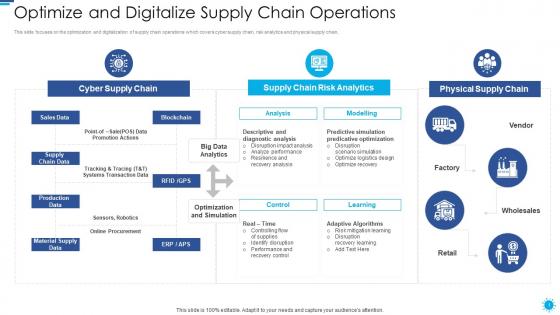
This slide focuses on the optimization and digitalization of supply chain operations which covers cyber supply chain, risk analytics and physical supply chain
People who downloaded this PowerPoint presentation also viewed the following :
Role of digital twin and iot optimize and digitalize supply chain operations with all 6 slides:
Use our Role Of Digital Twin And Iot Optimize And Digitalize Supply Chain Operations to effectively help you save your valuable time. They are readymade to fit into any presentation structure.





FAQs for Role of digital twin and iot optimize and digitalize
Key components of a digital twin in supply chain management include real-time sensor data, predictive analytics models, 3D visualization interfaces, integration platforms, and simulation engines. These technologies work together by monitoring physical assets, predicting potential disruptions, and optimizing logistics flows, with manufacturing and retail organizations finding that this strategic combination delivers enhanced visibility, reduced operational costs, and significantly improved decision-making capabilities.
IoT devices enhance digital twin functionality by providing real-time data streams, enabling predictive analytics, and automating response mechanisms across supply chain networks. Through connected sensors and smart devices, manufacturers and logistics companies can monitor inventory levels, track shipment conditions, and optimize warehouse operations, while reducing costs and improving delivery accuracy, ultimately delivering enhanced visibility and operational efficiency.
Real-time data serves as the foundation for digital twin supply chain optimization, enabling continuous monitoring of inventory levels, transportation routes, demand patterns, and operational bottlenecks across the entire network. This immediate visibility allows manufacturers and retailers to dynamically adjust procurement schedules, reroute shipments, and optimize warehouse operations, ultimately delivering reduced costs, improved delivery times, and enhanced customer satisfaction.
Digital twins predict supply chain disruptions by continuously monitoring real-time data from IoT sensors, analyzing historical patterns, and running predictive algorithms that identify anomalies in transportation routes, inventory levels, and supplier performance. Through machine learning models, companies can anticipate weather impacts, equipment failures, and demand fluctuations weeks in advance, ultimately enabling proactive mitigation strategies and maintaining operational continuity.
Key metrics include inventory turnover rates, order fulfillment accuracy, demand forecasting precision, warehouse utilization efficiency, and supply chain visibility scores. These measurements help organizations track how digital twin technology streamlines operations, reduces costs, and enhances customer satisfaction, with many logistics companies finding that improved forecasting accuracy ultimately delivers significant competitive advantages.
Digital twins enhance inventory management and demand forecasting by creating real-time virtual replicas that track stock levels, predict demand patterns, optimize reorder points, and simulate various supply scenarios. Through continuous data integration from IoT sensors, warehouses and retail chains can minimize stockouts, reduce excess inventory, and improve forecast accuracy by up to 30%, ultimately delivering significant cost savings and enhanced customer satisfaction.
Digital twins facilitate supply chain collaboration by providing a unified, real-time platform where manufacturers, suppliers, distributors, and retailers can access shared data, monitor performance metrics, and coordinate decisions seamlessly. Through synchronized digital models, stakeholders can identify bottlenecks, optimize inventory levels, and respond to disruptions collectively, with many organizations finding that this transparency significantly reduces communication delays and enhances overall operational efficiency.
Integration challenges include legacy system compatibility, data silos, high implementation costs, staff training requirements, and real-time connectivity issues. While these obstacles present complexity, many organizations find that phased rollouts across manufacturing and logistics operations ultimately streamline processes, enhance visibility, and deliver significant operational efficiency gains that justify initial investments.
Machine learning algorithms enhance digital twin accuracy by continuously analyzing real-time IoT data, identifying patterns in demand fluctuations, and automatically adjusting predictive models based on historical performance. These algorithms enable supply chain managers to anticipate disruptions, optimize inventory levels, and streamline logistics operations, with many manufacturing and retail organizations finding significantly improved forecasting precision and reduced operational costs.
Manufacturing, automotive, aerospace, pharmaceuticals, and logistics industries benefit most from digital twin IoT supply chain solutions due to their complex operations and precision requirements. These sectors leverage digital twins to optimize inventory management, predict equipment failures, streamline production workflows, and enhance quality control, ultimately delivering reduced operational costs and improved customer responsiveness.
Digital twin technology enhances asset lifecycle management by providing real-time monitoring, predictive maintenance capabilities, and comprehensive performance analytics throughout each asset's operational lifespan. Through continuous data collection and analysis, manufacturing plants, logistics companies, and energy facilities can optimize maintenance schedules, reduce unexpected downtime, and extend equipment longevity, ultimately delivering significant cost savings and improved operational efficiency.
Digital twins significantly reduce carbon footprints by enabling precise resource optimization, predictive maintenance scheduling, and waste minimization across supply chain operations. Through real-time monitoring and simulation, organizations streamline transportation routes, minimize energy consumption, and optimize inventory levels, with manufacturing and logistics companies finding that these virtual replicas deliver measurable environmental benefits while enhancing operational efficiency.
Digital twin simulations enhance logistics and transportation decision-making by creating real-time virtual models that predict traffic patterns, optimize route planning, and simulate various operational scenarios before implementation. These digital replicas enable supply chain managers to test different strategies, anticipate bottlenecks, and evaluate resource allocation decisions, with many transportation companies finding that this approach reduces costs while improving delivery efficiency and customer satisfaction.
Supply chain professionals need training in IoT data analytics, digital modeling software, systems integration, and predictive analytics to effectively leverage digital twin technologies. These skills enable teams to interpret real-time sensor data, optimize logistics workflows, and manage complex supply networks, with many organizations finding that cross-functional training in both technology and operations delivers the most strategic advantage.
Cybersecurity concerns significantly impact IoT and digital twin adoption by creating hesitation around data vulnerabilities, network security, and potential operational disruptions across interconnected supply chain systems. However, many organizations are finding that implementing robust encryption protocols, multi-layered authentication, and continuous monitoring frameworks enables them to harness these technologies' efficiency benefits while maintaining security, ultimately delivering competitive advantage through enhanced visibility and streamlined operations.
-
Great experience, I would definitely use your services further.
-
Enough space for editing and adding your own content.