


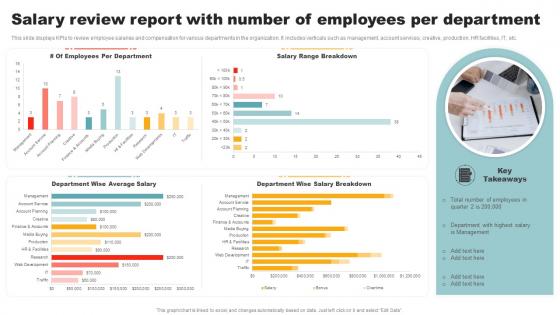
Salary Review Report With Number Of Employees Per Department




Try Before you Buy Download Free Sample Product
 Impress Your
 Audience
 100%
100% Editable
 Save Hours
 of Time


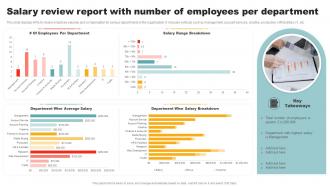
This slide displays KPIs to review employee salaries and compensation for various departments in the organization. It includes verticals such as management, account services, creative, production, HR facilities, IT, etc.
People who downloaded this PowerPoint presentation also viewed the following :
Salary Review Report With Number Of Employees Per Department with all 7 slides:
Use our Salary Review Report With Number Of Employees Per Department to effectively help you save your valuable time. They are readymade to fit into any presentation structure.





FAQs for Salary Review Report With Number Of
Focus on the big ones: current pay vs market rates, how they compare to coworkers, performance scores, and what it'll cost the budget. Retention risk is huge too - nobody wants to lose good people. Oh, and definitely include when they last got a raise because that always gets attention. Leadership will ask where your market data comes from, so have that methodology ready. Honestly, the executive summary is everything - lead with your main recommendations and total dollar ask. Give them enough context to either approve raises or at least explain why they can't.
Most places do annual reviews, but honestly that's kinda outdated now. I'd check your comp data twice a year minimum - quarterly if you're in tech or somewhere with crazy turnover. The market's moving so fast that waiting a whole year basically guarantees you're behind. What I usually tell people is do a quick check every 6 months, then go deep once a year. Pick like 3-4 key roles and see how they stack up against current market rates. That'll give you a good sense of where you actually stand. Trust me, you don't want to find out you're way off during exit interviews.
So basically, salary benchmarks are like your sanity check - they tell you what everyone else is actually paying for the same jobs. Without them, you're shooting in the dark and that's how you end up either hemorrhaging good people or blowing your budget on overpaid roles. I always pull from at least 2-3 different sources because one report can be totally skewed. The tricky part is comparing the right stuff - same location, industry, experience level. Otherwise you're looking at apples vs oranges and your data's useless. Trust me, competitors are using this info too.
Look, those salary reports basically tell you who's about to bolt before they do. Check who's getting underpaid compared to market rates - those are your flight risks. High performers stuck at old wages? They're already browsing LinkedIn, trust me. Plus you can catch weird pay gaps that'll bite you later. Way cheaper to give raises than hire replacements (and train them, ugh). The numbers also help when you're begging leadership for more budget. Run them every quarter though - don't wait until someone's already giving notice because then you're screwed.
Check out BambooHR, Workday, or PayScale - they'll handle most of your compensation analysis automatically. Excel works if money's tight, but those platforms pull market data and create the charts leadership actually wants to see. Plus they track salary history and catch equity issues early. Smaller teams might like Carta or Greenhouse since they have decent salary modules built in. Honestly, I'd start by writing down everything you do manually right now - then pick whichever tool kills your biggest headaches first. Way better than spending hours on spreadsheets every quarter.
Just be straight up about it - lead with the actual number first. Then walk them through why you landed there, like performance stuff or what similar roles are paying. Don't do this right before holidays though, that's just awkward timing. Be honest about your constraints if it's less than they wanted - people appreciate that more than corporate speak. Face-to-face is way better than email for this kind of thing. Oh and definitely write up notes afterward because HR will ask for documentation later. The whole thing feels less weird when you just treat it like a normal conversation instead of some formal announcement.
Budget constraints are the worst part, honestly. You're trying to keep good people while working with scraps. Market data is either old or all over the place, so benchmarking becomes this guessing game. Then there's the equity nightmare - making sure pay is fair across gender and race without getting sued. I swear half my job is just documenting why I made every single decision. Oh, and managing what employees expect vs. what you can actually deliver? That's fun too. Start collecting market data now though, and just be upfront with your managers about how messy this whole process really is.
Okay so first thing - pull your salary data and sort it by gender, race, age, all that stuff. Compare people in similar roles with similar experience. You're gonna want to look for patterns where certain groups keep getting paid less for basically the same work. Honestly, the data can be pretty shocking when you see it laid out. Run a pivot table analysis if you can - super straightforward and it'll show you the gaps right away. Also check if certain groups are stuck in the lower-paying positions while others dominate the senior roles. Numbers don't lie, even when the truth sucks.
Yeah, so basically companies look at their money situation first when deciding raises. Good economy = bigger budgets and better increases. Bad times? They'll freeze salaries even if you're crushing it (which is frustrating but whatever). Inflation's another big factor - that usually sets the minimum percentage they're working with. Right now with everything being expensive, that's definitely something to mention. I'd honestly just look up what's happening in your industry before you go in. Economy stuff changes fast, but knowing where things stand helps you figure out what's realistic to ask for.
Pull your last performance review data and compare it to what people are actually making - you'll probably find some weird mismatches. High performers getting underpaid while mediocre people coast at higher salaries? Classic. Use those gaps to build better incentive programs - targeted bonuses, merit pools, or faster promotion tracks for your best people. The key is checking if your top talent is getting paid competitively compared to market rates. Otherwise they'll just leave. Start with the obvious compensation vs performance mismatches first, then work from there.
Honestly, start with anonymous employee surveys - people are way more honest when they don't have to put their name on it. PayScale and Glassdoor are decent for benchmarking, though take them with a grain of salt. Your HR should have internal salary data too. Mix at least two sources because yeah, people definitely lie about what they make sometimes. Industry reports from those big consulting firms are solid if you can get them. Oh, and exit interviews are gold - someone who's already leaving will tell you exactly what's broken about your pay structure. I'd dig into your internal stuff first, then see how it stacks up against market rates.
Location makes a huge difference in salary reviews, honestly. Companies usually benchmark against local market rates, so if you're in SF or NYC, you'll probably see bigger bumps than someone in a smaller city. Cost of living and competition for talent vary so much between places - it's crazy how the same job can pay 50% more just based on zip code. Remote work has made this messier lately too. Some companies still do location-based pay while others don't. I'd check what your company's approach is and look up local salary data before going into your review.
Set up clear criteria first - performance stuff, market rates, budget limits - and tell everyone what they are. Document the whole thing so people get how decisions happen. Way too many places keep this secret and then wonder why everyone's pissed off. Post salary bands if you can swing it. Always walk through the "why" in review meetings. Honestly, half the battle is just not making it feel like some random mystery process. People need to trust it's fair and predictable. Oh, and definitely audit what you're doing now first - probably some messy steps in there.
Ugh, salary review discrepancies are the worst! First thing - document everything you're seeing. Compare your data sources because half the time it's just someone fat-fingering numbers or using old info. Once you figure out what's actually wrong, loop in HR and the managers ASAP. Don't wait around thinking it'll magically fix itself (learned that one the hard way). Write up what happened and how you're handling it. Then set up some checks so this mess doesn't happen again next time.
Honestly, salary reviews are perfect for this kind of stuff. Look at your compensation data to see where people usually move up and what skills actually get them there. Compare what your team has now against those higher-level roles - boom, there's your skill gaps. Then you can build training around that, maybe set up some mentoring or give people projects that stretch them. The cool part is you're showing them a clear path forward that's backed by real market data, not just vague promises. Way more motivating when they can see how developing X skill connects to actual career growth and better pay.
-
Been using SlideTeam for some time now…can’t imagine why I wasted all that time in front of the screen trying to make the perfect presentation.
-
SlideTeam is a great place for PPT templates. They have many templates on a single topic. It has made my life a lot easier.