

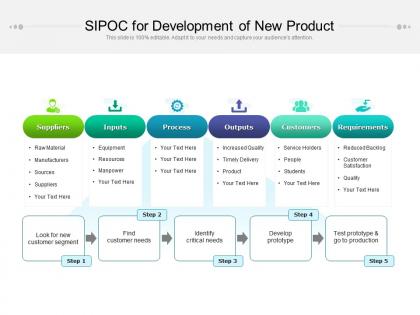
Sipoc for development of new product




Try Before you Buy Download Free Sample Product
 Impress Your
Audience
 100%
Editable
 Save Hours
of Time


Gear up for challenging adventures with our SIPOC For Development Of New Product. They are an excellent accessory to have.
People who downloaded this PowerPoint presentation also viewed the following :
Sipoc for development of new product with all 2 slides:
Acquire across the board flexibility with our SIPOC For Development Of New Product. Cater for fast changing demands.

FAQs for Sipoc for development
So SIPOC diagrams basically show you the big picture before you start messing with a process. Maps out your Suppliers, Inputs, Process, Outputs, and Customers all on one page. Super useful for setting boundaries - like when Karen from accounting tries to expand your project into her territory too (happens every time). You'll want to sketch one out first thing so everyone's on the same page about what you're actually fixing. It keeps stakeholders aligned on who's affected and what's really in scope. Honestly saved me so much headache on my last project. Just grab a whiteboard and start with the basics.
So SIPOC is basically this visual map that shows who does what in your process - Suppliers, Inputs, Process, Outputs, Customers. The cool thing? It forces different departments to actually sit down and talk. Which, let's be real, never happens otherwise. You'll catch all those messy handoffs where marketing thinks one thing and operations expects something totally different. IT finally gets why their decisions matter to customers. Honestly, just run a 90-minute SIPOC session at the start of your next cross-functional project. Those "not my job" fights? They'll disappear pretty fast.
So you'll want five columns with the right level of detail in each one. List your suppliers first - could be internal teams, vendors, whoever gives you stuff. Then inputs are the actual tangible things like data or materials. For the process part, stick to 4-7 high-level steps. Don't go nuts with every tiny detail or you'll hate yourself later. Outputs are what you're delivering, customers are who gets it. The trick is hitting that sweet spot where someone new could follow along without being overwhelmed. I'd map what you're doing now first, then worry about fixing things. Way easier than trying to design the perfect process from scratch.
SIPOC is honestly brilliant for finding stakeholders you'd totally overlook otherwise. You map out your Suppliers (who gives you inputs), Customers (who gets your outputs), plus all the Process people in between. Each group becomes a stakeholder with specific expectations or contributions. It's way more systematic than just brainstorming names - though I still forget to do it half the time. The cool part is seeing connections you missed. Start your next project with SIPOC and you'll catch people early instead of scrambling later when they pop up with opinions.
SIPOC is honestly a game-changer for scoping projects. You map out suppliers, inputs, process steps, outputs, and customers right at the start. No more jumping into the weeds too early (guilty as charged). The visual helps everyone get on the same page about what's actually in scope. You'll spot gaps and dependencies before they bite you later. Plus stakeholders love seeing the big picture laid out simply - makes those kickoff meetings way smoother. Next project, grab your team for 30 minutes and fill out those five columns. Trust me on this one.
Just do SIPOC first thing in your Define phase - trust me on this one. Get everyone on your team together and map out Suppliers, Inputs, Process steps, Outputs, and Customers on a whiteboard. There's something oddly satisfying about seeing it all drawn out visually. This gives you the big picture before diving into details, plus it helps identify who you'll need to work with later. Honestly, I've seen too many projects go sideways because people skipped this step. SIPOC keeps your scope tight and prevents that dreaded mission creep. Try a quick 30-minute session next time.
Stick to 5-7 big picture steps, not every tiny detail. Talk to people who actually know the process instead of making assumptions about suppliers and customers. Here's where everyone messes up - they try mapping their dream process instead of the messy reality that exists today. Focus on major outputs, not every random document or email that gets created along the way. I know it's tempting to fix everything upfront, but you need that baseline first. Map what's really happening now, then you can improve it later. Trust me, skipping this step just creates more headaches down the road.
Think of suppliers as everything feeding INTO your process - vendors, other departments, even automated systems. They're like the backstory before your main plot starts. Customers and process steps? That's your actual workflow and who gets the final outputs. Honestly, I always map suppliers first because they set up everything else. You can't really understand your process without knowing what's coming in, right? The "C" and "P" handle the during and after stuff, but suppliers are your starting point. Makes the whole thing way clearer once you nail down those inputs.
SIPOC's perfect for manufacturing - those production lines are messy. Healthcare uses it all the time for patient workflows, which honestly makes total sense when you think about all those handoffs. Banks love it for loan processing too. I've seen call centers have crazy success with it, though that might seem random. The thing is, these industries have super clear inputs and outputs, so mapping suppliers and customers is actually pretty straightforward. If your industry is process-heavy, just pick your worst workflow and map it out. You'll spot those annoying bottlenecks immediately.
Yeah, just make SIPOC way more flexible for Agile stuff. Create smaller versions for each sprint instead of one giant diagram - honestly, those huge upfront docs are kind of a waste anyway. Focus on suppliers, inputs, processes, outputs, and customers for whatever you're actually working on that iteration. Don't overcomplicate it though! Update it during retrospectives as you figure things out. I'd throw a quick template in whatever tool your team uses so people can edit it during sprint planning. Treat it like it's alive and changes with your project - way better than static documentation.
Honestly, just get everyone in a room together - don't try to build this thing solo. Start by interviewing a few key people first to understand their take on things. Then run some working sessions where people can actually build the SIPOC map as a group. Sticky notes are your best friend here, trust me. People get way more engaged when they can physically move stuff around. After that, have them review and tweak what you've captured. The whole point is making it collaborative rather than you presenting some finished diagram. Oh, and schedule that first workshop ASAP - like within the next week or you'll lose momentum.
SIPOC's actually pretty solid for this - just map out who your real customers are first (internal teams? end users?), then figure out what they actually want from you. Most of us get caught up thinking we know what matters to them, but honestly we're usually wrong. Work backwards from their needs to spot where you're missing the mark. The whole thing forces you to see through their eyes instead of yours, which is harder than it sounds. Try mapping just one customer journey this week - you'll probably find some obvious gaps you've been blind to. Short bursts work better than trying to tackle everything at once.
Walk through each SIPOC piece with the people who actually do the work - not just management. Double-check that your suppliers really provide those inputs you listed. Then trace everything forward to confirm outputs actually reach those customers. I swear, every time I do this validation step I find gaps I totally missed. It's wild how much we assume we know vs what's really happening. Also cross-check against any SOPs or process docs you've got lying around. The folks doing the daily grind will spot issues you'd never catch from your desk.
Honestly, SIPOC is a game-changer for finding where things go wrong. Map out your suppliers, inputs, process steps, outputs, and customers first - then you'll actually see the failure points before diving deep. Problems become way clearer when you can trace them backward from complaints or forward from supplier screwups. It's like finally getting directions when you're totally lost (which happens to me more than I'd like to admit). Your next root cause analysis will be so much easier if you sketch out that SIPOC diagram first. Trust me on this one.
SIPOC diagrams basically force everyone to look at the same picture instead of talking past each other. You know how meetings get when everyone's thinking about different parts of the process? This fixes that. The visual aspect is huge - people spot gaps they'd never catch just talking through stuff. When stakeholders see where they actually fit in the bigger workflow, they'll finally speak up about problems instead of staying quiet. Honestly, I've seen more "aha moments" from these simple diagrams than from hours of discussion. Next time your meeting feels confused, just grab a whiteboard and sketch one out.
No Reviews