


Vision statement for new product development




Try Before you Buy Download Free Sample Product
 Impress Your
 Audience
 100%
100% Editable
 Save Hours
 of Time


Our Vision Statement For New Product Development are topically designed to provide an attractive backdrop to any subject. Use them to look like a presentation pro.
People who downloaded this PowerPoint presentation also viewed the following :
Content of this Powerpoint Presentation
Description:
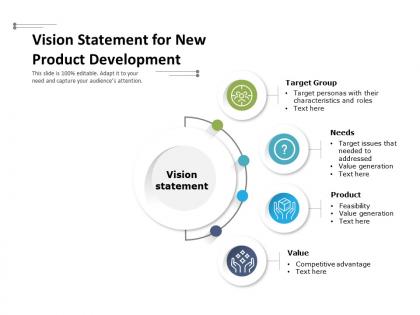
The image is a PowerPoint slide titled "Vision Statement for New Product Development." It serves as a structured template for defining the vision of a new product by addressing four key areas: Target Group, Needs, Product, and Value.
1. Vision Statement:
Central to the diagram, this is likely where the overarching vision or goal for the new product is succinctly stated.
2. Target Group:
Identifies the intended customers, including their characteristics and roles, to tailor the product effectively to their needs.
3. Needs:
Lists the specific issues or requirements the product aims to address, highlighting how it will create value for the target group.
4. Product:
Describes the practical aspects of the product, such as its feasibility and the value it will provide.
5. Value:
Focuses on the competitive advantage the product offers, which could be innovation, cost-effectiveness, or superior performance.
Use Cases:
This slide is useful for a variety of industries that focus on product development and innovation:
1. Technology:
Use: Outlining new software or hardware offerings.
Presenter: Product Manager
Audience: Investors, internal development teams
2. Pharmaceuticals:
Use: Crafting vision for new drug development.
Presenter: Research & Development Lead
Audience: Stakeholders, research scientists
3. Automotive:
Use: Presenting the concept for a new vehicle model.
Presenter: Design Chief
Audience: Executives, engineering teams
4. Consumer Electronics:
Use: Defining the future of home or personal devices.
Presenter: Innovation Director
Audience: Marketing team, R&D department
5. Fashion:
Use: Setting the direction for a new clothing line.
Presenter: Creative Director
Audience: Designers, brand managers
6. Food and Beverages:
Use: Introducing a new food product or drink concept.
Presenter: Product Development Chef
Audience: Marketing specialists, culinary team
7. Financial Services:
Use: Planning a new financial product or service.
Presenter: Strategy Officer
Audience: Financial analysts, product development team
Vision statement for new product development with all 2 slides:
Use our Vision Statement For New Product Development to effectively help you save your valuable time. They are readymade to fit into any presentation structure.
FAQs for Vision statement for
Look, a good vision statement has three things going for it: aspirational but not crazy unrealistic, specific enough that it actually guides decisions, and something your team can genuinely get behind. Where do you see yourself in 5-10 years? Paint that picture clearly - and honestly, skip the corporate buzzword nonsense because people see right through it. Keep it short too. If you need a whole paragraph to explain it, you've already lost people. Here's what I always tell people: test it on someone completely outside your business. Do they get it immediately? That's your answer right there.
So basically, your mission is what you're doing *now* - like your day-to-day purpose. Vision is where you wanna be down the road. I literally confused these for years until my old boss broke it down like this: mission answers "why do we exist today?" and vision is more like "what do we dream of becoming?" Your mission should feel totally doable and reflect what's actually happening. But vision? That should get you pumped up, maybe even sound a little crazy ambitious. I always just ask myself - am I talking about today or someday? Works every time.
Oh totally! Your vision statement should definitely evolve. Markets shift, companies grow, and honestly - what felt impossible a few years back might be your current reality now. Look at Netflix going from mailing DVDs to creating original shows, right? Update yours when you hit big milestones or pivot your business model. Just don't change it randomly every few months. I'd say review it once a year and ask yourself: does this still get us excited about where we're going? If it feels stale or off-track, time for a refresh.
Think of your vision statement as your company's GPS - without it, you're just driving around hoping to get somewhere useful. I've watched way too many teams skip this part and then act shocked when their strategy feels like a hot mess. Every opportunity that comes up? Run it through your vision filter first. Does it get you closer to where you want to be? If not, pass. Honestly, just tape that vision statement to the conference room wall before every planning meeting. Trust me, it'll stop you from chasing every shiny idea that walks through the door.
Honestly, your vision statement needs to show people WHY their work matters beyond just getting a paycheck. When employees see how their daily tasks connect to something bigger, they actually start caring about the results. It's that whole "laying bricks vs building a cathedral" thing - same work, totally different mindset. The trick is making your vision compelling enough that people genuinely want to help make it happen. Don't just dictate it from the top either. Get your team involved in creating or tweaking it. That buy-in makes a huge difference in whether they'll actually embrace it or just ignore another corporate poster on the wall.
Biggest mistake? Making it way too vague - like those generic corporate mission statements that could literally be for any company. You don't want something so ambitious it's laughable either (unless you're actually Elon Musk). Focus on one clear direction instead of cramming everything in there. Here's the thing though - if you write it alone in your office, your team won't care. Get them involved or it'll just collect dust. Make it memorable enough that people can actually say it without googling it. Oh, and definitely run it by a couple people you trust first before announcing it to everyone.
Honestly, templates are a game-changer for vision statements. Plain text is just boring - nobody remembers it. With visuals, you can break down complex stuff into bite-sized pieces that actually stick. Colors and images back up what you're saying too. People have zero attention span now (myself included lol), so you need something that pops. Templates save you hours of design work while hitting all the important bits - values, goals, impact, whatever. Just grab a simple one and throw in your brand colors. Way better than staring at a blank page forever.
Look at Disney's "To make people happy" - so simple but it hits you right in the feels. Tesla nailed it too with accelerating sustainable transport. Amazon used to crush it with being the most customer-centric company (though they've tweaked that since). Here's the thing - these actually mean something to employees. A Disney worker can instantly see how their job connects to making people happy, right? That's pure gold. When you're writing yours, try this: could someone working the front desk explain how their daily grind ties back to your vision? If not, you're probably overthinking it.
Your vision statement is basically what keeps everyone rowing in the same direction. People need something they actually believe in - not just some generic corporate poster nonsense. When your team genuinely buys into it, you'll notice they make better decisions without you having to micromanage everything. It becomes this invisible thread connecting how they work together, treat customers, handle problems. Honestly, if your employees can't recite it or roll their eyes when you mention it, you've got a problem. Short bursts of chaos are inevitable in business, but a solid vision keeps people grounded.
Mind mapping is honestly my go-to for this stuff - just put your company's main thing in the middle and branch out from there. The "future headlines" exercise is pretty cool too, where you imagine what news articles would say about you in like 5-10 years if everything went perfectly. SWOT analysis feels super corporate but it actually helps you figure out what makes you different. Oh, and definitely talk to your team or key people - they'll catch things you miss. I'd pick maybe 2 or 3 of these and just dedicate a good chunk of time to really thinking it through.
Start with everyone brainstorming solo first - way better than jumping straight into group chaos. Then use affinity mapping to cluster similar ideas together. The quiet people always have the best insights, so try anonymous submissions or go around the room so the extroverts don't steamroll everyone (learned this the hard way lol). Once you've got your main themes, collaborate on the actual wording. Don't stress about nailing it immediately. Keep tweaking until it genuinely feels like something your whole team would actually say, not some corporate BS.
Think of your vision as where you actually want to end up - like the big destination. Goals are just the steps that get you there. I know it sounds obvious, but so many people skip the vision part and wonder why their goals feel random or contradictory. You'll waste tons of time being "productive" without actually getting anywhere meaningful. It's honestly like driving around without knowing where you're going. Every goal should move you closer to that bigger picture. Otherwise you're just checking boxes for no real reason.
Skip the boring "We will be the leading provider" stuff and paint an actual picture instead. Like "Imagine families never stressing about Y because our tech made Z totally effortless." Way more powerful, right? Think of it as creating a movie trailer for your company's future impact. People connect with stories emotionally - they'll remember it and actually care about where you're headed. Honestly, most vision statements put me to sleep. Start by figuring out what success looks like for the people you're trying to help, then tell that story.
Honestly, the best test is just asking random employees to explain your vision back to you. If they're all over the place or drawing blanks, that's your answer right there. Run some surveys about whether people actually get it and feel pumped about it. Check your retention rates too - when people believe in where you're going, they tend to stick around. Oh, and sit in on leadership meetings. Do they even mention the vision or just skip straight to quarterly numbers? That tells you everything. Customer feedback helps too since a good vision should improve their experience somehow.
Honestly, just start with a Google Doc for drafting - way simpler than overthinking it. Miro's great for brainstorming with your team since everyone can throw ideas up there at once. Survey tools help you collect input from stakeholders without chasing people down. Then use something like Grammarly to polish the language (though don't let it make everything sound corporate-y). Canva's perfect for turning it into something visual for presentations. Oh, and definitely post it somewhere people will actually see it - Slack works better than email in my experience. The whole process is less painful when you're not doing everything manually.
No Reviews