


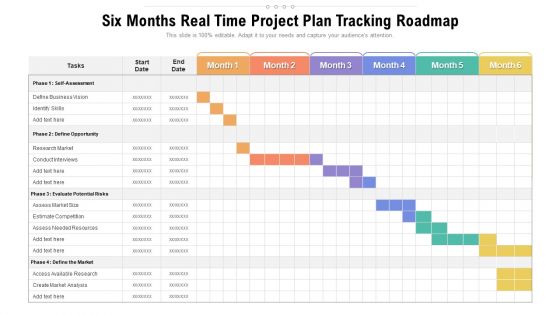
Six months real time project plan tracking roadmap




Try Before you Buy Download Free Sample Product
 Impress Your
 Audience
 100%
100% Editable
 Save Hours
 of Time


A cohesive work plan is essential for achieving the desired target. Communicate your vision and lay a firm ground in front of your audience with our PowerPoint layout. Align your project milestones, budgets, deliverables, deadlines, and all the requisite information for a dynamic presentation by employing this amazingly designed Six Months Real Time Project Plan Tracking Roadmap. Maximize team efficiency and streamline a work plan efficiently by introducing our ready made roadmap PowerPoint theme. You can quickly establish coordination between different activities across the organization and present an insight to your colleagues by utilizing this useful business tool. Color code specific tasks, prioritize, and keep a close eye on the deadlines with the help of our eye catchy PowerPoint template. Download our Six Months Real Time Project Plan Tracking Roadmap for excelling at productive management.
People who downloaded this PowerPoint presentation also viewed the following :
Six months real time project plan tracking roadmap with all 2 slides:
Use our Six Months Real Time Project Plan Tracking Roadmap to effectively help you save your valuable time. They are readymade to fit into any presentation structure.
FAQs for Six months real time project
Start with your main milestones and who's responsible for what. Timeline estimates are crucial - but seriously, add buffer time because projects always run late. Map out your dependencies too, that's where things usually break down. You'll need some way to track progress and flag risks before they blow up. Don't overcomplicate the stakeholder updates either, just set a regular cadence. The whole point is making something your team will actually reference, not another doc that gets buried. Keep it simple at first - you can get fancy with details once everyone's using it consistently.
Dude, get a project roadmap going - seriously changes everything. No more of those annoying "where are we on this?" meetings because everyone can just look and see what's happening. Dependencies become super obvious, plus people actually start talking to each other more since they can see how their stuff affects everyone else's work. When things go sideways (and they will), the whole team gets why and can pivot faster. I mean, I've seen teams waste hours just trying to figure out who's doing what. Make it visual and put it somewhere everyone can access - that's honestly the key part that most people mess up.
Honestly, Asana and Monday.com are your best bet if you want everything in one place - roadmaps plus task tracking. ProductPlan and Roadmunk look way more polished for client presentations though. I've seen teams do amazing things with just Notion databases too, especially if budget's tight. Jira with Portfolio is overkill unless you're already deep in agile stuff, but man does it pack a punch. Oh, and definitely test the free trials first - I learned that the hard way after paying for something my team hated using.
Honestly, I'd say every 2-4 weeks is a good sweet spot. Weekly works better if you're doing agile stuff since priorities change constantly (which is kinda annoying but whatever). Monthly updates are fine for those longer, more predictable projects. But here's the thing - update it whenever something big happens. New requirements, scope changes, timeline shifts, major blockers. Don't let it sit there collecting dust for over a month or it'll be completely useless. Pro tip: set a recurring calendar reminder or you'll definitely forget. I learned that one the hard way.
Start with your critical path - what directly hits your deadline. I rank by business impact first, then check dependencies since some stuff literally can't start without other pieces done. Quick wins are gold though, so grab those high-impact, easy tasks early. Resource availability is huge too - no point planning around people who aren't free yet. Time sensitivity matters obviously. Oh, and definitely loop in stakeholders during this whole process. Trust me, getting everyone aligned upfront saves you from those fun "wait, why isn't this finished?" meetings later.
Honestly, I'd focus on three main things: how many milestones you're actually hitting, whether you're sticking to your timeline (spoiler: probably not, but whatever), and if your team's stretched too thin or sitting around. Milestone completion is huge - it shows real progress vs what you planned. Timeline stuff reveals if you're behind schedule, which happens to literally everyone. Oh and resource utilization catches when people are drowning or bored. Throw in some red/yellow/green status updates for the big stuff since executives love that simple visual. Weekly dashboard keeps everything visible so problems don't blindside you.
Set up feedback checkpoints every 2-3 weeks - though honestly, adjust based on how fast things are moving. Get input from your stakeholders, team, and users through quick surveys or dedicated sessions. Document everything you hear (trust me, you'll forget otherwise). The real trick is actually doing something with the feedback. Don't just collect it and move on. Update priorities, shift timelines, maybe even pivot features if that's what the data's telling you. First step? Figure out who you need input from and when you'll reach out to them.
Honestly, visual design makes or breaks roadmaps. I've watched executives completely ignore messy spreadsheets while giving instant approval to clean, well-organized ones. Use intuitive colors - red for blocked stuff, green for on-track. Keep fonts readable and don't crowd everything together. Your stakeholders need to scan it quickly and actually understand what they're looking at. Consistent color coding for different phases helps a ton. Look, I'd say spend about 20% of your roadmap time just making it look decent. Sounds excessive but trust me - a digestible roadmap actually gets used instead of buried in someone's inbox.
Honestly, you've got to make everything way more visual since nobody can just pop over to check a whiteboard anymore. I'd go with something like Notion or Miro - even a shared Google Doc works if that's what your team already uses. The biggest thing though? Over-communicate like crazy. Seriously, it feels excessive but it's not when people are in different time zones. Set up those automated milestone notifications and make sure everyone knows who owns what. Build in extra time for delays too - async communication just takes longer. Regular check-ins are clutch, and pick one main place where the roadmap lives so people aren't hunting around for the latest version.
Honestly, roadmaps are game-changers for catching problems before they blow up. You get this bird's-eye view of everything - timelines, who's doing what, dependencies between tasks. Makes it super obvious where things might crash into each other. I always end up spotting bottlenecks I would've totally missed otherwise. The visual aspect really helps when you're trying to game out different scenarios too. You can see which pieces are make-or-break for your deadline and pad those areas with extra time. Just don't let it get stale - update that thing regularly or you'll be making decisions on old info.
First thing - set clear deadlines and milestones from day one. Those are gonna save your butt later. Track which tasks depend on others too, because that stuff always comes back to haunt you. I'm big on making everything visual - color coding, progress bars, whatever works. People don't want to dig through spreadsheets to figure out what's happening. Update weekly (minimum!) and send it out before anyone asks. Don't wait for them to come to you. Oh, and always pad your timeline. Things will go wrong. Make sure everyone knows who's doing what, and treat it like a real tool, not just eye candy for meetings.
Don't even think about building that roadmap alone - get your stakeholders involved from the start. Figure out who matters most and what success actually looks like to each person (spoiler: they'll all want different things). Build your timeline around their expectations, not yours. Track metrics they care about, not just what's easy to measure. Oh, and communication is huge here - you've got to keep everyone updated constantly. Set up regular check-ins so you can pivot before things go sideways. Trust me, it's way easier to adjust early than explain later why everything's off track.
Ugh, the worst thing you can do is get all detail-crazy with your roadmap. Like, tracking every little task? You'll be updating spreadsheets instead of getting shit done. Timeline-wise, be realistic and pad everything because something always goes sideways. Keep it flexible too - roadmaps that never change are basically useless. Oh, and this one bit me before: get your stakeholders on board early. Trust me, having everyone aligned upfront saves you from those fun conversations later when someone decides your priorities are "wrong." Way easier than dealing with pushback when things inevitably shift around.
Look at your last few projects and see where things actually went sideways - that's your roadmap gold. Teams always underestimate stuff, so find those patterns. What dependencies screwed you over? How long did things really take vs. what you planned? Honestly, I've never seen a team that accurately estimates on the first try. Pull data from 3-5 similar projects and you'll start seeing the same bottlenecks pop up. Then just bake that extra time into your next roadmap upfront. Way better than explaining to stakeholders why you're late again.
Honestly, project roadmaps are lifesavers. You'll catch budget problems and delays before they blow up in your face. Break everything down into phases with clear deadlines and spending limits - makes it way easier to track. When your boss inevitably starts breathing down your neck about progress, you've got real numbers to show them instead of just "uh, we're doing fine." My old manager used to review ours religiously every week, which seemed annoying but actually saved us twice. Set realistic timelines from the start though. Don't be that person who promises the moon.
No Reviews