


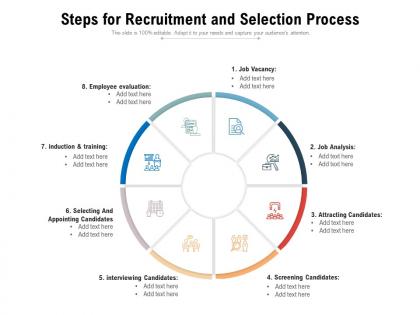
Steps for recruitment and selection process




Try Before you Buy Download Free Sample Product
 Impress Your
 Audience
 100%
100% Editable
 Save Hours
 of Time


Our Steps For Recruitment And Selection Process are explicit and effective. They combine clarity and concise expression.
People who downloaded this PowerPoint presentation also viewed the following :
Steps for recruitment and selection process with all 2 slides:
Give your audience a fulfilling experience. They will find our Steps For Recruitment And Selection Process elevating.
FAQs for Steps for recruitment
Recruitment involves attracting and generating a pool of qualified candidates through job postings, networking, and sourcing activities, while selection focuses on evaluating and choosing the best candidates through interviews, assessments, and reference checks. These complementary processes enable organizations to streamline hiring efficiency, reduce time-to-fill positions, and ultimately secure top talent that drives competitive advantage.
Companies effectively define job requirements by conducting thorough job analyses, clearly outlining essential skills versus preferred qualifications, specifying measurable performance expectations, and detailing growth opportunities within the role. This strategic approach streamlines the recruitment process by attracting qualified candidates while filtering out mismatched applicants, with many organizations finding that precise job descriptions reduce hiring time and improve candidate quality significantly.
Employer branding significantly influences talent acquisition by showcasing company culture, values, career development opportunities, and workplace environment to potential candidates. Strong employer brands attract higher-quality applicants, reduce recruitment costs, and improve candidate experience, with companies like Google and Microsoft finding that authentic branding messages ultimately deliver competitive hiring advantages and faster position fills.
Technology streamlines recruitment and selection through automated candidate screening, AI-powered resume parsing, video interviewing platforms, and digital assessment tools. These solutions significantly reduce time-to-hire by eliminating manual processes, while enabling HR teams to evaluate larger candidate pools more efficiently, ultimately delivering faster placements and improved candidate experiences across organizations.
Organizations should consider fairness in job postings, unbiased screening processes, transparent interview procedures, equal opportunity compliance, and candidate privacy protection during recruitment. These ethical practices help eliminate discrimination, ensure diverse talent pools, and build trust with candidates, while many companies finding that ethical recruitment ultimately enhances their employer brand and attracts higher-quality applicants.
Data analytics enhances candidate selection by analyzing performance patterns, predicting job success rates, reducing unconscious bias, and identifying key competency indicators from historical hiring data. Through predictive modeling and skills assessments, organizations streamline their recruitment processes, improve candidate quality, and reduce time-to-hire, ultimately delivering better cultural fit and long-term employee retention.
Bias-reduction techniques include structured interviews, diverse hiring panels, blind resume screening, standardized assessment criteria, and unconscious bias training for recruiters. These methods streamline evaluation processes by focusing on job-relevant skills, eliminating demographic identifiers, and ensuring consistent candidate comparisons, with many organizations finding that systematic approaches ultimately deliver more diverse talent pools and improved hiring decisions.
Candidate experience significantly impacts employer branding, talent acquisition success, and organizational reputation, with poor experiences deterring quality applicants and damaging company credibility. Organizations enhance candidate experience through streamlined application processes, transparent communication timelines, personalized feedback, and respectful interview practices, ultimately delivering stronger talent pipelines, reduced hiring costs, and competitive advantage in increasingly talent-competitive markets.
**INPUT**: What are the most effective interview methods for ensuring a good fit? **OUTPUT**: Effective interview methods include behavioral interviewing, structured panel discussions, skills-based assessments, cultural fit evaluations, and scenario-based questioning. These approaches enhance hiring accuracy by evaluating past performance, technical capabilities, and alignment with organizational values, with many companies finding that combining multiple methods ultimately delivers better retention rates and reduced turnover costs. [Word count: 53 words]
Organizations assess cultural fit through behavioral interviews focusing on values alignment, situational judgment tests, team-based interview panels, and cultural immersion experiences like office visits or collaborative exercises. These methods enable recruiters to evaluate communication styles, work preferences, and interpersonal dynamics, with many companies finding that structured cultural assessments significantly reduce turnover while enhancing team cohesion and organizational performance.
Remote recruitment presents challenges including limited candidate assessment opportunities, technology barriers, communication delays, cultural fit evaluation difficulties, and onboarding complexities. These obstacles can be overcome through structured video interviews, comprehensive skills assessments, streamlined digital platforms, and enhanced virtual onboarding processes, with many organizations finding that strategic technology adoption ultimately delivers faster hiring cycles and access to broader talent pools.
Diversity and inclusion initiatives fundamentally reshape recruitment strategies by expanding talent pipelines, eliminating unconscious bias through structured processes, and implementing targeted outreach programs. These approaches enable organizations to access broader candidate pools, enhance decision-making through diverse perspectives, and strengthen employer branding, with many companies finding that inclusive recruitment practices ultimately deliver improved innovation, employee retention, and competitive market positioning.
Social media enables recruiters to source candidates through LinkedIn professional networks, assess cultural fit via Facebook profiles, and showcase company culture through Instagram content. These platforms streamline talent acquisition by expanding candidate reach, reducing hiring costs, and accelerating screening processes, with many organizations finding that strategic social recruitment delivers broader talent pools and enhanced employer branding.
Candidate feedback improves recruitment and selection by identifying process inefficiencies, communication gaps, and experience pain points that may deter top talent. Through structured post-interview surveys and exit feedback, organizations can streamline application workflows, enhance interviewer training, and reduce time-to-hire, ultimately delivering better candidate experiences and stronger employer branding in competitive talent markets.
Key recruitment metrics include time-to-fill, cost-per-hire, quality of hire, source effectiveness, and candidate experience scores. These measurements streamline talent acquisition by identifying top-performing channels, reducing hiring costs, and improving candidate satisfaction, with many organizations finding that strategic metric tracking ultimately delivers faster placements and enhanced competitive advantage.
No Reviews