


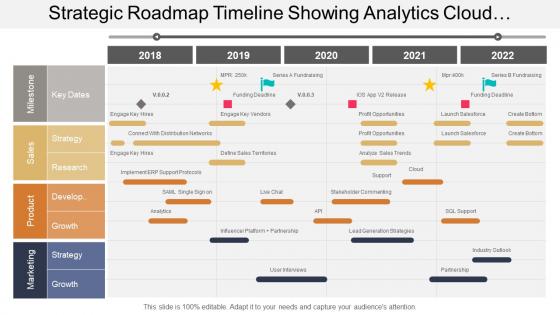
Strategic roadmap timeline showing analytics cloud support





Try Before you Buy Download Free Sample Product
 Impress Your
 Audience
 100%
100% Editable
 Save Hours
 of Time


Download our strategic roadmap timeline showing analytics cloud support PowerPoint layout to show the elements of the data analytics process through a public or private cloud. This presentation slide of cloud analytics has been designed by our professional team members and helpful you to define different elements of analytics such as processing applications, data sources, data models, computing power, and storage of results. With the help of this cloud based analytics PPT slideshow you can display how data is made available via hosted data warehouse to users from a remote location operated by the service provider, rather than being located on the enterprise’s own systems. Our big data and analytics presentation slide helps to increase performance by providing accurate and on time data reporting of different types of modeling techniques, deep computing and simulation techniques. This PPT layout of analytics helps in designing the policies on rapid pace based on the information available in the organization. Advocate an intrepid attitude with our Strategic Roadmap Timeline Showing Analytics Cloud Support. Encourage individuals to indulge in exploration.
People who downloaded this PowerPoint presentation also viewed the following :
Strategic roadmap timeline showing analytics cloud support with all 5 slides:
Invite folks to join in the effort with our Strategic Roadmap Timeline Showing Analytics Cloud Support. They will definitely agree to contribute.


FAQs for Strategic roadmap timeline showing
You'll need data integration tools, scalable computing power, self-service analytics, and solid governance. Security should be your first priority - trust me, fixing it later is a nightmare. Build a platform that handles both batch and real-time data processing. Your business users need to actually understand the insights without constantly calling IT for help (we've all been there). Most important thing though? Don't try moving everything at once. Pick your biggest impact use cases first and migrate those. Way less stressful that way.
Honestly, just start with whatever's causing your team the biggest headache right now. Most places begin with basic reporting and dashboards - boring but necessary since everyone needs to actually see their data. From there, you can build toward the fancier stuff like self-service analytics or real-time processing. The trick is matching each capability to real business problems, not just doing it because it sounds cool. I'd say audit what your teams are complaining about most. Then sequence everything so each step builds naturally on the previous one. Focus on revenue impact and current pain points first.
Honestly, data governance is what separates analytics projects that actually work from total disasters. Without it, you get inconsistent metrics across teams and compliance nightmares - trust me on this one. Your cloud roadmap should bake in governance frameworks from day one: data lineage, access controls, quality standards. It's not just busy work either. Poor governance means your insights are basically worthless. Oh, and figure out who owns what data before you start scaling everything up. Skip this step and you'll be cleaning up messes for months.
Oh man, build for scale from the start - trust me on this one. Cloud services that auto-scale are your friend, plus containerized workloads you can spin up whenever. I've watched so many teams try to add scalability later and it's a nightmare. Way easier upfront. Go with platforms that scale both ways (vertical and horizontal), partition your data properly, and monitor for bottlenecks before they bite you. Also test your limits regularly - you don't want surprises when you actually need that capacity. Actually had a coffee with my old teammate yesterday who's still dealing with their scaling mess from 2 years ago.
Honestly, the worst thing you can do is try to tackle everything at once - that's how projects spiral into budget nightmares. Pick one specific use case and nail that first. Data governance isn't sexy but skipping it will bite you later (trust me, I've watched teams waste months fixing sloppy migrations). Your stakeholders? They'll flip-flop on requirements constantly. Build some flexibility in but don't lose sight of your main goals. Quick wins are everything here. Show value fast with something small, then you can expand once people see it actually works.
Honestly, having a solid analytics cloud roadmap is a game-changer for getting real-time insights up and running. You want to map out your streaming data pipelines and event processing stuff before you dive in - trust me on this one. Figure out which data sources actually need live connections first. Don't make the mistake I see everywhere of trying to build everything at once (your team will hate you). Pick your top 3 use cases that genuinely need real-time data, then work backwards from there. Set up alerts that won't drive everyone crazy with false positives. Phase things based on what'll actually move the needle for your business.
Honestly, data silos are gonna be your worst nightmare - nothing talks to each other properly. Your legacy systems? They hate cloud platforms, like really hate them. Security teams will freak out the second data leaves their precious on-premise bubble. Plus network delays can totally screw up real-time stuff, especially with massive datasets. Your team probably doesn't know cloud tools yet either, which... yeah, that's fun. I'd say audit what you've got first and figure out which systems actually need to connect. Start there before you go crazy trying to fix everything at once.
Oh man, training is HUGE and honestly most companies just ignore it completely. Like they'll drop tons of cash on some fancy analytics platform then act shocked when nobody uses it. Been there, seen that disaster play out too many times. Don't make training a one-and-done thing either - people forget stuff, platforms get updated. Start planning how you'll train people before you even pick which tool to buy. Otherwise you're just paying for really expensive digital paperweights that collect dust.
Honestly, start with adoption - are people actually using the thing or just ignoring it? Then look at how fast teams can pull insights from their data. Track if folks are logging in regularly too. Nothing worse than building something nobody touches. ROI is obviously the big one, but you gotta measure your baseline first or you'll have no clue if it's working. Oh and see if you're cutting down on manual reports - that's where you'll really feel the impact. Cost savings and revenue from data-driven decisions are solid proof points when leadership asks what they're getting for their money.
Think of it as your game plan for rolling out data tools that actually work together. You'll map out what gets built when - dashboards first, maybe predictive stuff later, real-time reporting whenever. Without one? You're basically just buying random analytics tools and praying they talk to each other (spoiler: they won't). The whole point is building things in an order that makes sense, so data flows properly between systems. That way when your boss needs numbers for the quarterly meeting, you're not frantically cobbling together Excel sheets at 11pm.
Honestly, start with your storage foundation - AWS S3 or Azure Data Lake work great. For processing all that data, you're gonna want Spark or Databricks. Airflow is a lifesaver for orchestrating workflows because nobody wants to wake up at 3am to manually run jobs (been there, done that). Once you've got the basics down, add streaming stuff like Kafka if you need real-time data. Tableau or Power BI for dashboards obviously. Oh, and data cataloging tools are super boring but you'll thank yourself later when you can actually find your datasets. Build it piece by piece though - don't try to do everything at once.
Start with the boring stuff first - automated data prep and anomaly detection. Trust me, it'll save you so much time you won't believe it. Then move into predictive analytics for forecasting and figuring out what customers actually want. Real-time recommendations come later once your data's more mature. Don't try to do everything at once though. Pick 2-3 use cases where ML will actually make a difference for your business - like, where you'll see real results, not just cool dashboards. Build incrementally from there. I've seen too many teams go all-in and burn out.
So first thing - get your encryption sorted for data moving around and stuff sitting in storage. Identity management is critical too, plus whatever compliance rules hit your industry (GDPR, HIPAA, etc). Network security with VPNs and firewalls is obvious but super important. Honestly, audit trails are boring but your auditors will be all over that later. Set up clear policies about who accesses what data and retention periods. APIs need to be locked down tight if you're integrating systems. Oh, and do a risk assessment upfront to figure out where you're most exposed - saves headaches down the road.
Honestly, I'd say quarterly reviews are the bare minimum for analytics roadmaps. The space moves so fast it's kinda nuts. Every 6 months you should do a proper deep dive - new platform features, shifting business needs, different data sources popping up. Monthly check-ins are smart too, just quick ones to catch any major issues early. Don't treat your roadmap like it's carved in stone though. Flexibility is everything. Oh and pro tip - actually put those review sessions on your calendar now, or you'll keep finding excuses to skip them. Trust me on that one.
Honestly, collaboration tools will save your sanity on this analytics roadmap. Set up a dedicated Slack channel or Miro board where everyone can see milestones and progress - no more silos between IT and business teams. The best part? When blockers pop up, people actually talk about them instead of letting things derail quietly. I've seen too many projects crash because executives suddenly pivot mid-sprint, but real-time visibility keeps that chaos in check. Track dependencies openly and you won't get blindsided by "surprise" delays. Plus you'll dodge half those pointless status meetings we all hate.
-
Best way of representation of the topic.
-
Very unique and reliable designs.