


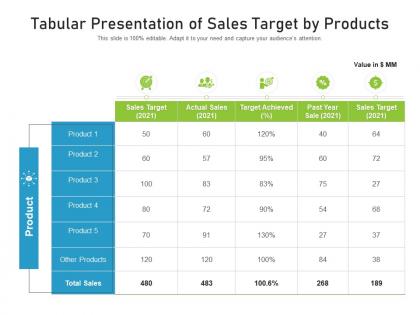
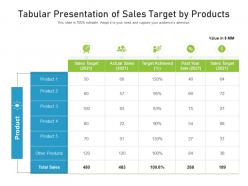
Tabular presentation of sales target by products




Try Before you Buy Download Free Sample Product
 Impress Your
 Audience
 100%
100% Editable
 Save Hours
 of Time


Our Tabular Presentation Of Sales Target By Products are topically designed to provide an attractive backdrop to any subject. Use them to look like a presentation pro.
People who downloaded this PowerPoint presentation also viewed the following :
Tabular presentation of sales target by products with all 2 slides:
Use our Tabular Presentation Of Sales Target By Products to effectively help you save your valuable time. They are readymade to fit into any presentation structure.
FAQs for Tabular presentation of sales
Key components include clear target definitions, historical performance analysis, market opportunity assessment, resource allocation plans, timeline milestones, and accountability measures. These elements work together by establishing realistic expectations, providing context for goal-setting, and creating structured pathways for achievement, with many sales organizations finding that comprehensive presentations significantly enhance team alignment and ultimately drive higher performance outcomes.
Visuals enhance sales target presentations by simplifying complex data, highlighting key performance gaps, and making projections more memorable through charts, graphs, and infographics. These elements enable sales teams to quickly identify trends, communicate strategies more effectively, and maintain audience engagement, with many organizations finding that visual presentations increase buy-in and accelerate decision-making processes.
Tailoring sales target presentations involves adjusting messaging, metrics depth, visual complexity, timeline focus, and stakeholder-specific outcomes for each audience. Executive audiences require high-level strategic insights and ROI projections, while sales teams need detailed quota breakdowns and tactical roadmaps, with marketing teams focusing on lead generation alignment, ultimately ensuring each group receives relevant, actionable information that drives engagement and buy-in.
Benchmark sales targets effectively by analyzing historical performance data, competitor metrics, industry standards, market conditions, and team capacity within your presentation. Through comparative charts and trend analysis, organizations can establish realistic yet ambitious targets that account for seasonal variations, market growth potential, and resource allocation, ultimately delivering credible forecasts and strategic alignment.
Storytelling transforms sales target presentations by creating emotional connections, making complex data relatable, and inspiring action through compelling narratives that resonate with audience experiences. These narrative techniques enhance engagement by illustrating real customer success stories, market challenges, and growth opportunities, with many sales teams finding that storytelling significantly improves message retention and motivates teams toward achieving ambitious targets.
Data analytics supports sales targets by providing historical performance trends, customer segmentation insights, market opportunity analysis, and predictive forecasting models. Through visualization tools and statistical modeling, sales teams can identify high-conversion prospects, optimize resource allocation, and demonstrate evidence-based target feasibility, while ultimately enabling more strategic territory planning and competitive positioning in increasingly data-driven markets.
Common pitfalls include setting unrealistic targets, lacking supporting data, failing to address market conditions, ignoring team capacity, and presenting without clear action plans. These presentation weaknesses undermine credibility by creating disconnect between ambitious goals and practical execution, with many sales organizations finding that grounding targets in historical performance, market analysis, and resource allocation ultimately delivers better team buy-in and achievable results.
Maintaining sales team motivation through target presentations requires transparent communication, achievable goal-setting, and recognition of past achievements alongside future expectations. Successful organizations enhance engagement by breaking down annual targets into quarterly milestones, providing clear pathways to success, and incorporating team input during planning sessions, ultimately delivering higher performance and sustained momentum throughout the sales cycle.
Key metrics include revenue performance versus targets, conversion rates by stage, average deal size, sales cycle length, and pipeline health indicators. These measurements enable sales teams to identify bottlenecks, optimize resource allocation, and accelerate deal closures, with many organizations finding that comprehensive tracking ultimately delivers improved forecasting accuracy and enhanced team accountability.
Past performance data justifies future sales targets by establishing baseline metrics, identifying growth trends, analyzing seasonal patterns, and demonstrating market responsiveness through historical achievements. This data-driven approach enables sales teams to create realistic projections while showcasing proven capability, with many organizations finding that performance analytics strengthen stakeholder confidence and ultimately deliver more accurate forecasting and strategic buy-in.
Effective sales target presentations should follow clean layouts with consistent color schemes, strategic use of white space, and clear visual hierarchy through typography and sizing. These design principles enhance comprehension by incorporating compelling data visualizations, professional charts, and balanced text-to-visual ratios, with many sales teams finding that well-designed presentations increase stakeholder engagement and accelerate decision-making processes.
Effectively communicating sales target challenges involves presenting data-driven analysis, identifying specific market barriers, competitive pressures, resource constraints, and customer behavior shifts with transparent context. Through visual dashboards and scenario planning, sales teams can demonstrate realistic timelines, alternative strategies, and mitigation approaches, while proposing actionable solutions that maintain stakeholder confidence and ultimately enable strategic pivots for sustainable revenue growth.
Follow-up strategies should include regular progress tracking meetings, milestone check-ins, performance review schedules, accountability measures, and resource allocation adjustments. These approaches streamline goal achievement by maintaining momentum, addressing obstacles proactively, and ensuring team alignment, with many sales organizations finding that structured follow-up processes ultimately deliver higher target attainment and sustained performance improvement.
Incorporating feedback involves analyzing previous presentation metrics, audience engagement patterns, and stakeholder comments to refine messaging, visual design, and data presentation approaches. Sales teams typically adjust storytelling techniques, simplify complex charts, and enhance interactive elements based on buyer feedback, ultimately delivering more compelling presentations that resonate with prospect needs and accelerate deal closure rates.
Innovative approaches include interactive dashboards with real-time metrics, gamified leaderboards showcasing team progress, visual storytelling through infographics, dynamic video presentations, and augmented reality displays. These methods enhance engagement by transforming traditional data presentations into compelling narratives, with many sales organizations finding that interactive formats increase team motivation and target achievement rates significantly.
-
Unique research projects to present in meeting.
-
Great product with highly impressive and engaging designs.