


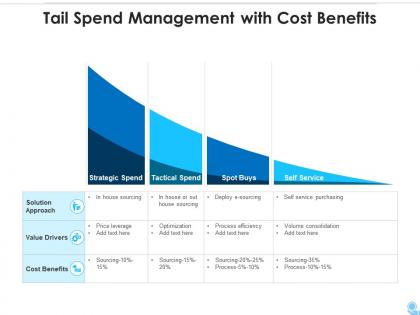
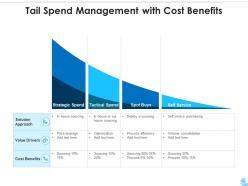
Tail spend management with cost benefits




Try Before you Buy Download Free Sample Product
 Impress Your
 Audience
 100%
100% Editable
 Save Hours
 of Time


Our Tail Spend Management With Cost Benefits are topically designed to provide an attractive backdrop to any subject. Use them to look like a presentation pro.
People who downloaded this PowerPoint presentation also viewed the following :
Tail spend management with cost benefits with all 2 slides:
Use our Tail Spend Management With Cost Benefits to effectively help you save your valuable time. They are readymade to fit into any presentation structure.
FAQs for Tail spend management
Tail spend refers to the numerous low-value, infrequent purchases that collectively represent 10-20% of procurement spending but involve 80% of suppliers and transactions. Effective management streamlines procurement processes, reduces administrative costs, and enhances supplier relationships, with many organizations finding that strategic tail spend optimization delivers significant operational efficiency and cost savings.
Organizations identify tail spend categories through comprehensive spend analysis using procurement software, data analytics platforms, and vendor classification systems that categorize purchases below strategic thresholds. These technologies streamline identification by consolidating fragmented transactions, mapping supplier relationships, and analyzing purchasing frequency patterns, with many companies finding that automated categorization and spend visibility tools ultimately deliver 15-20% cost reductions across previously unmanaged categories.
Key tail spend management challenges include limited visibility into small transactions, fragmented supplier relationships, high administrative costs relative to purchase values, lack of standardized processes, and inadequate spend analytics. These issues create procurement inefficiencies across organizations, with many companies finding that decentralized purchasing and maverick buying ultimately increase costs while reducing strategic control over vendor relationships.
Effective tail spend management contributes to procurement efficiency by consolidating fragmented purchases, standardizing vendor relationships, and automating routine transactions through digital platforms. This strategic approach reduces administrative overhead, minimizes maverick buying, and enhances compliance across decentralized purchasing, with many organizations finding that streamlined tail spend processes ultimately deliver 15-30% cost savings while improving operational control.
**INPUT**: What strategies can be implemented to reduce tail spend without compromising quality? **OUTPUT**: Effective tail spend reduction strategies include supplier consolidation, automated procurement workflows, preferred vendor agreements, standardized purchasing processes, and strategic sourcing partnerships. These approaches streamline operations by reducing administrative costs, enhancing compliance visibility, and leveraging volume discounts, while maintaining quality standards through vetted supplier networks, ultimately delivering better cost control and operational efficiency. [Word count: 55 words]
Technology and procurement software assist in managing tail spend by automating purchase order processes, centralizing supplier data, and providing real-time spending visibility across categories. These platforms streamline procurement workflows, enable better contract compliance, and deliver advanced analytics, with many organizations finding that automated systems reduce maverick spending while improving operational efficiency and cost control.
Data analytics transforms tail spend visibility by consolidating fragmented purchasing data, identifying spending patterns across departments, categorizing unmanaged transactions, and revealing supplier concentration risks. Through advanced analytics platforms, organizations streamline procurement oversight, reduce maverick spending, and negotiate better supplier terms, with many companies finding that enhanced visibility delivers 15-20% cost savings while improving compliance.
Companies ensure compliance and mitigate tail spend risks through centralized procurement policies, automated approval workflows, regular supplier audits, and comprehensive spend visibility tools. These strategic approaches enable organizations to monitor previously untracked purchases, enforce contract compliance, and reduce maverick spending, with many finding that structured tail spend governance ultimately delivers cost savings and operational transparency.
Best practices for negotiating with tail spend suppliers include consolidating volumes across categories, standardizing contract terms, leveraging group purchasing power, establishing preferred supplier panels, and implementing automated procurement processes. These approaches streamline vendor relationships by reducing administrative costs, improving compliance, and enhancing payment terms, with many organizations finding that strategic consolidation delivers 10-15% cost savings while minimizing procurement complexity.
Organizations can leverage group purchasing to optimize tail spend by consolidating low-value, fragmented purchases with other buyers, negotiating volume discounts, and accessing pre-negotiated contracts with preferred suppliers. This collaborative approach enables companies to reduce administrative costs, streamline procurement processes, and achieve better pricing on indirect materials, with many finding 15-20% cost savings while minimizing supplier management complexity.
Effective tail spend management can deliver cost savings of 10-15% through consolidated purchasing, automated procurement processes, reduced maverick buying, and improved supplier negotiations. By streamlining fragmented transactions and enhancing visibility across low-value purchases, organizations minimize administrative costs, leverage volume discounts, and ultimately achieve significant operational efficiency gains while reducing overall procurement expenses.
Tail spend management varies significantly across industries based on regulatory requirements, supply chain complexity, and risk tolerance. While manufacturing focuses on indirect materials and MRO supplies, healthcare emphasizes compliance-driven procurement, and financial services prioritizes vendor risk management, with many organizations finding that industry-specific approaches ultimately deliver better cost control and operational efficiency.
Organizations should measure tail spend management success using spend visibility percentages, supplier consolidation ratios, cost reduction percentages, compliance rates, and process automation metrics. These measurements enable businesses to track improved procurement efficiency, enhanced supplier relationships, and reduced administrative costs, while many companies finding that comprehensive metrics ultimately deliver better strategic sourcing decisions and operational transparency.
Procurement teams enhance tail spend management by establishing cross-functional partnerships with finance, operations, and department heads to identify spending patterns, standardize purchasing processes, and implement centralized approval workflows. Through regular stakeholder meetings and shared visibility tools, organizations streamline vendor relationships, reduce maverick spending, and consolidate purchases, ultimately delivering cost savings and improved compliance across departments.
Sustainable tail spend management delivers enhanced supplier diversity, improved compliance visibility, reduced procurement costs, strengthened risk mitigation, and streamlined operational efficiency. These strategic approaches enable organizations to transform fragmented purchasing into competitive advantage, with many companies finding that comprehensive tail spend oversight ultimately reduces total procurement costs by 10-15% while enhancing supplier relationships and regulatory compliance.
-
Appreciate the research and its presentable format.
-
Excellent products for quick understanding.
-
The content is very helpful from business point of view.
-
Helpful product design for delivering presentation.