


Three buckets of investment plan






Try Before you Buy Download Free Sample Product
 Impress Your
 Audience
 100%
100% Editable
 Save Hours
 of Time


Avoid getting blinded by data with our Three Buckets Of Investment Plan. They will effectively act as your eyes.
People who downloaded this PowerPoint presentation also viewed the following :
Content of this Powerpoint Presentation
Description:
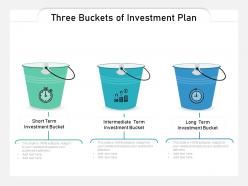
The image is a PowerPoint slide titled "Three Buckets of Investment Plan," which represents a financial planning concept. The slide is divided into three sections, each with a graphic of a bucket that symbolizes a category of investment strategies based on time frames: Short Term, Intermediate Term, and Long Term.
1. Short Term Investment Bucket:
The first bucket, colored in a light green hue, is labeled 'Short Term Investment Bucket' and features an icon of a stopwatch. This bucket is intended to represent investments that are to be held for a shorter duration, typically less than three years. Below the bucket are placeholders for additional text, suggesting that the presenter can detail specific short-term investment strategies or instruments.
2. Intermediate Term Investment Bucket:
The middle bucket is a teal color and is associated with 'Intermediate Term Investment Bucket.' It is marked by an icon with a graph and lightbulb, possibly indicating a mix of growth and income strategies suitable for a medium time horizon, often ranging from three to ten years.
3. Long Term Investment Bucket:
The third bucket, shown in blue, is titled 'Long Term Investment Bucket' with an icon featuring a tree and upward arrows, suggesting the growth and compounding effect expected from long-term investments, which are typically held for more than ten years.
Each section contains a note that says "This slide is 100% editable. Adapt it to your needs and capture your audience's attention." This indicates that the slide is designed to be customized for specific financial planning presentations, where the presenter can add text to elaborate on the investment objectives, potential assets, or strategies appropriate for each time horizon.
Use Cases:
Investment strategies are fundamental to business and personal finance. The "Three Buckets" slide helps explain investment distribution based on timelines in various industries:
1. Wealth Management:
Use: Explaining diversified investment portfolios to clients.
Presenter: Financial Advisor.
Audience: Individual Investors, Wealth Management Clients.
2. Retirement Planning:
Use: Illustrating retirement savings strategies over time.
Presenter: Retirement Planner.
Audience: Future Retirees, Pension Fund Members.
3. Education:
Use: Teaching students about financial planning and investment.
Presenter: Finance Professor.
Audience: Business and Finance Students.
4. Insurance:
Use: Advising on cash value life insurance investment components.
Presenter: Insurance Agent.
Audience: Policyholders, Insurance Clients.
5. Real Estate:
Use: Planning property investments for different investment horizons.
Presenter: Real Estate Investment Consultant.
Audience: Real Estate Investors, Homebuyers.
6. Corporate Finance:
Use: Allocating corporate funds across different time-bound projects.
Presenter: CFO or Corporate Treasurer.
Audience: Board Members, Investment Analysts.
7. Non-Profits:
Use: Managing endowment funds and donations.
Presenter: Fund Manager.
Audience: Board of Directors, Donors.
Three buckets of investment plan with all 2 slides:
Deliver good decisions with our Three Buckets Of Investment Plan. All the data will go in your favor.
FAQs for Three buckets
Honestly, figure out your risk tolerance first - are you cool with losing money short-term or does that stress you out? Then think timeline. Saving for a house in 3 years vs retirement is totally different investing. I'd write down specific goals with actual dollar amounts and dates, makes everything clearer. Don't invest if you've got high-interest debt though, that's just math. Your age matters too - younger people can ride out market crashes easier. Oh and diversify obviously, don't put everything in one stock or crypto or whatever. Emergency fund should be solid before you start.
Honestly, it all comes down to how much risk you can handle and what you're saving for. Young with decades ahead? Go heavy on growth stocks - be aggressive while you can. But approaching retirement or the type who panics when markets tank? Stick with bonds and boring stable stuff. I definitely learned this lesson the hard way back in '08! Timeline's huge too. Even risk-takers need safe investments for short-term goals. Just be brutally honest about both before you start throwing money around.
So asset allocation is just how you divide your money between different investments - stocks, bonds, cash, whatever. Don't put everything in one place, obviously. Your age matters a ton here. Like if you're 25, you can go heavy on stocks since you've got decades to ride out the ups and downs. But if you're about to retire? Yeah, maybe chill on the risky stuff. The whole point is when one thing crashes, hopefully something else stays stable. Honestly, I think most people overthink this part. Just figure out your target percentages based on your timeline and goals, then check in every so often to rebalance.
Honestly, I'd go with like 70-80% in boring stuff - index funds, solid dividend stocks, whatever. That's your bread and butter that just sits there and grows. Then use the other 20-30% for when you spot good opportunities or the market tanks and you want to jump in. The trick is not touching that long-term money when you see some "amazing" short-term deal (I've definitely been tempted before). Just set those boundaries early and actually stick to them. Short stuff is fun but your core holdings are what really build wealth over time.
Honestly, I'd go with index funds first. Way cheaper fees and you don't have to stress about picking stocks all the time. Most fund managers can't even beat the market consistently - which is pretty wild when you think about it. Sure, active investing gives you more control and *maybe* better returns if you're good at it, but you'll pay more and need to actually know what you're doing. The data backs up passive investing for most people long-term. Start with a solid index fund base, then throw some money at individual picks later if you want. That's what I did anyway.
Dude, think of market trends as your heads-up before you need to switch things around. Watch for sector rotation - like when tech starts tanking but energy's on fire. That's when you rebalance. 2022 taught me that lesson pretty brutally, not gonna lie. Don't go crazy chasing every little movement though. You want trends that stick around for 3-6 months, not just weekly drama. Set up some alerts for your main sectors and check monthly. Way better than stressing over daily market chaos, trust me.
Your economic outlook definitely shapes how you invest. Expecting a recession? You'll probably move toward safer stuff - defensive stocks, bonds, maybe more cash. Bulls make people chase growth stocks and take bigger risks. Perfect market timing is basically a myth though, let's be real. The general economic mood still affects what risks you're comfortable with and which sectors look appealing. I wouldn't ignore economic trends completely, but don't let every prediction mess with your long-term plan either.
Look, we're all pretty terrible at investing because our brains work against us. Behavioral finance basically shows you where you mess up - like panic selling when things get scary or thinking you're smarter than the market. Once you know your weak spots, you can set up systems to save yourself from yourself. I set automatic rebalancing so I don't try to time anything (spoiler: I'm bad at timing). Also worth tracking when you get that itch to do something dramatic with your portfolio - that's usually your bias talking. Loss aversion is real, man. Stick to boring strategies instead of chasing whatever's hot.
So emerging markets are basically developing countries like India, Brazil, Vietnam - places that are growing way faster than the US but are also more volatile. The upside? Younger populations and growing middle classes can really juice your returns. I'd throw maybe 5-15% of your portfolio at them through ETFs. They don't always tank when US markets do, which is nice for diversification. Fair warning though - they get pretty wild during global freakouts. Honestly I'd start with like 5% and see how you handle the swings before going bigger.
Yeah, taxes totally change the game with investing. Stocks get taxed as capital gains - way better rates if you hold them over a year. But bonds and REITs? They hit you with ordinary income tax rates, which honestly sucks. So I always put my bonds in my 401k where they're protected, and keep growth stocks in regular accounts to get those lower capital gains rates. Oh, and if you're making decent money, municipal bonds might be tax-free for you. Just don't get caught up in the flashy returns - what matters is what you actually keep after taxes.
Your investments naturally drift from your target mix - like you start with 60% stocks, 40% bonds, then boom, after a good market year you're suddenly at 70% stocks without knowing it. Way riskier than you planned! Life changes mess with your strategy too. New job, kids, retirement approaching - stuff that worked two years ago might be totally wrong now. I check mine quarterly (honestly sometimes I forget and it's more like every 6 months). Definitely review after big life stuff though. Just throw a reminder in your calendar or you'll never do it.
Dude, tech tools are seriously amazing for investing - they crunch data way faster than you ever could. AI platforms spot market patterns and automate your portfolio rebalancing. You can backtest strategies without losing actual money, which is clutch. Robo-advisors nail the timing on trades based on whatever criteria you set. The dashboards are sick too, showing real-time performance and risk stuff. Oh and honestly? Don't go crazy at first. Just grab one tool that fixes your biggest headache - maybe research or trade execution - then expand from there.
Honestly, diversification is your friend right now - spread stuff across different sectors and asset classes. Dollar-cost averaging works too, where you just invest the same amount regularly no matter what the market's doing. Utilities and consumer staples are pretty boring but they hold up better when things get messy. Keep some cash around for when good stocks go on sale. I get it, the urge to panic sell is real, but timing the market almost never works out. Stick to your plan and try to see dips as buying opportunities instead of disasters.
Look, your values should totally drive how you invest - not the other way around. Pick 2-3 things you actually care about, then find ESG funds or impact investing that matches. You can screen out tobacco, weapons, whatever makes you feel gross. I used to think ethical investing meant sacrificing returns, but honestly? A lot of these funds perform just as well as regular ones. Why make money off companies that make you feel shitty? There's enough good options out there now that you don't have to compromise your conscience for decent performance.
Honestly, dividends are pretty great if you want steady income or you're getting close to retirement. You can reinvest the cash to compound your gains, or just pocket it - there's something satisfying about getting paid while your stocks (hopefully) go up too. The companies that pay dividends are usually more stable and mature, which balances out any risky growth stuff you might have. Oh, but watch out for crazy high yields - sometimes that's a red flag the company's struggling. I learned that one the hard way a few years back.
No Reviews