

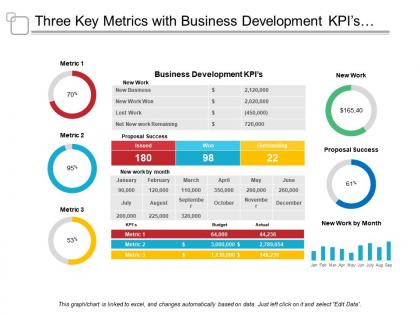
Three key metrics with business development kpis and proposal success




Try Before you Buy Download Free Sample Product
 Impress Your
Audience
 100%
Editable
 Save Hours
of Time


Caution them about errors with our Three Key Metrics With Business Development Kpis And Proposal Success. Enable them to avoid any accidents.
People who downloaded this PowerPoint presentation also viewed the following :
Three key metrics with business development kpis and proposal success with all 5 slides:
Don't allow conditions to get inflammatory with our Three Key Metrics With Business Development Kpis And Proposal Success. Douse any feelings of anger.


FAQs for Three key metrics with business development kpis
So I'd break it down into three buckets: pipeline health, conversion rates, and relationship stuff. Your lead gen numbers matter obviously, plus deal velocity (how fast things move through stages) and win rates. Revenue per deal and customer acquisition costs are huge - seriously, these will save your ass in quarterly reviews. Oh and don't sleep on the softer metrics like relationship depth and referral rates. BD is really about those long-term partnerships anyway. Start with maybe 5-7 core metrics you can actually track consistently. Way better than trying to measure literally everything and burning out.
Here's my take: map every metric straight back to what you're actually trying to accomplish. Market expansion? Track new market penetration, not just revenue (which honestly tells you nothing useful). Most companies I've seen totally blow this by chasing vanity metrics that look pretty in presentations but don't matter. Do quarterly check-ins to see if your metrics still make sense - business moves fast and your tracking should too. Oh, and create a simple scorecard linking each KPI to specific goals. Sounds basic but you'd be surprised how many skip this step.
CAC is your go-to metric for seeing how efficiently you're actually growing. Just divide total sales and marketing spend by new customers acquired that period. But here's where people mess up - low CAC means nothing if customers bail quickly or barely spend. You've gotta compare it to customer lifetime value (CLV). The sweet spot? 3:1 CLV to CAC ratio. Track it monthly and watch trends. If CAC's climbing faster than revenue per customer, time to fix your acquisition channels or boost conversions. Honestly, most startups obsess over CAC but ignore the retention side completely.
CLV is gold for figuring out where to actually put your money. Check out your highest-value customers first - which channels brought them in? What features hooked them? Then just do more of that stuff. Honestly beats guessing what's working based on random metrics. For acquisition budgets, you can justify spending way more upfront if you know someone's likely to stick around and pay. I'd start with your top 3 segments and see what jumps out - the patterns are usually pretty obvious once you map it out.
Honestly, just track everything from lead capture to closed deals in your CRM. Google Analytics plus your marketing automation tool will save you tons of headache - trust me, I've seen people try doing this in Excel and it's a nightmare. Break down your conversion rates by channel and campaign so you can actually see what's working. Daily numbers will drive you crazy, so focus on longer trends instead. Oh, and definitely find your biggest bottlenecks first. Time-to-conversion data is gold too since it shows where leads are getting stuck in your funnel.
So market penetration rate basically shows you what chunk of your target market you've actually grabbed. It's way more useful than just looking at revenue - like, you could be making more money but still losing ground if your competitors are growing faster. I track mine monthly because it shows whether I'm actually winning or just floating along with everyone else. Honestly, sometimes I get obsessed with the numbers but whatever. It helps you spot opportunities you're missing and see how you stack up against the competition. Pretty solid metric to focus on.
Track partner revenue first - that's your bread and butter. Lead conversion from networking events matters too, plus how much each partnership costs you. Honestly, measuring relationship depth can be tricky but it's worth it - like counting touchpoints and how fast partners respond to you. Time-to-value is critical, basically how long before you see real results from initial contact. Softer stuff like brand awareness and referral quality help round out the picture. Pick 3-4 metrics max though, otherwise you'll be swimming in spreadsheets all day.
Honestly, pipeline analytics are where the magic happens - you'll see exactly which stage deals die at and why your conversion rates tank. I'd focus on deal velocity first (total game changer for forecasting), then track time per stage and win/loss by source. The patterns between your hot leads vs. the duds? Super telling. This stuff shows you which marketing channels actually deliver, when deals need help, and where your team should spend time. Oh, and set up weekly automated reports for stage conversions - saves you tons of manual work later.
Honestly, start with a solid CRM - HubSpot or Salesforce are both great, though Pipedrive's cheaper if budget's tight. That'll handle your pipeline tracking. Google Analytics is obvious for web stuff. Then maybe grab Mixpanel for user behavior if that matters to you. Oh, and dashboards are clutch - Tableau's fancy but Google Data Studio works fine and it's free. Here's the thing though: don't go crazy with tools. Pick like 2-3 max that actually integrate well together. I've seen people drown in spreadsheets because they tried tracking everything everywhere. CRM first, then add whatever else you actually need.
Honestly, you gotta watch what the market's actually doing and adjust accordingly. When things get rough, I'd focus on cash flow and keeping customers happy - forget the vanity metrics. Boom times? That's when you can track the cool long-term stuff like market share. I learned this the hard way last year. Economic uncertainty means doubling down on early warning indicators. Don't get stuck using the same dashboard forever just because it worked before. Switch things up monthly, not once a year when everything's already changed.
Honestly, qualitative metrics are where the real insights live. Your conversion rates might tank, but without talking to people you'll never know it's because your demo sucks or the sales pitch feels weird. I always tell people to actually interview customers and check in with their sales teams - that's how you find out what's really broken. Track stuff like deal quality and common objections alongside your regular numbers. The combo is powerful because you can actually fix issues instead of just watching them happen. Numbers tell you what, but conversations tell you why.
So startups are totally obsessed with getting to market fast and keeping customer acquisition costs low. They track stuff like viral coefficients and product-market fit - though honestly, half of them get distracted by vanity metrics that don't matter. The smart ones focus on revenue per user and stopping churn early. Meanwhile, established companies? They're all about lifetime value and retention analytics. Heavy investment in predictive stuff and cross-selling metrics. Basically startups measure how fast they're growing, mature companies measure if that growth will actually last. If you're somewhere in the middle, you probably need both approaches.
Retention rates show you where to focus your energy - new customers or keeping current ones happy. High retention? Great, you can invest in growth because people actually stick around. But if retention sucks, you're basically throwing money into a black hole. Fix your product first before worrying about business development - I learned this the hard way at my last job. You'll want to check cohort retention monthly so you know whether to speed up or slow down your growth plans. Makes all the difference in deciding your next move.
Set up feedback loops both ways - internal and external. Your sales team and customer success people will call out what's actually useful vs total junk. Customer surveys during deals are honestly where you'll find the best insights about whether you're even tracking the right stuff. Do quarterly reviews to catch trends you're missing. Oh and make it systematic - can't just rely on random hallway conversations. Pick one feedback source first and commit to checking it monthly. That's way better than trying to do everything at once.
Pick 3-5 metrics that actually matter for your growth first. Then grab some solid industry reports - trade associations or research firms like Gartner work well. Honestly, don't stress about comparing every tiny detail since half those "benchmarks" are kinda BS anyway. Focus on trends instead of exact numbers because everyone's situation is different. The real win? Tracking your own improvement over time while using industry stuff as a sanity check. You'll spot if something's seriously off track. Oh, and do quarterly reviews to see how both your progress AND the benchmarks are shifting.
-
Unique design & color.
-
It saves your time and decrease your efforts in half.