


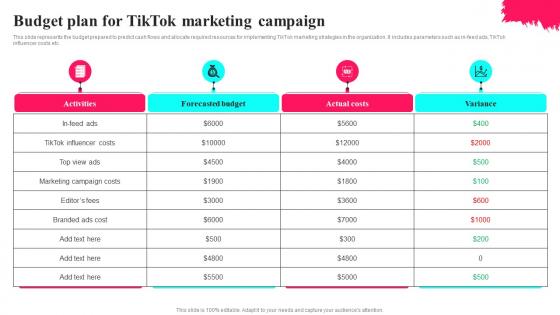
Budget Plan For Tiktok Marketing Campaign Tiktok Marketing Tactics To Provide MKT SS V




Try Before you Buy Download Free Sample Product
 Impress Your
 Audience
 100%
100% Editable
 Save Hours
 of Time


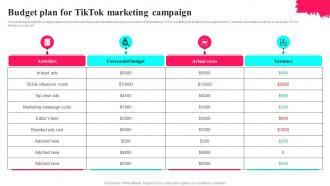
This slide represents the budget prepared to predict cash flows and allocate required resources for implementing TikTok marketing strategies in the organization. It includes parameters such as in-feed ads, TikTok influencer costs etc.
People who downloaded this PowerPoint presentation also viewed the following :
Budget Plan For Tiktok Marketing Campaign Tiktok Marketing Tactics To Provide MKT SS V with all 6 slides:
Use our Budget Plan For Tiktok Marketing Campaign Tiktok Marketing Tactics To Provide MKT SS V to effectively help you save your valuable time. They are readymade to fit into any presentation structure.





FAQs for Budget Plan For Tiktok Marketing Campaign Tiktok Marketing Tactics To Provide
Key components include content creation costs, influencer partnerships, paid advertising spend, analytics tools, and contingency reserves. These elements work together to maximize campaign effectiveness, with many brands finding that allocating 40% to content production, 35% to paid promotions, and 25% to influencer collaborations delivers optimal reach and engagement while maintaining cost efficiency.
Businesses can determine ideal TikTok ad budget allocation by analyzing campaign objectives, target audience reach, and expected ROI for each format. Top-view ads typically require larger budgets for maximum visibility, in-feed ads offer cost-effective engagement, and branded hashtags drive community participation, with many companies finding that balanced allocation across formats delivers optimal campaign performance.
Key ROI metrics for TikTok marketing campaigns include engagement rates, reach and impressions, click-through rates, conversion tracking, and cost per acquisition. These analytics enable businesses to measure brand awareness growth, lead generation effectiveness, and sales attribution, while tracking metrics like video completion rates and hashtag performance ultimately delivers comprehensive campaign optimization and demonstrates tangible marketing investment returns.
Influencer partnerships can be integrated by allocating 40-60% of your TikTok budget across micro, mid-tier, and macro influencers, with costs varying from $100-$10,000+ per post based on follower count and engagement rates. This strategic distribution enables brands to maximize reach while maintaining cost efficiency, with many companies finding that combining multiple micro-influencers delivers higher ROI than single high-cost partnerships.
TikTok Ads Manager provides comprehensive cost estimation tools, alongside third-party platforms like AdEspresso, Hootsuite, and Sprout Social that offer budgeting calculators and campaign forecasting capabilities. These platforms enable marketers to analyze CPM rates, audience targeting costs, and creative production expenses, with many retail and entertainment brands finding that strategic budget allocation through these tools delivers improved ROI and more efficient ad spend optimization.
Brands can leverage user-generated content by creating hashtag challenges, partnering with micro-influencers, offering product incentives for content creation, and repurposing existing customer videos across campaigns. These cost-effective strategies maximize reach while minimizing production costs, with many retail and beauty brands finding that authentic user content delivers higher engagement rates and stronger brand trust than traditional advertising approaches.
Audience targeting significantly influences TikTok ad costs by determining competition levels, reach potential, and bid requirements, with broader demographics typically costing less while niche segments command premium rates. Strategic targeting enables advertisers to optimize budget allocation by focusing spend on high-converting user segments, ultimately delivering better ROI and cost-per-acquisition rates across campaigns.
A/B testing should account for 15-20% of your TikTok ad budget, allowing you to test different creative formats, audiences, and bidding strategies simultaneously. This approach enables marketers to compare video styles, hashtag strategies, and targeting parameters across campaign variations, with many brands finding that systematic testing reduces cost-per-acquisition by 25-40% while identifying high-performing elements for budget reallocation.
Hidden costs in TikTok marketing campaigns include influencer management fees, content production expenses, paid promotion boosts, analytics tools subscriptions, and community management resources. These additional expenses can significantly impact budget allocation, with many businesses finding that successful campaigns require 30-40% more investment than initial projections, ultimately demanding strategic resource planning for sustainable growth.
Businesses can balance TikTok organic and paid content by allocating 60-70% of their budget to organic creation, including content production, influencer collaborations, and trend participation, while dedicating 30-40% to strategic paid amplification. This approach enables brands to build authentic community engagement through consistent organic posting while leveraging targeted ads to scale high-performing content, ultimately delivering sustained growth and cost-effective reach across diverse audience segments.
Effective TikTok budget strategies include allocating 60-70% to high-performing content promotion, diversifying across multiple ad formats, testing micro-influencer partnerships, and reserving 20% for trend-responsive campaigns. These approaches streamline cost efficiency by targeting engaged audiences, leveraging authentic creator content, and capitalizing on viral opportunities, ultimately delivering higher engagement rates and broader reach than traditional advertising methods.
Seasonal trends and events significantly impact TikTok marketing budgets by driving increased competition for ad placements, higher CPMs, and amplified content creation demands during peak periods like holidays, back-to-school, and major cultural moments. Brands should prepare by allocating 20-30% additional budget for high-traffic seasons, developing evergreen content libraries in advance, and leveraging TikTok's trend forecasting tools to capitalize on emerging opportunities while maintaining cost efficiency.
Scaling a TikTok marketing campaign requires increased content production costs, expanded influencer partnerships, broader audience targeting investments, and enhanced analytics tools for performance tracking. As campaigns grow, budgets should allocate proportionally more resources toward high-performing content formats and audience segments, while maintaining flexibility for creative experimentation, ultimately delivering improved cost-per-acquisition and stronger brand presence across diverse demographics.
Post-campaign analytics inform future TikTok budget planning by analyzing cost-per-engagement, conversion rates, audience demographics, peak performance times, and content format effectiveness across different spending levels. These insights enable marketers to reallocate resources toward high-performing segments, optimize timing strategies, and adjust creative investments, with many brands finding that data-driven budget optimization delivers significantly improved ROI and audience targeting precision.
Small businesses should allocate 10-15% of their marketing budget to TikTok, prioritizing organic content creation, influencer partnerships, and targeted ads while tracking cost-per-engagement metrics. Start with modest spending on native content and micro-influencers, with many retail and service businesses finding that consistent posting and community engagement delivers higher ROI than large ad spends initially.
-
The best and engaging collection of PPTs I’ve seen so far. Great work!
-
Exclusive and extensive collection of templates. Really helped me create a professional presentation in just no time.