


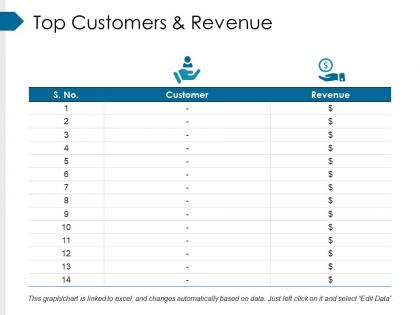
Top customers and revenue ppt slide examples




Try Before you Buy Download Free Sample Product
 Impress Your
 Audience
 100%
100% Editable
 Save Hours
 of Time


Folks feel engaged with our Top Customers And Revenue Ppt Slide Examples. They begin to freely contribute.
People who downloaded this PowerPoint presentation also viewed the following :
Top customers and revenue ppt slide examples with all 5 slides:
Elaborate on the evolution of jet engines with our Top Customers And Revenue Ppt Slide Examples. Highlight factors that increase efficiency.

FAQs for Top customers and revenue
Focus on customer lifetime value first - that's your goldmine right there. Then track total revenue per customer, how often they buy, and average order size. Honestly, some of your "best" customers might actually be costing you money once you factor in all the discounts and extra service they demand (learned that one the hard way). Don't forget repeat purchase rates and recency too. Pull these numbers for your top 20% and you'll start seeing patterns pretty quick.
Honestly, treating all your big customers the same is leaving money on the table. Look at your top 20% and you'll probably spot 3-4 different types - maybe enterprise clients who need hand-holding vs. scrappy mid-market companies that just want results fast. Each group buys differently, so they need different approaches. Your enterprise folks might need those fancy retention programs, while the growing companies just want you to not screw up their momentum (learned that one the hard way). Pick the clearest segments first and build specific playbooks around them. Way better ROI than the spray-and-pray approach.
Loyal customers are honestly your goldmine for consistent revenue. They buy more often, stick around longer, and actually upgrade their services. Way cheaper than chasing new clients all the time - that's exhausting. Here's the thing though: your biggest accounts become predictable money coming in, which makes forecasting so much easier. I learned this the hard way, but losing one major loyal customer absolutely destroys your numbers compared to gaining a few smaller ones. Track retention for your top accounts religiously. Those relationships are everything.
Honestly, focus on your best clients first - they're already bought in and will give you the real stuff. I do quarterly check-ins with mine, sometimes just grab coffee if they're local. Way better than those generic "how's everything?" questions though. Ask specific things about their actual experience. Here's the thing - when you actually implement what they suggest, they totally notice and it makes the relationship stronger. Plus you end up fixing issues you didn't even know existed. These conversations usually reveal what's actually moving the needle for them, which helps everyone else too.
Honestly, skip the generic case studies and hit them with their own numbers - show ROI using their actual data. Map everything to whatever their big priorities are this quarter. They couldn't care less about fancy features, trust me. Use their industry language, not your tech jargon. Visual slides with lots of data work way better than walls of text. Oh, and definitely grab testimonials from companies just like theirs if you can. Most important thing though? End with concrete next steps and timelines they can actually present to their boss. That's what'll get you the follow-up meeting.
Honestly, knowing your customer demographics is a total game-changer for campaigns. You can actually target the right people instead of just hoping for the best. Look at who's spending the most money with you - what do they have in common? Age, location, interests, whatever. Then build your messaging around those patterns. Different channels work better for different groups too. Like, my mom's generation still checks Facebook religiously but younger people? Not so much. Stop burning cash on audiences that don't convert and double down on the ones that do. Way more efficient than the spray-and-pray approach.
So I'd start by connecting your CRM with behavioral tracking - stuff like Mixpanel or Amplitude work great. Your CRM shows which accounts are growing fast or buying more often. Meanwhile, the behavioral tools catch engagement spikes that usually happen right before people start spending big. Google Analytics helps too, especially for spotting who's testing premium features. Oh, and definitely set up alerts when accounts hit certain milestones - you want to jump on these opportunities before your competitors even notice what's happening. The real trick is combining all this data instead of just looking at one thing.
Start with your top 20% revenue customers and figure out what makes each group tick. Don't just throw the same VIP treatment at everyone - that's lazy and it shows. Map out their usage patterns and what originally got them to upgrade. Some want dedicated account managers, others just need early feature access or personal check-ins. I've watched companies blow this by assuming all high-value customers care about the same perks. Build your retention around actual insights, not generic "white-glove" stuff. Oh and definitely look at their pain points too - sometimes keeping someone is easier than you think.
Your biggest customers are like revenue multipliers, honestly. They spend way more than average clients AND they'll actually refer people to you - which is basically free marketing. The referral thing alone is huge. But here's the scary part: lose one of these major accounts and you're not just losing their money. Your reputation takes a hit too, and that can mess with future deals. I've seen it happen. Regular check-ins with these accounts are totally worth it. Maybe dedicate someone to manage them specifically? The investment pays off when they keep coming back and bringing friends.
Honestly, I'd go with something like 80/20 here. Most of your energy should go toward your best customers since they're already buying from you and way easier to upsell. New customers are great but they're also a pain to convert - you know how that goes. That said, you can't just ignore growth completely or you'll be screwed when people inevitably leave. Set some quarterly goals for both keeping your top clients happy and bringing in fresh blood. Track everything so you can see what's actually moving the needle. Oh, and your existing customers have way higher lifetime value anyway, which is another reason to focus there first.
Dude, it's like putting all your money on one horse - super risky move. When that big client decides to bail or slash their budget, you're screwed. Like, I watched one company lose almost half their revenue when their main client just... left. Brutal. Your negotiating power goes out the window too because they know you need them more than they need you. So they start demanding discounts and better terms. Honestly, the smart play is spreading things out - don't let any single client make up more than 10-15% of your revenue. Way less stressful that way.
Honestly, just give your biggest clients a dedicated account manager who actually gets what they're trying to accomplish. Check in with them regularly - not just when it's renewal time, you know? Yeah, it can feel like babysitting sometimes but whatever. Give them the good stuff early - new features, custom tweaks, maybe those quarterly reviews where you actually share useful industry intel. Make them feel special basically. I'd start by listing your top 10 clients and figuring out how often you're actually talking to them right now. The whole point is they should feel like partners, not just another invoice.
So I'd start by mapping out when your best customers naturally hit those "need more stuff" moments in their buying cycle. AI recommendation tools can spot patterns you'd miss and suggest the right products at perfect times. Give your VIPs early access to new things - seriously, everyone eats that exclusivity stuff up. Bundle what they're already buying with discounted add-ons. Predictive analytics will show you when they'll need upgrades before they even know it themselves (kind of creepy but works). The trick is timing these pitches around their actual business needs, not just randomly throwing offers at them.
Dude, visual storytelling is your best friend here. Make your top customers the stars - throw their logos on slides with growth charts and revenue impact. Dashboard templates are clutch too. Clean charts, customer rankings, those little trend arrows that actually mean something. Honestly, spreadsheets are soul-crushing and nobody pays attention anyway. Timeline layouts showing how accounts evolved work really well, or pit your top 5 against each other in a comparison format. The whole point? Make your data tell a story that gets people pumped about these relationships instead of zoning out.
Your biggest customers are gold mines for new revenue - seriously. Start with regular brainstorming sessions with your top 3-5 accounts. They'll give you the best ideas for products that actually solve real problems (and other customers will want them too). Most of these folks have networks they're happy to tap into for referrals. You can turn their success stories into killer case studies for landing bigger deals. The market insights they share? Usually stuff you'd never think of on your own. Oh, and partnership opportunities tend to pop up naturally once you're collaborating more. It's honestly one of the easiest ways to grow.
-
Editable templates with innovative design and color combination.
-
Unique and attractive product design.