


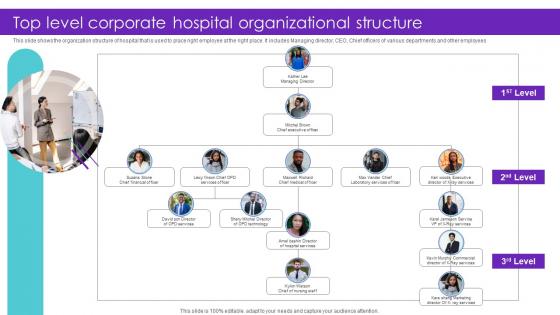
Top Level Corporate Hospital Organizational Structure




Try Before you Buy Download Free Sample Product
 Impress Your
 Audience
 100%
100% Editable
 Save Hours
 of Time


This slide shows the organization structure of hospital that is used to place right employee at the right place. It includes Managing director, CEO, Chief officers of various departments and other employees
People who downloaded this PowerPoint presentation also viewed the following :
Top Level Corporate Hospital Organizational Structure with all 6 slides:
Use our Top Level Corporate Hospital Organizational Structure to effectively help you save your valuable time. They are readymade to fit into any presentation structure.





FAQs for Top Level Corporate
Hospital organizational structures include medical departments, nursing services, administrative divisions, support services, and governance bodies. These components work together by streamlining patient care coordination, enhancing operational efficiency, and ensuring regulatory compliance, with many healthcare systems finding that well-integrated structures ultimately deliver faster patient services and improved clinical outcomes.
Clinical and administrative functions interact through integrated workflows where medical staff collaborate with administrators on resource allocation, quality metrics, and operational efficiency. Administrative teams support clinical decisions by managing budgets, scheduling, and compliance requirements, while clinical departments provide patient care data that guides strategic planning, ultimately enabling hospitals to deliver quality care while maintaining financial sustainability and regulatory compliance.
Governance and leadership establish strategic direction, oversee quality standards, ensure regulatory compliance, and drive operational efficiency across hospital departments. Through effective board oversight and executive management, hospitals streamline patient care delivery, optimize resource allocation, and enhance staff coordination, with many healthcare systems finding that strong leadership structures ultimately deliver improved patient outcomes and sustainable financial performance.
Hospital organizational structures significantly impact patient care by determining communication pathways, decision-making speed, resource allocation, and care coordination across departments. Clear hierarchies and interdisciplinary teams enable faster diagnosis, streamlined treatment protocols, and reduced medical errors, while well-defined roles enhance accountability and patient safety, ultimately delivering improved health outcomes and operational efficiency.
Best practices for creating collaborative medical staff environments include establishing interdisciplinary care teams, implementing structured communication protocols, conducting regular case reviews, fostering open feedback cultures, and utilizing collaborative technology platforms. These approaches enhance patient outcomes by streamlining care coordination, reducing medical errors, and improving staff satisfaction, with many hospitals finding that structured collaboration ultimately delivers faster treatment decisions and significantly better patient experiences.
Hospital departments coordinate through integrated management systems, shared protocols, and cross-functional teams that streamline communication between nursing, administration, pharmacy, and clinical units. These coordination mechanisms enable real-time resource allocation, reduce operational inefficiencies, and enhance patient care delivery, with many healthcare institutions finding that strategic departmental integration ultimately delivers faster treatment times and improved cost management.
Hospitals face challenges including regulatory compliance complexity, staff retraining requirements, technology integration demands, workflow restructuring needs, and budget allocation pressures when adapting organizational structures. These regulatory shifts often require healthcare institutions to streamline operations, enhance reporting capabilities, and reallocate resources, with many finding that strategic restructuring ultimately delivers improved patient outcomes and operational efficiency.
Technology integration enhances hospital organizational structures by automating workflows, streamlining communication systems, and centralizing patient data management across departments. Through electronic health records, telemedicine platforms, and AI-powered scheduling systems, hospitals achieve faster patient processing, reduced administrative overhead, and improved care coordination, ultimately delivering better patient outcomes while minimizing operational costs.
The Chief Medical Officer serves as the senior physician executive responsible for clinical quality, medical staff oversight, patient safety protocols, and strategic healthcare initiatives within the hospital's leadership structure. This role bridges clinical expertise with administrative decision-making, ensuring medical standards compliance, coordinating with department heads, and driving quality improvement initiatives, ultimately enhancing patient outcomes while supporting the organization's operational efficiency and competitive positioning.
Hospital size directly influences organizational complexity through increased departmental layers, specialized units, and management hierarchies required to coordinate diverse services. Larger hospitals develop complex matrix structures with multiple service lines, specialized committees, and extensive reporting relationships, while smaller facilities operate with flatter hierarchies, ultimately requiring more sophisticated governance systems and administrative oversight to maintain operational efficiency and quality care delivery.
Effective interdepartmental communication strategies include standardized protocols, cross-functional teams, regular department meetings, shared digital platforms, and liaison roles between units. These approaches streamline information flow by eliminating silos, establishing clear reporting channels, and creating accountability structures, with many hospitals finding that integrated communication systems ultimately enhance patient care coordination and operational efficiency.
Patient-centered care influences hospital organizational structure by flattening hierarchies, creating multidisciplinary care teams, and establishing shared decision-making processes between clinicians, patients, and families. This approach streamlines communication channels, reduces administrative barriers, and enhances care coordination across departments, with many hospitals finding that integrated service lines and collaborative governance models ultimately deliver improved patient outcomes and operational efficiency.
Hospital culture significantly impacts organizational effectiveness through communication patterns, staff collaboration, patient safety protocols, decision-making processes, and employee retention rates. A positive culture enhances coordination between departments like emergency services and surgical units, streamlines care delivery, and reduces medical errors, while fostering innovation and adaptability that ultimately delivers better patient outcomes and operational efficiency.
Public hospitals typically emphasize comprehensive coverage with larger nursing ratios, residency programs, and union-represented staff, while private hospitals focus on efficiency with leaner staffing and performance-based models. These structural differences enable public hospitals to deliver broader community services and teaching functions, whereas private institutions streamline operations for specialized care and faster patient throughput, ultimately reflecting their distinct operational priorities.
Leadership style significantly impacts hospital team dynamics by influencing communication patterns, decision-making processes, staff morale, patient safety outcomes, and overall operational efficiency. Transformational leaders in healthcare settings enhance collaboration between departments like nursing, surgery, and administration, while participative approaches streamline care coordination and reduce medical errors, ultimately delivering improved patient experiences and staff retention across hospital systems.
-
Wow, never been this impressed with any online service provider. Really appreciate the customer support all along from the navigation to purchasing the right products.
-
The templates are easy to get, and the chat customer support is excellent.