


Explainable AI Models Powerpoint Presentation Slides




Try Before you Buy Download Free Sample Product
 Impress Your
 Audience
 100%
100% Editable
 Save Hours
 of Time


This PowerPoint presentation provides a concise overview of an Explainable AI XAI provider company, outlining why organizations should choose them. It highlights the successful applications of XAI in various sectors such as healthcare, finance, automobiles, the judicial system, and manufacturing. The Explainable AI PowerPoint Presentation is designed to offer a comprehensive understanding of the need for XAI, its importance, value, and critical capabilities. Key features of this Interpretable AI PPT include an in-depth overview of explainable artificial intelligence, considerations for XAI, its role in serving AI ethics, benefits, and a comparison between traditional artificial intelligence and explainable AI. Furthermore, the Explainable AI PPT delves into implementation frameworks and techniques, providing insights into how these methods work and addressing common implementation challenges. Take advantage of the opportunity to download this comprehensive template, which offers valuable insights into Explainable AI and its applications across diverse industries. Elevate your understanding and communication of XAI with this professionally crafted presentation.
People who downloaded this PowerPoint presentation also viewed the following :
Content of this Powerpoint Presentation
Slide 1: This slide introduces Explainable AI Models. State Your Company Name and begin.
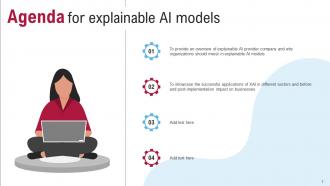
Slide 2: This is an Agenda slide. State your agendas here.
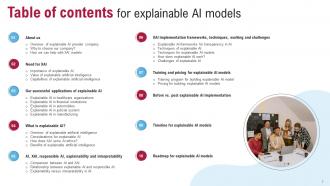
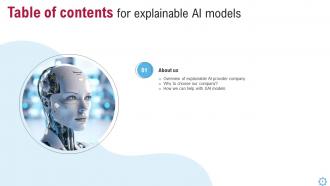
Slide 3: This slide presents Table of Contents for Explainable AI.
Slide 4: This is another slide continuing Table of Contents for Explainable AI.
Slide 5: This slide highlights title for topics that are to be covered next in the template.
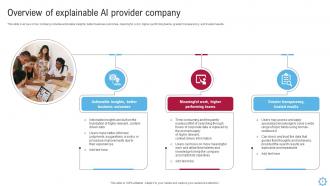
Slide 6: This slide displays Overview of Explainable AI Provider Company.
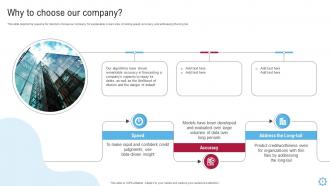
Slide 7: This slide depicts the reasons for clients to choose our company for explainable AI services.
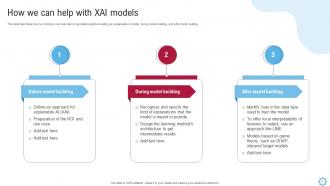
Slide 8: This slide describes how our company can help client organizations before building an explainable AI model.
Slide 9: This slide highlights title for topics that are to be covered next in the template.
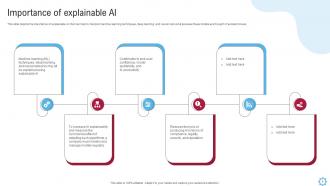
Slide 10: This slide depicts the importance of explainable AI that can help to interpret machine learning techniques.
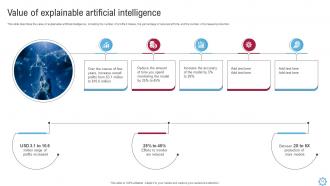
Slide 11: This slide describes the value of explainable artificial intelligence, including the number of profits it makes, the percentage of reduced efforts, etc.
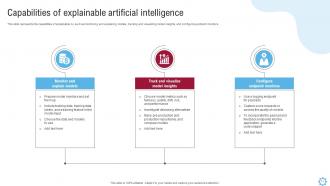
Slide 12: This slide represents the capabilities of explainable AI, such as monitoring and explaining models, tracking and visualizing model insights, etc.
Slide 13: This slide highlights title for topics that are to be covered next in the template.
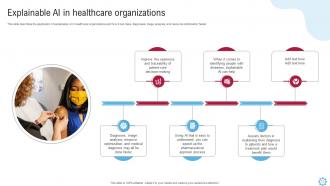
Slide 14: This slide describes the application of explainable AI in healthcare organizations and how it can make diagnoses.
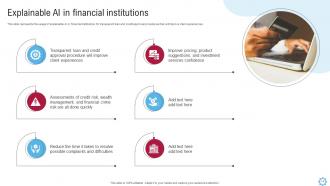
Slide 15: This slide represents the usage of explainable AI in financial institutions for transparent loan and credit approval procedures.
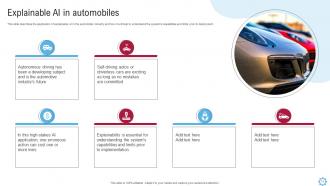
Slide 16: This slide describes the application of explainable AI in the automobile industry and how it will help to understand the system’s capabilities.
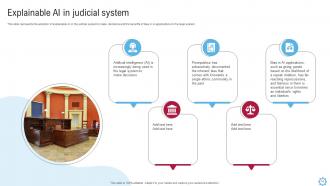
Slide 17: This slide represents the adoption of explainable AI in the judicial system to make decisions and the benefits of bias in AI applications.
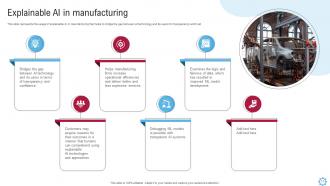
Slide 18: This slide showcases usage of explainable AI in manufacturing that helps to bridge the gap between AI technology and its users.
Slide 19: This slide highlights title for topics that are to be covered next in the template.
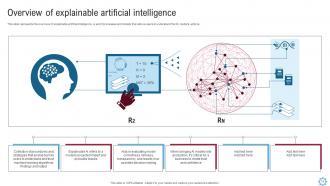
Slide 20: This slide shows Overview of Explainable Artificial Intelligence.
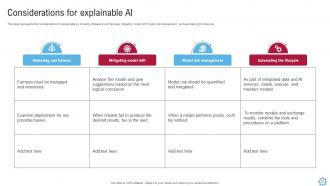
Slide 21: This slide presents considerations for explainable AI, including debiasing and fairness, mitigating model drift, model risk management, etc.
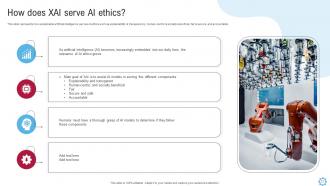
Slide 22: This slide represents how explainable artificial intelligence serves AI ethics such as explainability & transparency, human-centric & socially beneficial, etc.
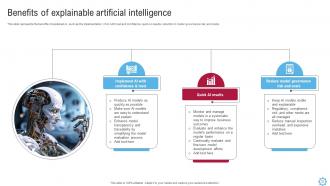
Slide 23: This slide showcases benefits of explained AI, such as the implementation of AI with trust and confidence, quick AI results, etc.
Slide 24: This slide highlights title for topics that are to be covered next in the template.
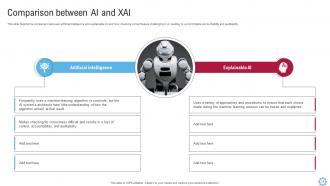
Slide 25: This slide depicts the comparison between artificial intelligence and explainable AI and how checking correctness is challenging in AI.
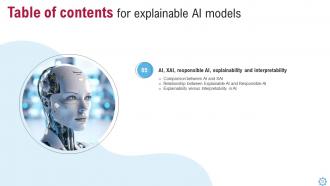
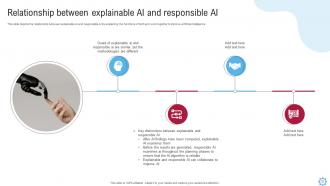
Slide 26: This slide represents Relationship between Explainable AI and Responsible AI.
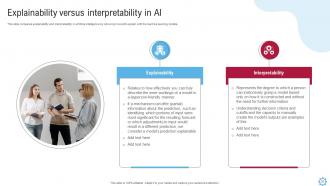
Slide 27: This slide compares explainability and interpretability in artificial intelligence by showing how both explain with the machine learning models.
Slide 28: This slide highlights title for topics that are to be covered next in the template.
Slide 29: This slide showcases Explainable AI Frameworks For Transparency In AI.
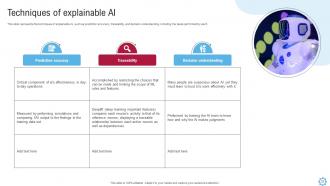
Slide 30: This slide presents techniques of explainable AI, such as prediction accuracy, traceability, and decision understanding, etc.
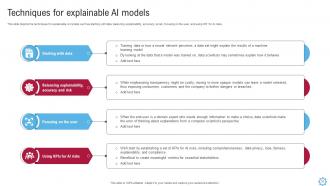
Slide 31: This slide depicts the techniques for explainable AI models such as starting with data, balancing explainability, accuracy, etc.
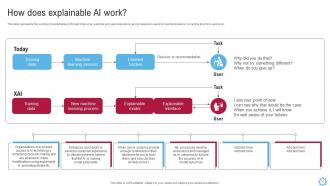
Slide 32: This slide represents the working of explainable AI through improving customer and user experience.
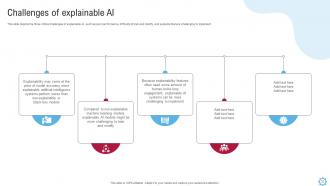
Slide 33: This slide depicts the three critical challenges of explainable AI, such as poor performance, difficulty to train and modify, etc.
Slide 34: This slide highlights title for topics that are to be covered next in the template.
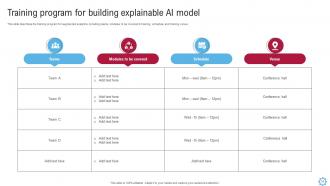
Slide 35: This slide represents Training Program for Building Explainable AI Model.
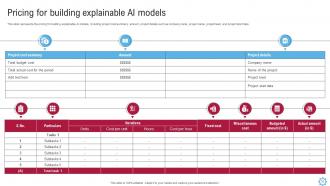
Slide 36: This slide showcases Pricing for Building Explainable AI Models.
Slide 37: This slide highlights title for topics that are to be covered next in the template.
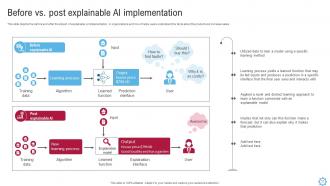
Slide 38: This slide depicts the before and after the impact of explainable AI implementation in organizations.
Slide 39: This slide highlights title for topics that are to be covered next in the template.
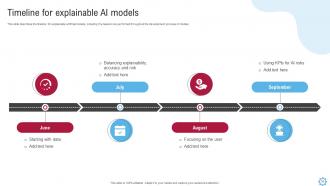
Slide 40: This slide describes the timeline for explainable artificial models, including the tasks to be performed throughout the development process of models.
Slide 41: This slide highlights title for topics that are to be covered next in the template.
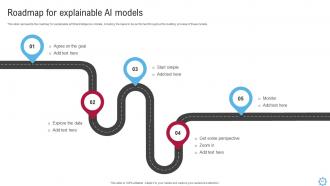
Slide 42: This slide represents the roadmap for explainable artificial intelligence models, including the tasks to be performed.
Slide 43: This slide displays Icons for Explainable AI (IT).
Slide 44: This slide is titled as Additional Slides for moving forward.
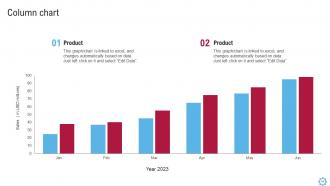
Slide 45: This slide displays Column chart with two products comparison.
Slide 46: This slide shows Pie Chart with data in percentage.
Slide 47: This slide provides 30 60 90 Days Plan with text boxes.
Slide 48: This is a Financial slide. Show your finance related stuff here.
Slide 49: This slide depicts Venn diagram with text boxes.
Slide 50: This slide contains Puzzle with related icons and text.
Slide 51: This is Our Goal slide. State your firm's goals here.
Slide 52: This slide shows Post It Notes. Post your important notes here.
Slide 53: This is a Thank You slide with address, contact numbers and email address.
Explainable AI Models Powerpoint Presentation Slides with all 61 slides:
Use our Explainable AI Models Powerpoint Presentation Slides to effectively help you save your valuable time. They are readymade to fit into any presentation structure.











FAQs for Explainable AI Models
So the big three are transparency, interpretability, and accountability - you've gotta be able to explain how your model actually works. Which features influenced what predictions, confidence levels, the whole decision trail. Trust me, people hate black boxes making calls about their mortgage or job application. Regulators are getting stricter about this too, which honestly makes sense. LIME and SHAP are good starting points - they'll show you what inputs drive each prediction. Oh, and don't overthink it at first, just get something basic running so you can see what's happening under the hood.
Look, explainable AI basically shows you how it thinks instead of just spitting out random answers. You can see what data it used, what rules it followed - the whole process. Makes way more sense than trusting some mysterious black box, right? It's like when your friend gives advice but won't tell you why... sketchy. The transparency lets you catch biases and actually verify the logic isn't completely off. Oh, and definitely ask vendors what explainability stuff they've got before you commit to anything.
LIME and SHAP are probably your best bet - they show which features matter most for predictions. Attention mechanisms work well for NLP projects. Gradient-based methods can highlight key input areas too. Oh, and counterfactual explanations are cool because they show what'd need to change for different results. Really depends who you're explaining to though. Technical people usually want SHAP values and detailed breakdowns. Executives? They just want clean charts they can actually understand. Model-agnostic tools are nice since they work with whatever you've already built. I'd start with LIME - it's pretty straightforward and gets the job done quickly.
So healthcare and finance both need explainable AI but for totally different reasons. Doctors use LIME and SHAP to figure out why AI flagged something as cancer - makes sense since patients' lives are on the line. Finance is more about regulatory stuff - they need feature importance and counterfactual explanations for loans and fraud detection because the government basically forces them to. Insurance companies are super into this too (honestly they're probably more paranoid than banks). Both use attention mechanisms in their models. My advice? Figure out which decisions absolutely need transparency first - that's where you'll see the biggest impact.
Yeah, there's tons of good examples out there. IBM Watson shows doctors why it picks certain cancer treatments - builds way more trust that way. Banks like JPMorgan have to use explainable models for loans since they literally can't reject people without giving reasons (regulatory mess if they don't). LIME and SHAP are basically the go-to tools now. Self-driving cars also need this stuff to explain their decisions to regulators. Oh, and Google's What-If Tool is actually pretty solid if you're trying to build something - way easier than I expected to use.
Honestly? The main pain is that explainable AI usually means worse performance - there's always this annoying trade-off between getting good results and actually understanding them. Your current systems probably weren't designed for this stuff, so integrating explainability gets messy quick. Teams need training too because interpreting AI explanations is weirdly harder than you'd think. Regulations keep changing which... yeah, that's always fun to deal with. My advice? Start small with just one use case where you absolutely need the explanations, then expand from there. Don't try to fix everything at once or you'll hate your life.
So black-box models are basically mysteries - you can't see what's going on inside, so you need tools like LIME or SHAP to decode their decisions. It's weird having to reverse-engineer your own model, right? White-box models like decision trees just show you their logic upfront. Way easier. If you're in finance or healthcare where people actually ask "why did the model do that," white-box saves you headaches. Though honestly, sometimes the black-box stuff performs so much better it's tempting anyway. Just plan for extra explainability work if you go that route.
So basically governments are forcing companies to explain their AI decisions - especially for stuff like loans, hiring, medical stuff. The EU's AI Act and GDPR are the big ones right now. Honestly, some companies are scrambling to catch up. But it's actually pushing everyone to build better explainable AI tools, which is kinda cool I guess. My advice? Start building that transparency stuff into your systems now. Trust me, retrofitting it later when deadlines hit is gonna be way more painful than just doing it right from the start.
So honestly, start with a pilot using your actual users - that's where you'll get the real insights. Check if domain experts actually trust what they're seeing and whether it matches their intuition. User studies are clutch here, even if they're small. Does the explanation help people make better calls or spot when the model screws up? Also worth checking: do similar inputs give you consistent reasoning patterns? When you have ground truth available (which isn't always), see if explanations line up. The whole point is whether people walk away with fewer questions, not more.
So user feedback is basically your reality check - tells you if your AI's explanations actually make sense to regular people. When someone flags something confusing or asks follow-ups, boom, you've spotted a gap in how your model explains itself. It's honestly like having an endless focus group. You can tailor explanations too - tech people want the nitty-gritty feature weights, but business folks just want plain English summaries. I'd say start collecting feedback on everything, even simple thumbs up/down. You'll catch patterns in what clicks with people pretty quickly.
SHAP's probably your best bet to start with - crazy good visualizations and works with almost anything. LIME's solid too for feature importance stuff. For deep learning, Captum if you're using PyTorch, tf-explain for TensorFlow. IBM has AIX360 but honestly their documentation is kind of a mess. Oh and if you're doing computer vision, definitely check out GradCAM. It shows exactly what parts of images your model focuses on, which is pretty cool. I'd just grab SHAP first though. Throw it at whatever model you've got and you'll start seeing patterns right away. Way better than guessing what's happening under the hood.
So here's the thing - cultural stuff really shapes how people feel about AI explanations. Scandinavians tend to trust black box systems more, but Germans and Japanese? They want every detail explained because of their whole accountability thing. Europeans are obsessed with transparency as a basic right (fair enough), while some Asian markets just care if it works fast. Religious backgrounds matter too - cultures that value human control want more say in AI decisions. Honestly, you've gotta research local attitudes about tech and authority before rolling anything out globally. Could save you major headaches.
Explainable AI is honestly a game-changer for catching bias. You can finally see what's actually happening when your models make decisions. If they're picking up on protected characteristics or random weird patterns, you'll spot it way earlier. Think of it as x-ray vision for algorithms - super useful stuff. I'd start with your riskiest models first, like anything doing hiring or loan decisions. You can audit the decision patterns and fix problems systematically instead of crossing your fingers and hoping nothing goes wrong. Should probably be standard practice at this point, but here we are.
So it really depends on what you're building. Medical stuff or loan decisions? Yeah, you'll want models people can actually understand, even if they're not perfect. Less critical things, maybe you can get away with prioritizing performance. SHAP is honestly a lifesaver for explaining black box models to non-tech people - I've used it tons. You could also try ensemble methods or just start with simpler models before going full black box. The key thing is figuring out upfront what "explainable enough" actually means for whoever's going to use this thing.
So from what I'm seeing, three main things are happening with explainable AI. Interactive explanations are getting way better - like chatbots that can actually walk you through their decisions instead of just giving you boring static reports. Also, explanations are becoming more personalized based on your expertise level, which is pretty cool. Real-time explanations built right into systems are replacing the clunky add-on approaches too. Honestly, regulatory pressure is pushing a lot of this forward faster than expected. You should probably start playing around with tools that offer conversational explanations now to get ahead of it.
-
“As you have innovative ideas and they are all customizable, this saves a huge chunk of your time to prepare well-read presentations.”
-
The service is fast, and I could access any presentation after buying the subscription. I don’t think I’ll ever have to worry about a presentation in my life.
-
Their designing team is so expert in making tailored templates. They craft the exact thing I have in my mind…..really happy.
-
Great quality product.