


Value Stream Mapping Of Supply Chain Supply Chain Transformation Toolkit




Try Before you Buy Download Free Sample Product
 Impress Your
 Audience
 100%
100% Editable
 Save Hours
 of Time


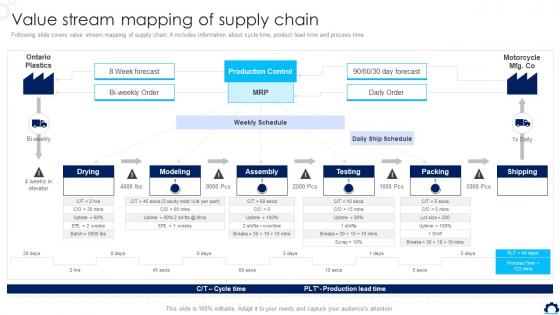
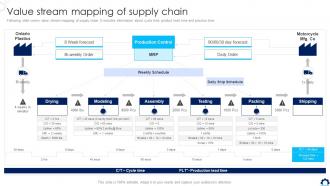
Following slide covers value stream mapping of supply chain. It includes information about cycle time, product lead time and process time.
People who downloaded this PowerPoint presentation also viewed the following :
Value Stream Mapping Of Supply Chain Supply Chain Transformation Toolkit with all 6 slides:
Use our Value Stream Mapping Of Supply Chain Supply Chain Transformation Toolkit to effectively help you save your valuable time. They are readymade to fit into any presentation structure.





FAQs for Value Stream Mapping Of Supply Chain Supply
Think of VSM like drawing a detailed map of how work actually moves through your process - the good stuff and all the messy parts. You sketch out what's happening now, then figure out what it should look like without the bottlenecks and stupid redundancies. Honestly, it's kind of like getting X-ray vision for spotting where time disappears and which steps customers actually care about. Pick one process that's driving you crazy and just start mapping it. The stuff you'll uncover is pretty wild - handoffs that take forever, steps that add zero value. Trust me on this one.
Honestly, value stream mapping is like putting your entire process under a microscope. Map out every single step - all the activities, wait times, handoffs, everything. What happens is wild - you'll suddenly see waste that was basically invisible before. Materials just sitting there for days between steps? Yeah, that'll jump right out at you. The visual aspect makes such a difference because stuff that felt "normal" looks absolutely nuts when it's all laid out. You can catch overproduction, too much inventory, people running around unnecessarily. Circle the worst offenders on your map and go after those first.
So you'll need process boxes for each step, then data boxes underneath with your cycle and lead times. Between processes, add those little inventory triangles. Information flow arrows show how people actually communicate - which is usually messier than you'd think! Don't forget customer and supplier boxes at the ends (seriously, everyone skips these). Timeline calculations go at the bottom to compare total lead time vs value-add time. Here's the thing though - walk the actual process first before drawing anything. Map what's really happening now, not what you wish was happening.
Look at the stuff that actually matters - cycle times, wait times, how often things get screwed up, delays between handoffs. Don't just read the process docs though, they're usually wrong anyway. Walk around and talk to people actually doing the work. Time the steps, but also ask what's driving them crazy day-to-day. Here's the thing - measure everywhere work gets stuck or sits waiting. That's where your real problems hide. Honestly, just start walking the floor tomorrow and collecting data as you go. It's way easier once you get moving.
So basically, your current state map is documenting how things actually work right now - all the chaos and inefficiencies included. Pretty eye-opening stuff, honestly. Future state is where you sketch out your ideal version after fixing everything. Start by walking through the real process and writing down every step, delay, and handoff. Don't sugarcoat it. Then figure out what waste you can eliminate and design your improved flow. The difference between those two maps? That's your action plan for getting there.
Yeah, so VSM started in manufacturing but you can use it pretty much anywhere with repeatable processes. Healthcare, software dev, banks, logistics - even restaurants and call centers see results. The main thing is having workflows where stuff moves from one step to another with clear handoffs. Got waste, delays, or quality problems? VSM will help you find them. Honestly, I'd just pick one simple process you deal with every day and map it out first. Something small. You'll be surprised what bottlenecks pop up once you actually see it all laid out visually.
Dude, Value Stream Mapping is honestly a game changer. Map out how things work now, then spot all the bottlenecks and waste. After that, you design what the ideal process should look like. Gets everyone aligned on what actually matters instead of working on random stuff that doesn't help. I've seen teams waste months on improvements that barely moved anything. With VSM, your kaizen events hit the right spots. It's basically a roadmap showing exactly where to focus your energy. Pick one process and try mapping it next week - you'll be surprised what you find.
Honestly, don't overthink the tool choice. Sticky notes on whiteboards still work amazing for workshops - people love moving stuff around physically. Digital-wise, Lucidchart and Visio have those VSM templates already built in, which is super handy. Miro's great for remote teams too. Some people swear by specialized lean tools like iGrafx, but I've seen teams do perfectly fine work in PowerPoint (not glamorous, but it works). The key thing? Pick whatever your team already knows how to use. You'll get way better insights when people aren't fighting the software.
So VSM gives you this complete picture of your whole value stream, which is way more useful than just looking at individual sprints. During retrospectives, map out your current state to spot bottlenecks. Then use that future state map to guide your sprint planning - it's honestly pretty satisfying to see everything laid out like that. For Lean stuff, it shows you exactly where delays and waste happen across your entire workflow. I'd start small though - just map one feature from concept to delivery first. You'll immediately see where things can connect better. It's like having that bird's eye view you never knew you needed.
You absolutely need everyone in the room for this - operations, quality, IT, logistics, the whole crew. Each team spots different waste that others completely miss. They actually know how stuff really moves around, not what some process doc says should happen. Honestly, I've watched so many VSM projects crash and burn because only one department showed up. The real insights come when different functions map together and suddenly find all these weird handoffs nobody talks about. Sometimes there's like three approval steps that serve zero purpose. Get the right mix of people from the start or you're just wasting time.
So basically, Value Stream Mapping puts your whole process on paper where everyone can actually see it. No more guessing what other people think the workflow looks like! When my team first did this, we were shocked at how differently we all pictured things. You'll spot bottlenecks and weird gaps way faster when you're all staring at the same visual. Makes those improvement meetings so much better too - you're pointing at actual steps instead of just talking in circles about vague stuff. Honestly beats those endless discussions where nobody's really sure what we're even fixing.
Honestly, the hardest part is just getting people to show up - everyone claims they're swamped even though mapping will actually save them hours down the road. Leadership needs to visibly back this or you're dead in the water. People will want to map their entire universe in one go, which never works. Expect pushback from teams who like their current mess of a process. Oh, and good luck getting reliable data since half the team probably tracks things differently (or not at all). Sessions can turn into finger-pointing marathons if you're not careful. My advice? Start tiny with one pilot project.
Honestly, focus on the stuff that actually matters - lead time, cycle time, how much waste you cut, and defects. Customer-facing metrics should be your priority since that's what pays the bills. Don't waste time on metrics that just look pretty in presentations but tell you nothing useful. Measure how much faster you're getting value out the door and how much rework disappeared. Oh, and set up some basic dashboard so you're not scrambling for numbers later. Monthly reviews with the team work well - keeps everyone honest about whether this VSM thing is actually working or just busy work.
Get your team together first - but make sure it's people who actually do the work, not just their bosses looking over their shoulders. Map what's happening now before you try fixing anything (I know, everyone wants to jump straight to solutions). Focus on just one process at a time or it gets messy. Walk through it physically if you can - timing everything and spotting all the usual waste like waiting around, making too much stuff, fixing mistakes. Oh, and don't let it end without assigning actual next steps with real deadlines, otherwise you'll have a nice poster nobody looks at.
So basically, Value Stream Mapping shows you where you're bleeding time and money in your processes. Map out every single step from when a customer asks for something until they actually get it. Then hunt down all the bottlenecks and delays that piss customers off. Think of it like x-ray vision for your work - suddenly all those hidden time-wasters become obvious. Once you cut out the junk, lead times drop and quality goes up. Customers get their stuff faster too. My advice? Start with whatever process generates the most customer complaints. That's usually where you'll find the biggest wins anyway.
-
Informative and engaging! I really like the design and quality of the slides.
-
Innovative and attractive designs.