


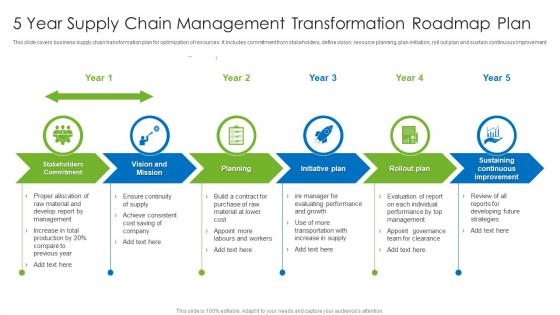
5 Year Supply Chain Management Transformation Roadmap Plan




Try Before you Buy Download Free Sample Product
 Impress Your
 Audience
 100%
100% Editable
 Save Hours
 of Time


This slide covers business supply chain transformation plan for optimization of resources. It includes commitment from stakeholders, define vision, resource planning, plan initiation, roll out plan and sustain continuous improvement.
People who downloaded this PowerPoint presentation also viewed the following :
5 Year Supply Chain Management Transformation Roadmap Plan with all 6 slides:
Use our 5 Year Supply Chain Management Transformation Roadmap Plan to effectively help you save your valuable time. They are readymade to fit into any presentation structure.





FAQs for 5 Year Supply Chain Management
Honestly, it's mostly the stuff you'd guess. Customers expect Amazon-speed everything now - pandemic spoiled everyone. Supply chains got completely wrecked and showed how rickety the whole system was. Everyone's scrambling to digitize and automate (which, fair enough). Sustainability rules are making companies totally rethink where they source from. And yeah, costs are still brutal. Your supply chain basically needs to bend without breaking now. I'd start by figuring out where you're most exposed - like, what happens if your main supplier disappears tomorrow?
Totally doable, just gotta be smarter about it. Look for wins that hit both - like route optimization cuts fuel costs AND emissions. Working with local suppliers? Shorter delivery times plus less transport. The upfront costs can be brutal though, I won't lie. Most companies think it's either/or when really there's a sweet spot somewhere in the middle. Track your efficiency and environmental metrics together - data helps you figure out what actually works. I'd start small with a pilot program in one region first. Test it out, see what sticks, then expand from there.
Tech is pretty much everything when it comes to fixing supply chains. AI helps predict what customers actually want, IoT sensors track stuff in real-time, and warehouse automation speeds everything up. Cloud systems connect all your suppliers and distributors so data doesn't get stuck in silos. The analytics part is honestly where you'll see the biggest wins - I've seen companies find waste they didn't even know they had. My advice? Pick whatever's driving you crazy right now and start there. Once you get some quick wins, you can expand to other areas.
Honestly, data analytics is a lifesaver for spotting stuff you'd never catch otherwise - demand spikes, bottlenecks brewing, suppliers screwing up before it hits you. No more scrambling when things go sideways. Instead of flying blind with gut feelings and old reports, you'll actually see what's happening across your whole supply chain in real-time. Those dashboards are pretty clutch. My advice? Don't go crazy trying to fix everything at once though. Pick something specific like inventory and nail that first, then expand once you've got some wins to show for it.
Look, globalization's basically a trade-off - you get cheaper suppliers and bigger markets, but man, you're exposed to so much more risk. COVID really showed how brittle those long international chains are. One port shuts down in Asia and suddenly your whole operation's screwed. The smart move? Don't rely on just one region for anything critical. Set up backup suppliers in different countries, maybe some regional distribution hubs too. And honestly, you need way better tracking systems - half the time companies don't even know where their stuff is until it goes missing. Redundancy costs more upfront but it'll save your ass when things go sideways.
Honestly, your customers are running the show now. They want same-day delivery, personalized everything, and zero-hassle returns. So you've gotta completely rethink how your supply chain works. Real-time tracking is a must. Flexible warehouses too - can't just have one giant facility anymore. Predictive analytics helps you stay ahead of demand spikes. The brands still stuck in old-school operations? They're getting crushed. I'd start by actually asking your customers what they expect, then compare that to what you're doing. The gap is probably bigger than you think.
Start with just a couple partners - don't try to fix everything at once or you'll lose your mind. Set up shared dashboards so everyone can see the same inventory data in real-time. Regular check-ins are huge, but honestly? The relationship stuff matters more than people think. Get everyone working toward the same KPIs instead of just their own department's numbers. Face-to-face meetings help a ton when you can swing it. Cross-functional teams work well for big projects. Oh, and be upfront about both the good and bad stuff - transparency builds trust way faster than pretending everything's perfect.
Look at four main areas: your tech setup, how efficient your processes are, visibility into what's happening, and how quickly you can adapt. Most places use scoring frameworks - basic stuff is reactive and manual, advanced is predictive and integrated. Honestly? Get outside consultants. They spot things you're blind to when you're stuck in your own mess all day. Have them do stakeholder interviews, map your processes, audit your tech stack. My buddy's company skipped this step and wasted months going down the wrong path. Once you've got baseline scores, figure out what's most broken and build your roadmap.
Honestly, change resistance is brutal - people hate switching up what already works for them. Your data's probably scattered across systems that don't even communicate, which makes tracking anything a nightmare. Then there's the fun of trying to modernize when you're stuck with ancient tech that barely functions. Budget's always tight, and good talent? Nearly impossible to find these days. Oh, and don't even think about overhauling everything at once - that's a recipe for disaster. Pick your worst problem first and actually fix it before moving on.
Dude, change management is like 70% of whether you'll succeed or crash and burn. I've watched way more projects tank from people issues than crappy tech decisions - it's honestly wild. Your supply chain touches everyone from procurement folks to warehouse teams, so resistance spreads fast. Build your coalition of supporters early, before you even lock down the final plan. Communication and training cost money upfront but they're worth it. You can design the most genius system ever, but if your team isn't buying what you're selling? Game over.
Supply chain issues are the worst - you'll deal with late shipments, crazy costs, and running out of stock constantly. Customer complaints pile up fast when this stuff happens. Honestly, diversifying suppliers is clutch (learned this the hard way). Get visibility into who supplies your suppliers too. Strong relationships matter more than you'd think - suppliers will prioritize you during shortages if they actually like working with you. Map out your critical suppliers first, then find backups. Yeah, it costs more upfront but beats panicking when everything falls apart. Having solid backup plans isn't sexy but it'll save your sanity.
Dude, automation is a game changer for supply chains. It cuts out all the tedious manual stuff and reduces mistakes. Start with inventory management or order processing - those are easy wins. The crazy part is these systems never sleep, so they're cranking through work 24/7 while we're binge-watching Netflix. Your team gets freed up to do the actually interesting strategic stuff like building supplier relationships. Honestly, I'd pick one process to automate first, see how it goes, then expand. Don't try to automate everything at once or you'll lose your mind.
Honestly, you need to look at both the money side and how things actually run day-to-day. Cost reduction's the obvious one - what percentage of revenue goes to supply chain stuff now vs before. Track your inventory turnover, how fast orders get filled, on-time delivery rates. Customer satisfaction scores matter a ton since happy customers = more money. Oh, and agility metrics are super important now - like how fast can you pivot when something goes wrong? We've all learned that lesson recently. Supplier performance is worth tracking too, plus any sustainability goals if that was part of your original plan. Start with maybe 3-5 metrics that match what you were trying to fix initially.
Look, transforming your supply chain basically lets you beat competitors by being faster and cheaper. You'll streamline stuff, automate the boring parts, and actually see what's happening across your whole network. This means quicker deliveries at lower costs - and honestly, who doesn't want that? Market shifts happen constantly now, so being agile is huge. The data you get helps predict demand better too, so no more awkward "sorry we're out of stock" conversations with customers. I'd start by mapping what you're doing now and finding your worst bottlenecks. That's where you'll see results fastest.
Dude, Amazon literally ships stuff before you buy it - crazy predictive algorithms. Zara's the one that blew my mind though, they go from design to store shelves in like 2-3 weeks when everyone else takes months. Walmart ditched regular warehouses for this cross-docking thing that speeds everything up. Toyota's lean manufacturing? Yeah, that's basically the blueprint everyone steals from now. What's cool is none of them tried fixing everything - they just found their biggest slowdown and murdered it. Speed wins, apparently.
-
Easy to use and customize templates. Helped me give a last minute presentation.
-
The designs by SlideTeam are honestly the best I have seen so far. Will be definitely coming back for more.