

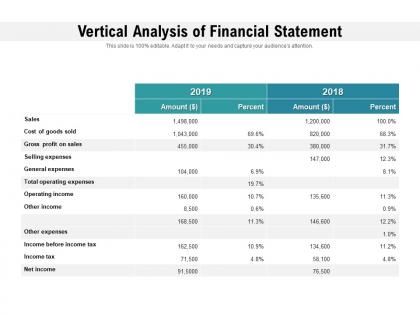
Vertical analysis of financial statement




Try Before you Buy Download Free Sample Product
 Impress Your
Audience
 100%
Editable
 Save Hours
of Time


Be ' Captain Courageous ' with our Vertical Analysis Of Financial Statement. Boldly lead them from the front.
People who downloaded this PowerPoint presentation also viewed the following :
Vertical analysis of financial statement with all 5 slides:
Boldly lead them from the front with our Vertical Analysis Of Financial Statement. They will call you ' Captain Courageous '.


FAQs for Vertical analysis
Vertical analysis examines each financial statement item as a percentage of a base figure within the same period, while horizontal analysis compares financial data across multiple time periods to identify trends. These complementary approaches enable businesses to assess current financial structure and performance changes over time, with many organizations finding that combining both methods delivers comprehensive insights for strategic decision-making and competitive positioning.
Vertical analysis applies to income statements by expressing each line item as a percentage of total revenue, and to balance sheets by showing each item as a percentage of total assets. This standardization enables meaningful comparisons across different time periods, company sizes, and industry benchmarks, with many financial analysts finding that it reveals profitability trends, cost structure efficiency, and asset allocation patterns that drive strategic decision-making.
Vertical analysis advantages include enhanced comparability across periods, simplified trend identification, standardized financial ratios, improved benchmarking capabilities, and clearer visualization of cost structures. By expressing each line item as a percentage of total revenue or assets, organizations streamline financial reporting, enable faster decision-making, and deliver more transparent insights to stakeholders, ultimately enhancing strategic planning and competitive positioning.
Vertical analysis proves most beneficial during strategic planning, performance benchmarking, industry comparisons, and investment evaluations, where businesses need to understand cost structures and operational efficiency. Companies in retail, manufacturing, and financial services find it particularly valuable for identifying expense patterns, optimizing resource allocation, and demonstrating financial stability to stakeholders, ultimately delivering competitive insights.
Financial ratios enhance vertical analysis by providing standardized metrics for comparing proportional relationships across different periods, companies, and industry benchmarks. These ratios, including profit margins, expense ratios, and asset composition percentages, enable analysts to identify operational efficiency trends and strategic opportunities, with many financial institutions and corporations finding that combining ratio analysis with vertical analysis delivers deeper insights into performance drivers and competitive positioning.
Common benchmarks used in vertical analysis include industry averages, competitor financial statements, historical company data, regulatory standards, and best-in-class performance metrics. These benchmarks enable organizations to evaluate their cost structures, profitability ratios, and operational efficiency against established standards, with many companies finding that systematic comparison ultimately delivers strategic insights and competitive positioning advantages.
Vertical analysis assists in identifying trends by expressing each line item as a percentage of a base figure, revealing proportional relationships and shifts over time within financial statements. This standardization enables businesses to spot patterns like increasing cost percentages or declining profit margins, with many organizations finding that these insights streamline strategic decision-making and enhance operational efficiency across departments.
Companies implementing vertical analysis face challenges including inconsistent data collection across departments, difficulty establishing meaningful baseline periods, and potential misinterpretation of percentage changes without proper context. While these obstacles require careful planning, organizations in retail, manufacturing, and financial services find that standardized reporting processes, comprehensive staff training, and integrated financial systems ultimately deliver enhanced decision-making capabilities and improved strategic insights.
Vertical analysis can be integrated into financial forecasting by establishing baseline percentage relationships between financial statement components, identifying historical trends in these proportions, and projecting future performance based on expected changes in business operations. Through this approach, organizations streamline budgeting processes, enhance accuracy in revenue and expense projections, and ultimately deliver more reliable financial forecasts that support strategic decision-making and resource allocation.
Vertical analysis affects stakeholder decision-making by revealing cost structures, profitability patterns, and operational efficiency trends that guide strategic choices. Through percentage-based comparisons, investors assess financial health, managers identify cost reduction opportunities, and creditors evaluate risk exposure, while suppliers and customers gain insights into company stability, ultimately enabling more informed resource allocation and partnership decisions.
Vertical analysis reveals operational efficiency by showing each expense category as a percentage of total revenue, enabling managers to identify cost structure patterns, benchmark against industry standards, and spot inefficiencies in resource allocation. This approach helps organizations streamline operations by highlighting which departments or functions consume disproportionate resources, ultimately delivering better cost control and improved profit margins.
Relying solely on vertical analysis presents limitations including lack of trend identification, absence of industry benchmarking, no competitor comparisons, limited insight into absolute growth, and inability to assess seasonal variations. While vertical analysis effectively reveals internal cost structures and proportional relationships, businesses increasingly combine it with horizontal analysis and industry data to gain comprehensive financial perspectives, ultimately delivering more strategic decision-making capabilities.
Vertical analysis enhances understanding of cost structures by expressing each expense as a percentage of total revenue, revealing proportional relationships and cost distribution patterns across different business segments. This approach enables companies to identify cost inefficiencies, benchmark against industry standards, and optimize resource allocation, with many organizations finding that proportional analysis delivers clearer insights into operational efficiency and competitive positioning.
**INPUT**: What software tools are available to perform vertical analysis efficiently? **OUTPUT**: Vertical analysis software tools include Excel with specialized templates, QuickBooks for automated percentage calculations, Tableau for visual financial analysis, Power BI for interactive dashboards, and dedicated platforms like PlanGuru and Adaptive Insights. These solutions streamline financial statement analysis by automating percentage calculations, generating comparative reports, and creating dynamic visualizations, with many accounting firms and finance departments finding that integrated platforms significantly reduce analysis time while enhancing accuracy and strategic insights. **Word count: 60 words**
Vertical analysis supports investor relations by providing standardized percentage-based metrics that facilitate clear performance communication, trend identification, and peer comparisons across reporting periods. Through these consistent financial ratios, companies can demonstrate operational efficiency, cost management effectiveness, and strategic resource allocation to stakeholders, while investors gain transparency into business fundamentals, ultimately enhancing trust and informed decision-making in increasingly competitive capital markets.
No Reviews