


Workplace Fire Detection And Risk Assessment Approach Training Ppt




Try Before you Buy Download Free Sample Product
 Impress Your
 Audience
 100%
100% Editable
 Save Hours
 of Time


The PPT Training Deck on Workplace Fire Detection and Risk Assessment Approach is an extensive guide that explores the life-saving functionalities of Smoke and Heat Detectors and understands the critical Role of a Fire Alarm System in keeping your workspace secure. It covers the complex process of Fire Risk Assessment to ensure that no stone is left unturned. The PowerPoint Module guides employees in identifying Fire Hazards, Identifying People at Risk, and Evaluating and Reducing Workplace Fire Risk. Each section is coupled with a Checklist that empowers employees to implement what they have learned effectively. It has Key Takeaways and Discussion Questions related to the topic to make the training session more interactive. The Deck also contains PPT slides on About Us, Vision, Mission, Goal, 30-60-90 Days Plan, Timeline, Roadmap, Training Completion Certificate, Energizer Activities, Client Proposal, and Assessment Form.
People who downloaded this PowerPoint presentation also viewed the following :
Content of this Powerpoint Presentation
Slide 3
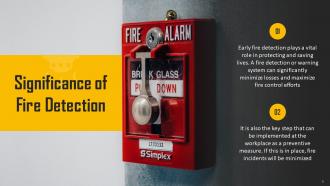
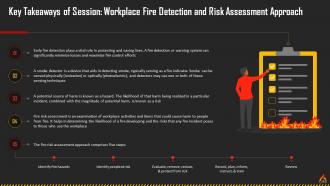
This slide discusses the importance of fire detection at the workplace. Early fire detection plays a vital role in protecting and saving lives. A fire detection or warning system can significantly minimize losses and maximize fire control efforts
Slide 4
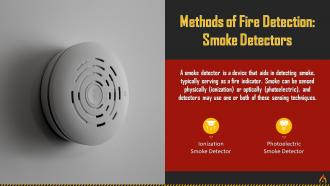
This slide talks about Smoke Detectors as a method of Detecting Fire. A smoke detector is a device that aids in detecting smoke, typically serving as a fire indicator. Smoke can be sensed physically (ionization) or optically (photoelectric).
Instructor’s Notes:
- Ionization Smoke Detector: Typically, these alarms are more responsive to flaming fires. They work by ionizing the air and creating a current flow between two electrically charged plates that comprise a small amount of radioactive material. Smoke disturbs the ion flow entering the chamber, reducing the current flow and setting off the alarm
- Photoelectric Smoke Detector: In general, photoelectric smoke alarms are more responsive to fires that start after a significant amount of smoldering. These alarms direct a light source at an angle away from the sensor into a sensing chamber. The alarm is set off when smoke enters the chamber and reflects light onto the light sensor
Slide 5
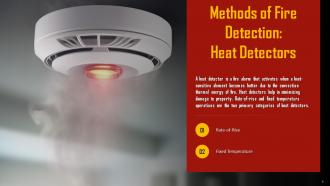
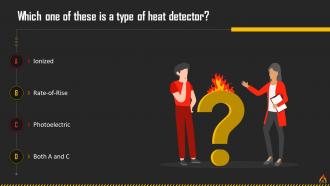
This slide talks about heat detectors as a method of detecting fire. A heat detector is a fire alarm that activates when a heat-sensitive element becomes hotter due to the convection thermal energy of fire. Heat detectors help in containing the property damage.
Instructor’s Notes:
- Rate-of-Rise: Rate-of-Rise (ROR) heat detectors function when there is a rapid rise in temperature of its heat-sensing element. This is typically of the order 6.7° to 8.3°C (between 12°F and 15°F) increase per minute, irrespective of the starting temperature
- Fixed Temperature: These are the most popular type of heat detectors. When the heat-sensitive eutectic alloy hits the eutectic point, where it changes from a solid to a liquid, fixed temperature detectors sound an alarm. Generally, the fixed temperature point for electrically connected heat detectors is 58°C (136.4°F)
Slide 6
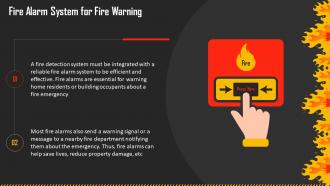
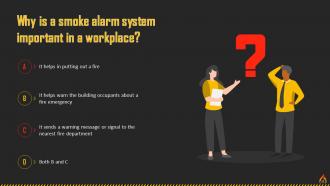
This slide gives an overview of fire alarm systems and their importance. A fire detection system must be integrated with a reliable fire alarm system to be efficient and effective. Fire alarms are essential for warning home residents or building occupants about a fire emergency
Slide 7
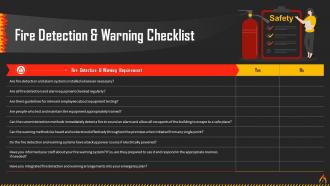
This slide depicts a Fire Detection and Warning Checklist.
Slide 8
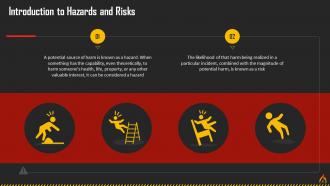
This slide gives an overview of hazards and risks. A potential source of harm is known as a hazard. The likelihood of that harm being realized in a particular incident, combined with the magnitude of potential harm, is known as a risk
Slide 9
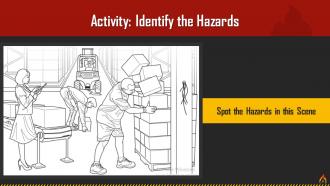
This slide depicts an activity to identify hazards around your surroundings using this picture as an illustration example.
Slide 10
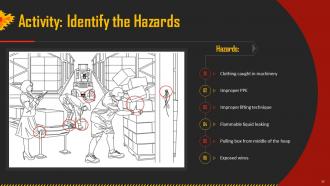
This slide highlights the hazards depicted in the picture. These are: Clothing caught in machinery, improper PPE, improper lifting technique, flammable liquid leaking, pulling box from middle of the heap, and exposed wires.
Slide 11
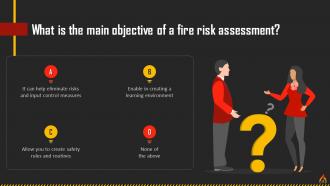
This slide gives the definition of fire risk assessment and discusses its goal. Fire risk assessment is an examination of workplace activities and items that could cause harm to people from fire.
Slide 12
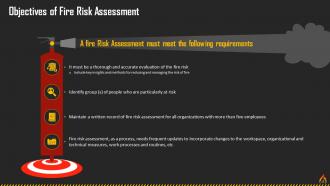
This slide lists the necessary requirements for a fire risk assessment. These include being thorough & accurate while evaluating fire risk, including key insights & methods for reducing & managing the risk of fire as the key policy and execution step, and more.
Slide 13
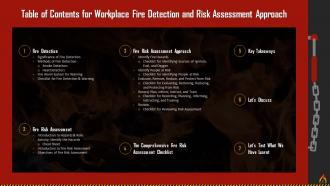
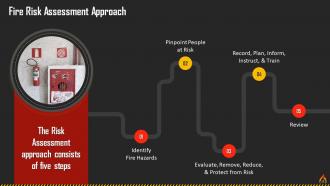
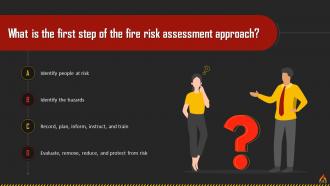
This slide depicts the five-step fire risk assessment approach. The steps are: Identify fire hazards, pinpoint people at risk, evaluate - remove - reduce - protect from risk, record - plan - inform - instruct - train, and review.
Slide 14
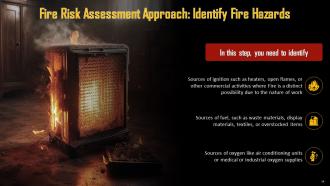
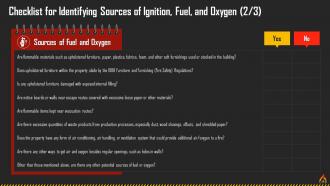
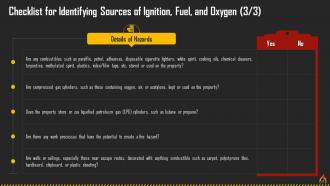
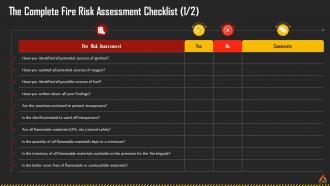
This slide discusses the first step of the fire risk assessment approach. This step entails the identification of hazards. In this step, you need to identify sources of ignition, fuel, and oxygen.
Instructor’s Notes: You must also take into account structural elements like ducts, holes carved into firewalls without stops, sizable concentration of combustible materials, open roof spaces, excessively long escape routes.
Slide 15 to 17
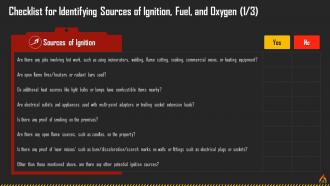
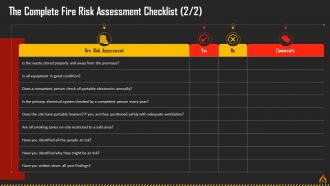
These slides depict the Checklist for identifying sources of ignition, fuel, and oxygen.
Slide 18
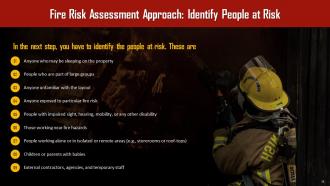
This slide talks about the second step of the fire risk assessment approach. This step is identifying people at risk, such as anyone who may be sleeping on the property, children or parents with babies.
Slide 19
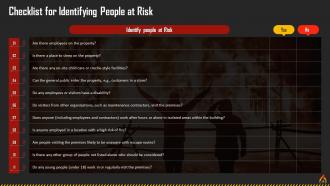
This slide shows a checklist for Identifying People at Risk.
Slide 20
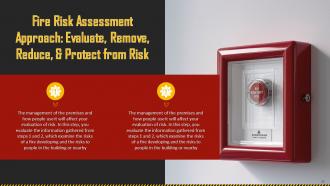
This slide discusses step 3 of the fire risk assessment approach. This step includes evaluating, removing, reducing, and protecting from risk. The management of the premises and how people use it will affect your evaluation of risk.
Slide 21
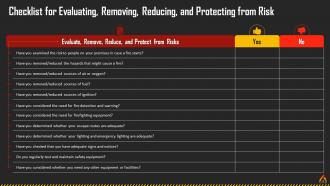
This slide depicts a checklist for Evaluating, Removing, Reducing, and Protecting from risk.
Slide 22
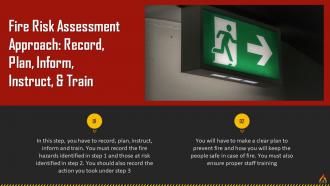
This slide talks about the fourth step of the fire risk assessment approach. This step includes Recording, Planning, Informing, Instructing, and Training. You must record the fire hazards identified in step 1 and those at risk identified in step 2. You should also record the action you took under step 3.
Slide 23
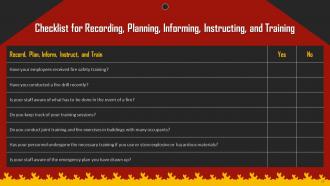
This slide depicts a checklist for recording, planning, informing, instructing, and training.
Slide 24
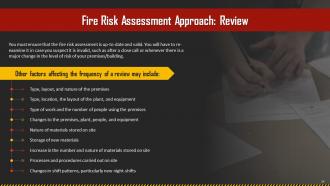
This slide discusses the last step of the fire risk assessment approach. This step entails the review of the assessment. You must ensure that the fire-risk assessment is up to date and valid. You will have to re-examine it in case you suspect it is no longer valid, such as after a near miss or every time there is a major change to the level of risk in your premises/building.
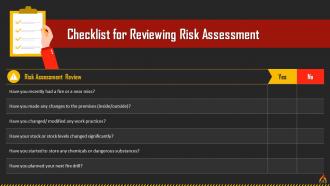
Slide 25 to 27
These slides depict review checklist for carrying out a Risk Assessment at Your Workplace.
Slide 47 to 62
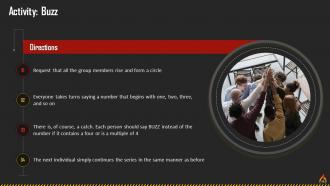
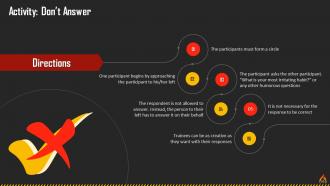
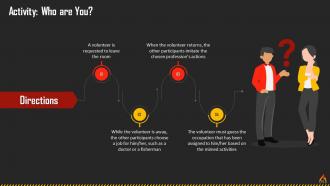
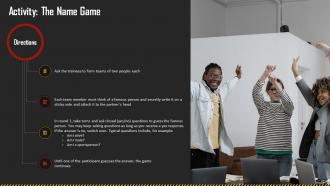
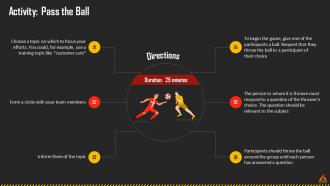
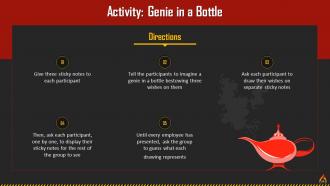
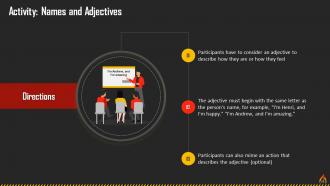
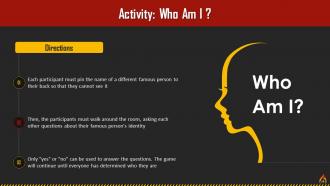
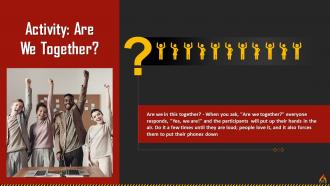
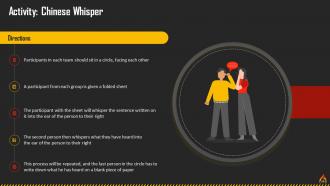
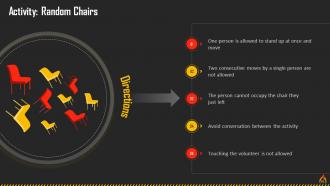
These slides contain energizer activities to engage the audience of the training session.
Slide 63 to 90
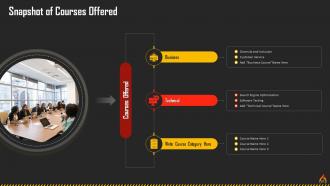
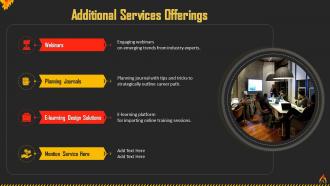
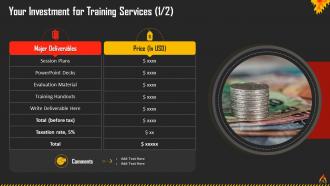
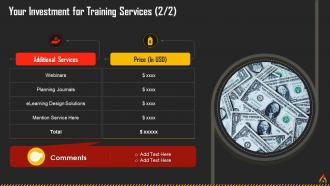
These slides contain a training proposal covering what the company providing corporate training can accomplish for the client.
Slide 91 to 93
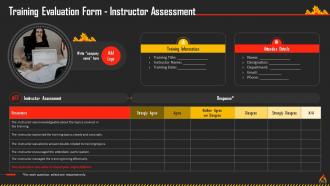
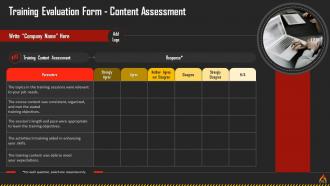
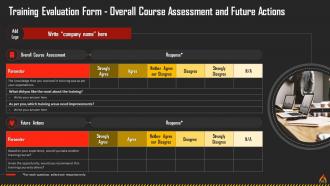
These slides include a training evaluation form for instructor, content and course assessment.
Workplace Fire Detection And Risk Assessment Approach Training Ppt with all 98 slides:
Use our Workplace Fire Detection And Risk Assessment Approach Training Ppt to effectively help you save your valuable time. They are readymade to fit into any presentation structure.




















FAQs for Workplace Fire Detection And Risk Assessment
Okay so fire safety plans - honestly most places totally wing this but you need four key things. Map out your escape routes first, like two exits minimum from each area plus where everyone meets outside. Someone's gotta be designated to call 911 while others help people get out. Test your alarms and sprinklers religiously because broken detectors are useless obviously. Regular drills are huge too - people freeze up when they're scared. I'd grab your team this week and actually walk through what you have now. You'll probably spot holes you never noticed before.
Okay so basically walk through your whole workplace and hunt for fire hazards - electrical stuff, heating systems, anywhere you store flammable materials. Also check if exit routes are blocked (you'd be surprised how often that happens). Document what you find and figure out which hazards are most likely to actually cause problems. Don't forget to look at what fire safety stuff you already have in place too. I'd say be really thorough about it, and definitely update everything when things change around your space. It's honestly pretty straightforward once you get started.
Honestly, fire training is one of those things that actually matters - saves lives and prevents your workplace from burning down. Your team learns to catch problems early, handle equipment right, and not freak out during emergencies. I've watched people completely lose it during fire drills because nobody bothered training them properly. Makes everyone think about prevention too, which is half the battle. Skip the boring generic videos though - do hands-on stuff that relates to your actual space. New people need it right away, and everyone else should refresh yearly at minimum.
Schools need monthly fire drills, workplaces usually do them quarterly. Kids are chaos during emergencies so schools have tighter rules - makes sense honestly. High-risk places like hospitals or factories? They're doing monthly ones too. The whole point is making evacuation routes second nature for everyone. Your local fire marshal can tell you exactly what your building needs since it varies by state and industry type. We had this confusion at my old job actually. Just stay consistent with whatever schedule you pick.
So you need at least two ways out of every room - don't rely on just one exit. Map everything out clearly and post the routes where people can actually see them. Pick a meeting spot outside where everyone gathers, and assign someone to do headcounts. Oh, and make sure someone's responsible for helping anyone who needs mobility assistance. I know drills are annoying but seriously, when there's real smoke and chaos, people freeze up without practice. Cover different scenarios too - what if the main stairwell's blocked? Keep your employee contact list current so you can track everyone down fast. The key is drilling it until it's automatic.
Honestly, smart smoke detectors are a game changer - they'll ping your phone when something's wrong and even tell you which room. Super helpful. You could also look into automated sprinklers with better sensors, plus IoT stuff that tracks air quality for early warnings. Fire departments are getting fancy with thermal drones and AI monitoring too, though that's more for big commercial places. For your workplace, I'd start simple with smart detectors. Maybe add a centralized system that alerts everyone at once? The trick is having multiple detection points - don't rely on just one thing.
So there's Class A for regular stuff like wood and paper, Class B for flammable liquids, Class C for electrical fires, and Class K for cooking oils. Your office probably has ABC extinguishers - they're pretty standard since they cover the first three types. PASS is what you need to know: Pull the pin, Aim at the base, Squeeze the handle, Sweep side to side. Always stay near an exit though, because honestly things can get out of hand fast. Oh, and check what type your office actually has ahead of time so you're not reading labels during an emergency.
Get smoke detectors on every floor and test them monthly - honestly, most people forget this part. Fire extinguishers in the kitchen and garage are clutch. Map out escape routes from each room and actually practice them with everyone. Sounds paranoid but whatever, better safe than sorry. Don't pile stuff near heat sources, check your electrical regularly, and avoid overloading outlets. Oh and clean your dryer vents! Those things are fire traps waiting to happen. Set quarterly reminders so you don't forget all this.
Dude, fire codes are literally your get-out-of-jail-free card if something bad happens. Courts expect you to follow them - it's the bare minimum standard. Don't comply and you're looking at criminal charges, huge fines, plus your insurance will probably bail on you. These rules exist because people actually died before we figured this stuff out. Exit routes, sprinklers, how many people you can cram in there - it all matters. I know it seems like annoying paperwork, but think of it as cheap insurance that keeps you from getting sued into oblivion.
Skip anything halon-based - that stuff's terrible for the ozone and mostly banned now anyway. Water sprinklers and foam systems are your best bet environmentally. There are newer clean agents like FM-200 that aren't nearly as harsh as the old chemicals. Look for minimal toxic emissions when they activate. Manufacturing impact matters too, plus whether you can actually recycle the parts later. Third-party environmental certifications help a ton when you're trying to figure out which ones balance performance with being green. Honestly, it's way easier than it used to be to find decent eco-friendly options.
Honestly, storage is where most warehouse fires start, so you'll want to keep those aisles clear between sections. Flammables need their own designated spots with good airflow - don't just shove them anywhere. The spacing between storage areas is clutch because it stops fires from jumping around like crazy. Also rotate your stock regularly so nothing just sits there turning into kindling. I'd walk through once a week checking for dumb stuff like blocked sprinklers or boxes stacked too close to electrical panels. Sounds boring but it's way better than explaining to your boss why half the warehouse burned down.
Ugh okay so smoke alarms are literally what'll save your life when things go bad. Test them every month - yeah I forget too but try to set a phone reminder or something. Replace batteries yearly, most people do it during daylight saving changes so they remember. The whole unit needs swapping every 10 years because the sensors get weak. Oh and that annoying chirping at like 2am? That's just the low battery whining at you, not some weird supernatural thing. Honestly the middle-of-the-night chirping is the worst timing ever but at least you know it works!
Look, post those evacuation maps everywhere - people need to actually see them. Regular fire drills are annoying but necessary, and pick some fire wardens who really know their stuff. Brief everyone during onboarding, then hit them with reminders occasionally. Maybe squeeze in a quick refresher during meetings when you can. Everyone should know where exits are and what that alarm sounds like (ours is ridiculously loud). Honestly, schedule your next drill soon and walk those escape routes yourself first - you'd be surprised how many "exits" are actually blocked by random storage.
Honestly, the AI detection stuff is pretty wild - catches fires way faster than regular smoke detectors by reading heat patterns and visuals. Smart sprinklers are another big one since they don't drench your whole building anymore, just hit problem spots. IoT sensors track air quality and even how crowded exit routes get, which is actually genius. Drones help too, both for checking buildings beforehand and responding when shit hits the fan. The crazy part? These systems talk to each other now. Your building basically knows when it's about to have fire issues. Definitely worth seeing what makes sense for your place.
When fires happen, people's brains basically short-circuit in weird ways. There's this thing called normalcy bias - you'll convince yourself it's just a drill or false alarm. Most people don't actually panic like in movies though. They just freeze up or move way too slowly while their mind tries to figure out what's happening. Oh, and tons of people waste time hunting down their spouse or whoever instead of just getting out. Your thinking gets all cloudy under that stress, which is honestly terrifying when you think about it. That's why practicing an escape plan ahead of time actually matters.
-
Delighted to see unique and eye-catching PowerPoint designs that are so easy to customize.
-
I downloaded some of the presentations for work. They were simple to modify and saved me a lot of time and effort.