

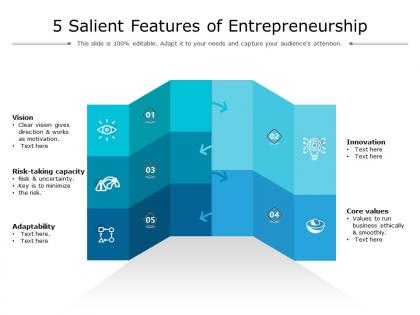
5 salient features of entrepreneurship




Try Before you Buy Download Free Sample Product
 Impress Your
 Audience
 100%
100% Editable
 Save Hours
 of Time


Make your mark with our 5 Salient Features Of Entrepreneurship. Create an impression that will endure.
People who downloaded this PowerPoint presentation also viewed the following :
5 salient features of entrepreneurship with all 2 slides:
Our 5 Salient Features Of Entrepreneurship can change the game. They will put you on the path to fame.

FAQs for 5 salient
Successful entrepreneurs demonstrate resilience, adaptability, strategic vision, strong leadership skills, and calculated risk-taking abilities. These traits enable them to navigate market uncertainties, build effective teams, and pivot business models when necessary, with many finding that combining innovative thinking with disciplined execution ultimately delivers sustainable growth and competitive advantage.
Effective storytelling enhances an entrepreneur's brand by creating emotional connections with customers, differentiating from competitors, and building authentic trust through shared values and experiences. Through compelling narratives about company origins, customer transformations, and mission-driven purposes, entrepreneurs establish memorable brand identities that resonate across markets, ultimately driving customer loyalty, investor confidence, and sustainable business growth.
Market research plays a crucial role in identifying business opportunities by revealing consumer needs, market gaps, competitor weaknesses, industry trends, and demand patterns that entrepreneurs can leverage. Through surveys, focus groups, and data analysis, businesses can validate ideas, minimize risks, and strategically position offerings, with many successful startups finding that thorough research ultimately delivers competitive advantage and higher success rates.
Financial planning and budgeting influence entrepreneurial success by establishing clear resource allocation, enabling informed decision-making, and providing measurable performance benchmarks against projected outcomes. Through strategic budgeting, entrepreneurs streamline cash flow management, minimize operational risks, and accelerate growth initiatives, with many startups finding that disciplined financial planning ultimately delivers sustainable profitability and competitive market positioning.
Collaboration drives startup innovation by combining diverse skill sets, accelerating problem-solving through collective brainstorming, and enabling rapid prototyping across functional teams. Cross-departmental partnerships in startups facilitate faster product development, more creative solutions, and enhanced market responsiveness, with many emerging companies finding that collaborative cultures ultimately deliver competitive advantages and breakthrough innovations.
New entrepreneurs commonly face funding limitations, market validation difficulties, talent acquisition challenges, operational scalability issues, and competitive positioning struggles. These obstacles can be overcome through strategic bootstrapping and investor networking, conducting thorough market research and customer feedback loops, building strong company culture and competitive compensation packages, implementing scalable systems early, and developing unique value propositions, with many successful startups finding that addressing these challenges systematically ultimately delivers sustainable growth and market advantage.
Entrepreneurs can leverage social media for business growth by building brand awareness, engaging directly with customers, showcasing products through visual content, and utilizing targeted advertising campaigns. Through platforms like Instagram and LinkedIn, businesses streamline customer acquisition, enhance community building, and drive sales conversions, with many startups finding that consistent social engagement ultimately delivers cost-effective marketing and competitive market positioning.
Sustainable business models depend on adaptability, customer-centricity, operational efficiency, digital integration, and strong value propositions that address evolving market needs. These factors enable organizations to navigate economic uncertainties while maintaining profitability, with many companies finding that combining technological innovation with sustainable practices ultimately delivers competitive advantage and long-term resilience.
Networking is crucial for entrepreneurs, providing access to mentors, investors, customers, and strategic partnerships that accelerate business growth. Effective strategies include attending industry conferences, joining entrepreneurship organizations, leveraging social media platforms like LinkedIn, participating in local business meetups, and offering value before asking for help, with many successful entrepreneurs finding that authentic relationship-building ultimately delivers new opportunities and competitive advantages.
Best practices for pitching to investors include crafting a compelling story, demonstrating clear market opportunity, presenting realistic financial projections, showcasing your experienced team, and articulating a scalable business model. These elements work together by building investor confidence through transparency, addressing risk concerns proactively, and highlighting competitive advantages, with many successful entrepreneurs finding that focusing on traction and measurable outcomes ultimately secures funding.
Entrepreneurs can balance creativity with practicality by conducting market research to validate innovative ideas, setting clear budget constraints while encouraging experimentation, and implementing iterative testing phases. This strategic combination enables startups to pursue breakthrough innovations while maintaining financial discipline, with many successful companies finding that structured creativity processes ultimately deliver both differentiated products and sustainable business models.
New entrepreneurs should prioritize business structure selection, intellectual property protection, contract management, employment law compliance, and tax obligations. These legal foundations streamline operations by establishing clear liability protection, securing competitive advantages through IP rights, and ensuring regulatory compliance, with many startups finding that early legal planning prevents costly disputes and enables sustainable growth.
Customer feedback drives product evolution by identifying pain points, revealing feature gaps, validating market demand, and highlighting user experience issues. Through systematic feedback collection, entrepreneurs refine offerings, pivot strategies when necessary, and prioritize development resources more effectively, with many businesses finding that customer-driven iterations significantly reduce market risks while accelerating product-market fit and sustainable growth.
Technology streamlines startup operations through cloud-based project management systems, automated accounting software, CRM platforms, AI-powered customer service tools, and digital marketing automation. These solutions enhance efficiency by reducing manual tasks, improving communication workflows, and enabling real-time data tracking, with many startups finding that strategic technology adoption accelerates growth while minimizing operational costs.
Entrepreneurial ecosystems significantly enhance startup success by providing access to funding, mentorship, talent pools, market networks, and collaborative resources. Through strategic connections with investors, experienced entrepreneurs, and industry partners, startups in thriving ecosystems like Silicon Valley, Austin, and Tel Aviv achieve faster growth, reduced failure rates, and greater scalability, ultimately delivering competitive advantages that isolated ventures rarely attain.
No Reviews