

Academic student research proposal powerpoint presentation slides





Try Before you Buy Download Free Sample Product
 Impress Your
 Audience
 100%
100% Editable
 Save Hours
 of Time


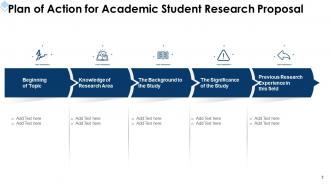
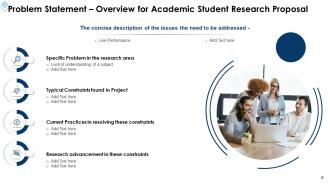
Academic research is a detailed study of a problem carried out to discover new facts by means of systematic and scientific procedures. Research can be done on any particular topic to understand the phenomena better. If you are to make a research report in a span of minutes, our Academic Student Research Proposal PowerPoint Presentation Slides can be of great help. Capture your clients’ attention by designing an impressive proposal and pitch your research services confidently. Describe your research topic in brief using our smartly-planned cover letter of this proposal. List various components of your proposal in the form of a table of contents. Provide an abstract and discuss the beginning, opportunity, expectation, methods, and findings of the thesis. Mention the scope and conclusion as well in the abstract sheet. Construct a plan of action with the help of Academic research proposal ppt and concisely elucidate the beginning of the topic, knowledge of research arts, the background to the study, the significance of the study, and previous research experience in this field. Provide a short overview of the issues that need to be addressed such as, problems in the research area, typical constraints found in a project, current practices in resolving these constraints, and research advancement in these constraints. With the help of a scholarly research PowerPoint slideshow, prepare a questionnaire and display the hypothesis. Explain the project context and objectives based on the subject by employing this scientific study PPT theme. Showcase literature review and illustrate your research methodology using compelling icons. Disclose the various sources for collecting data like primary and secondary sources using our artistic research PPT template. Walk down your clients through data analysis strategies that you implement to discover the facts. Create a timeline to provide an idea of the time required for completing the research. Inform your clients about the study constraints such as lack of previous study and scope of discussions proficiently. Immediately download this scholarly examination PPT design and create an informative research proposal.
People who downloaded this PowerPoint presentation also viewed the following :
Content of this Powerpoint Presentation
Slide 1: This slide introduces Academic Student Research Proposal. State Name of University, Dissertion title, Dissertion proposal, Name of person.
Slide 2: This slide displays Cover Letter for Academic Research Proposal
Slide 3: This slide displays Cover Letter for Academic Research Proposal
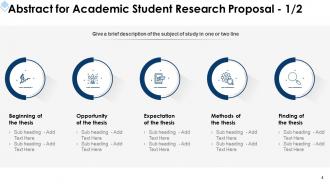
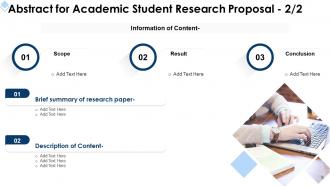
Slide 4: This slide depicts Abstract for Academic Research Proposal. Give a brief description of the subject of study in one or two line
Slide 5: This slide showcases Abstract for Academic Research Proposal.
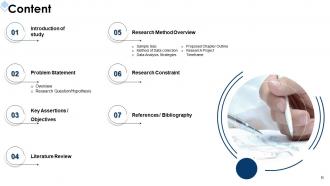
Slide 6: This slide showcases Content of the presentation.
Slide 7: This slide showcases Introduction of study for Academic Research Proposal.
Slide 8: This slide depicts Problem Statement – Overview for Academic Research Proposal
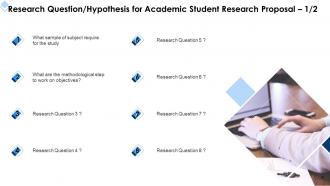
Slide 9: This slide showcases Research Question/Hypothesis for Academic Research Proposal.
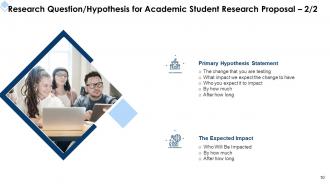
Slide 10: This slide showcases Research Question/Hypothesis for Academic Research Proposal.
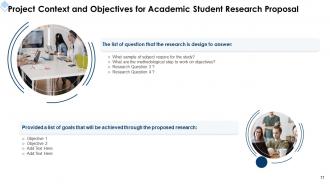
Slide 11: This slide decribes Key Assertions / Objectives for Academic Research Proposal. Provided a list of goals that will be achieved through the proposed research:
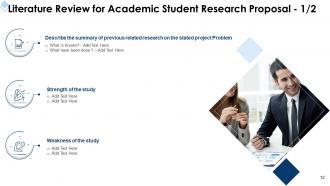
Slide 12: This slide showcases Literature Review for Academic Research Proposal. Describe the summary of previous related research on the stated project Problem
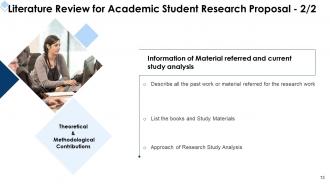
Slide 13: This slide showcases Literature Review for Academic Research Proposal
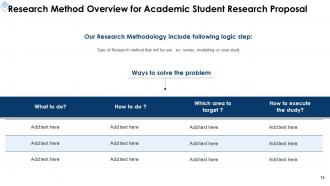
Slide 14: This slide showcases Research Method Overview for Academic Research Proposal. Type of Research method that will be use are ex- survey, modelling or case study
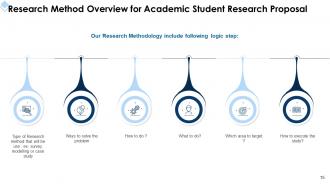
Slide 15: This slide showcases Research Method Overview for Academic Research Proposal
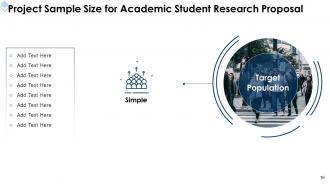
Slide 16: This slide describes Project Sample Size for Academic Research Proposal.
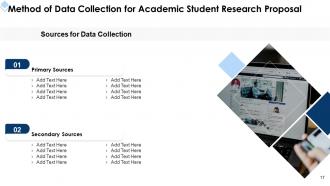
Slide 17: This slide depicts Method of Data Collection for Academic Research Proposal
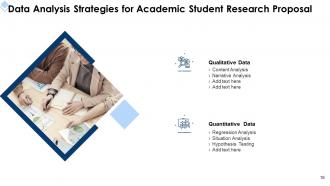
Slide 18: This slide represents Data Analysis Strategies contaning- Regression Analysis, Situation Analysis, Hypothesis Testing, Quantitative Data, Content Analysis, Narrative Analysis, Qualitative Data.
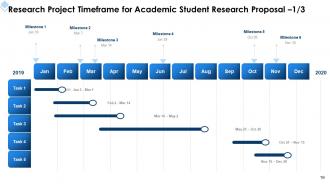
Slide 19: This slide showcases Research Project Timeframe for Academic Research Proposal.
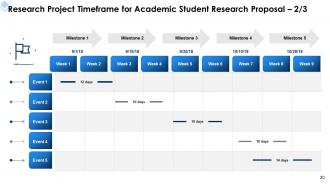
Slide 20: This slide presents Research Project Timeframe for Academic Research Proposal.
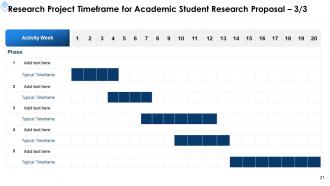
Slide 21: This slide showcases Research Project Timeframe for Academic Research Proposal.
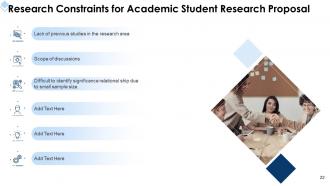
Slide 22: This slide showcases Research Constraints for Academic Research Proposal.
Slide 23: This slide represents References/ Bibliography for Academic Research Proposal.
Slide 24: This is Contact Us slide with Address, Email address and Contact number.
Slide 25: This is Icons Slide for Academic Research Proposal.
Slide 26: This slide is titled as Additional Slides for moving forward.
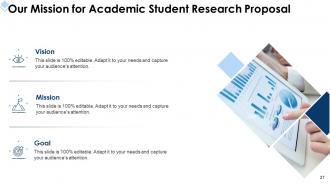
Slide 27: This is Our Mission slide with Vision, Mission and Goal.
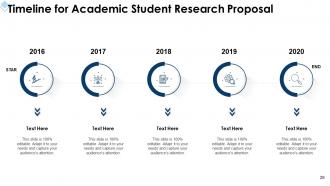
Slide 28: This slide displays Timeline process.
Slide 29: This slide depicts Roadmap process.
Slide 30: This slide shows Roadmap process.
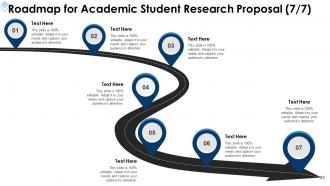
Slide 31: This slide also displays Roadmap process.
Slide 32: This slide shows Roadmap process.
Slide 33: This slide shows Roadmap 5 step process.
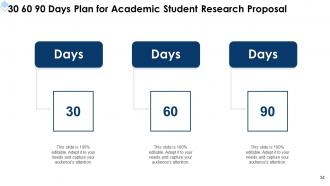
Slide 34: This is 30 60 90 Days Plan slide.
Academic student research proposal powerpoint presentation slides with all 34 slides:
Use our Academic Student Research Proposal Powerpoint Presentation Slides to effectively help you save your valuable time. They are readymade to fit into any presentation structure.
FAQs for Academic student research proposal
Okay so you need five main things for a decent research proposal. Start with your research question - make it specific and actually doable. Those "solve world hunger" questions are tempting but total disasters waiting to happen. Then do your lit review to show you're not reinventing the wheel. Your methodology section should spell out exactly how you'll gather and crunch your data. Timeline's crucial too - seriously, add extra time because stuff always goes wrong. Oh and make sure your budget actually matches what you're planning to do. Honestly, if you get the research question right first, the rest becomes way easier.
Make sure your research question is specific and actually doable within your timeframe. I'd start with whatever genuinely interests you, then keep narrowing it down until you can say it in one clear sentence. Your hypothesis is just your educated guess about what you'll discover - and honestly, it needs to be something you can actually test. Avoid anything too philosophical or vague (trust me on this one). Here's a quick test: if someone else reads your question and hypothesis, do they immediately get what you're trying to prove? If they're confused, keep refining until it's super clear.
Okay so basically you need to do a lit review to prove you're not just making stuff up. It shows reviewers you actually know what's been done before and where the holes are. Don't skip this part - I've seen people try and it never works out. You'll find out which methods totally bombed for other researchers, which honestly saves you so much time and money later. Plus it helps you figure out exactly how your work fits into everything else that's happening in your field. My advice? Start with recent systematic reviews - they're like cheat sheets for spotting gaps.
Okay so you want to make your goals SMART - specific, measurable, achievable, relevant, time-bound. Yeah I know, total business school buzzword but honestly it works. Instead of "I want to understand customer behavior," go with something like "I'll identify three key factors influencing millennial purchase decisions within six months." Way clearer, right? Break your main goal into 3-4 concrete pieces that actually build on each other. Use action words - "determine," "analyze," "evaluate" - not wishy-washy stuff like "explore." Think of it as creating a roadmap that's so clear even your cousin could follow it.
Figure out if you're going quantitative, qualitative, or mixing both first. Then justify why that approach actually makes sense for your question. Describe your data collection methods super specifically and explain your analysis plan. Sample size calculations are tedious but necessary - same with ethics stuff. Honestly, I'd just read a bunch of methodology sections from papers in your field to see what works. They're usually structured pretty similarly. Oh, and definitely mention your study's limitations upfront. Reviewers appreciate when you're realistic about what your research can and can't do.
Honestly, you gotta look at three things first: what resources you can actually get your hands on, how much time you have, and whether you're skilled enough for what you're planning. Map out the data you can realistically access and see if your methodology matches your abilities. Trust me, I've watched so many projects fail because people bit off way more than they could chew - guilty of this myself lol. Also worth checking if someone's already done similar work. The real test? Explain your scope to a friend outside your field. If they immediately get it, you're golden.
Definitely hit the big three: informed consent, privacy stuff, and risk assessment. The IRB gets super picky about vulnerable populations - honestly that section trips up so many people. Even if your study seems totally harmless, spell out any potential risks anyway. Data storage and destruction plans are mandatory too, which is kind of a pain but whatever. Oh, and get proper consent sorted before anyone participates obviously. Pro tip though - start drafting this ethics stuff way early because the review process drags on forever. You don't want that bottlenecking your whole timeline later.
Look, your budget is basically proof you're not just winging it. Break down everything - personnel costs, equipment, travel, supplies. I mean, you don't need to list every pen, but be thorough. Numbers have to match your timeline and methods too. If you're asking for expensive equipment, explain why you need it. Honestly, I've seen great projects get rejected because the budget looked like they pulled numbers out of thin air. Funders want to see you actually thought this through. Spend time on it - a wonky budget can tank your whole proposal.
Honestly, you gotta do your homework on each agency first. Check out their recent funding announcements and see what kind of projects they've backed before. NSF wants those super detailed methodology sections, but industry folks? They just care about timelines and whether it'll actually work. Some agencies are all about crazy innovative stuff, others want safe bets - kinda like figuring out what someone's looking for on a dating app lol. Match your language to what they use in their mission statements. Oh, and seriously follow their formatting rules exactly. Reviewers get annoyed when you don't.
Honestly, the worst thing you can do is be super vague about your methods - like, what are you actually going to *do*? Don't promise the moon either when you've got limited time. Your lit review shouldn't just list a bunch of papers - connect them and show what's missing. Budget for everything (yes, even paying yourself). Oh and this might sound obvious but you'd be surprised how many people forget to explain why anyone should care about their research. Seriously, get someone random to read it first. If your mom or roommate can't follow along, you need to simplify.
Okay so the timeline is super important - reviewers need to know you can actually pull this off. Break it into chunks with real milestones, like "Months 1-3: lit review and refining methodology, Month 4: getting IRB approval." I get way too into the weeds on this part honestly, but it shows you've actually thought about logistics. Build in extra time for when data collection goes sideways or your analysis takes forever. Oh, and work backwards from your deadline - I learned that the hard way when everything got crunched at the end.
Okay so basically you want to tell a story that connects your problem to your solution. Strong topic sentences help a ton - they preview what's coming. Use concrete examples instead of boring academic speak. Make sure everything flows logically between ideas. This might sound ridiculous, but read it out loud! You'll catch awkward phrasing immediately. Each paragraph should stick to one main concept. Your methodology needs to actually solve the problem you outlined (seems obvious but you'd be surprised). Link everything back to your main research goals so it doesn't feel scattered.
Honestly, first thing I do is sort all the feedback into buckets - like methodology stuff, missing literature, confusing sections, whatever. Way less scary than staring at one giant list. Go after the big critiques first, especially if they're questioning your main argument or how you did the research. The tiny suggestions? Just group those together for later. Here's the thing though - you don't have to use every single comment. Sometimes reviewers totally contradict each other or want you to do something that's just not realistic for your project. But definitely write back explaining what you changed and what you skipped. Shows you're actually thinking about their advice, not just being stubborn.
Your conclusion is basically your elevator pitch - gotta sell the "why" behind your research. Yeah, restate your main question and touch on methodology, but focus on impact. What new knowledge are you creating? Who actually benefits? I'd hit the broader implications for your field and real-world applications of your findings. Don't forget limitations and future research directions either. Honestly, reviewers often remember conclusions most, so this is where you hook them. Make it concise but get them genuinely excited about throwing money at your project. End strong.
Dude, visuals are a game changer for research proposals. Charts and graphs let reviewers instantly get your data instead of slogging through paragraphs. Timelines break down your methodology so it's not overwhelming. I swear, reviewers' eyes glaze over at wall-of-text proposals - learned that the hard way. Diagrams help when you've got non-experts on panels who don't know your field. Just don't randomly dump in charts though. Each visual needs to actually back up what you're saying and move your story forward.
-
Amazing
-
Excellent template with unique design.
-
Wonderful templates design to use in business meetings.
-
Appreciate the research and its presentable format.