


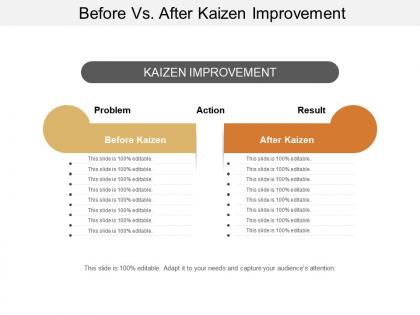
Before vs after kaizen improvement




Try Before you Buy Download Free Sample Product
 Impress Your
 Audience
 100%
100% Editable
 Save Hours
 of Time


Address the dilemma that has arisen with our Before Vs After Kaizen Improvement. Be able to handle the dichotomy.
People who downloaded this PowerPoint presentation also viewed the following :
Before vs after kaizen improvement with all 5 slides:
Be found fit for the job with our Before Vs After Kaizen Improvement. Instill belief that yo have the credentials.




FAQs for Before vs
So Kaizen is basically about tiny tweaks instead of huge changes that stress everyone out. Get your team involved in spotting problems and suggesting fixes - they're the ones doing the work anyway, so they know what's broken. Standardize stuff, measure progress obsessively (boring but necessary), and cut out wasteful steps. The whole point is building improvement into your daily routine rather than waiting for some big reorganization. Honestly? Just pick one annoying process your team gripes about. Spend 15 minutes brainstorming small fixes. You'll be surprised how much those little changes add up over time.
Honestly, remote Kaizen is totally doable - maybe even better sometimes. Start with quick 15-minute virtual sessions weekly to get everyone in the habit. Digital whiteboards are your friend here, way less awkward than trying to crowd around a flipchart on camera. Use shared docs so people can brainstorm ideas async too. Track those small wins in whatever project tool you're already using - visibility matters when you can't just walk by someone's desk. The continuous improvement thing actually flows pretty naturally once people get comfortable with the virtual setup. Just don't overthink the tech part.
Honestly? Employee pushback is your biggest headache - nobody likes feeling like change is being shoved down their throat. Leadership gets all excited at first but then bails when results don't show up in like two weeks. Super frustrating. You'll also deal with training that's all over the place between different teams. Oh, and don't try fixing everything at once - I learned that the hard way! Find a few people who actually want to help and make them your champions. Celebrate the small stuff first. Builds momentum way better than going company-wide immediately.
Kaizen basically shifts improvement from being this top-down management thing to everyone's job. Your employees become the ones spotting problems and pitching fixes during their actual work - which honestly makes way more sense than some executive deciding what needs changing from their office. Small wins are where it's at. People get genuinely pumped when their random suggestion actually saves everyone time or kills some stupid process that's been bugging them forever. I'd just ask your team straight up: what's the most annoying part of your day right now?
Honestly, if your leadership team isn't fully on board, you're pretty much dead in the water. They can't just give it the thumbs up and walk away - they need to actually jump in and do the work themselves. The best part? Once they see how much stuff actually gets fixed, they become total converts. Your leaders have to swallow their pride sometimes and admit when things suck. Employees won't speak up if they think they'll get shut down for suggesting changes. Oh, and don't forget the obvious part - they actually need to give people time to work on improvements instead of just piling it on top of everything else.
Dude, Toyota literally created Kaizen and it's everywhere now. Ford slashed their production times with it. Hospitals use it for wait times, banks for loan stuff - even Amazon's warehouses are basically running on these principles. Software teams do it too, which honestly makes sense since they're always tweaking code anyway. The whole thing works because those tiny daily improvements actually stack up pretty quick. My advice? Just grab whatever process annoys your team most and start messing with small changes. You'll be surprised how fast things improve.
Start with the basics - cycle time, defect rates, cost savings. That operational stuff is easy to measure. But here's the thing, employee engagement matters way more than most people think. Track how many improvement ideas people actually submit and who's showing up to Kaizen events. Customer satisfaction and delivery rates too, obviously. I'd honestly just pick 3-5 metrics that hit your worst problems first. You can always add more later. Oh, and make sure whatever you choose is simple enough that you'll actually look at the data regularly.
Honestly, digital tools can totally transform how you do Kaizen. Real-time tracking lets you make decisions way faster than the old manual way. Process mapping software shows you exactly where workflows get messy, and IoT sensors automatically grab performance data so you don't have to. Mobile apps are huge though - your team can submit ideas right from the floor instead of waiting around for meetings. AI can spot patterns in your improvement data and tell you where to focus next. My advice? Start with just one tool that fixes your biggest headache first.
Get leadership doing gemba walks - that's where they actually go see the work happening and ask people what's broken. Frontline employees eat this stuff up when bosses finally want their input. Set up suggestion boxes and cross-functional teams so ideas keep flowing. Quick wins are huge here - show people their suggestions actually get implemented, otherwise they'll stop caring. Train your team leads as Kaizen champions who can run smaller improvement sessions. Oh, and celebrate the small stuff publicly. I know it sounds cheesy, but recognition really does keep people motivated to stay involved.
So Kaizen is basically just getting everyone to make tiny improvements daily - no training needed. Lean and Six Sigma? Way more structured with specific tools and you usually need specialists for those. With Lean you're streamlining whole processes, Six Sigma uses stats to cut defects. Honestly, I love how simple Kaizen is compared to the other two. You don't need certifications or crazy analysis. Just get your team suggesting one small fix each week and you're golden. It's totally grassroots while the others are more... formal, I guess?
Make it part of your regular routine instead of some big one-off thing. Weekly team huddles are perfect for checking metrics and spotting new opportunities. Honestly, celebrating those small wins matters more than people think - your team needs that boost. Train multiple people as Kaizen facilitators so you're not stuck with just one or two experts. I'd rotate projects between departments too, keeps things fresh. Set up a basic suggestion box where anyone can pitch ideas. Monthly "Kaizen blitzes" work great for quick fixes and keeping everyone in that improvement mindset.
Don't try to copy Toyota exactly - that's where most companies mess up. Start by figuring out what communication and decision-making stuff you're already doing well. Build on that instead of scrapping everything. Maybe your team needs quick daily check-ins rather than formal walkabouts, or digital suggestion boxes if everyone's remote. I'd honestly just pick one department that's already cool with change and test things there first. Scale up whatever actually works for your situation. The whole "complete overhaul" approach usually backfires because you're ignoring what makes your company tick in the first place.
Get your whole team basic Lean training first - the 5 Kaizen principles are pretty straightforward but everyone needs that foundation. Masaaki Imai's "Gemba Kaizen" is solid if you want an actual book to share around, though the Kaizen Institute's online stuff works too. You'll definitely need someone who can facilitate workshops well since those sessions get messy fast. Oh, and don't skip change management training - people hate process changes even when they're obvious improvements. Honestly, I'd test everything in one small area first. Way easier than trying to fix a company-wide disaster later.
So here's the thing with kaizen - your customers actually feel the difference when you're constantly tweaking things. Less stuff breaks, orders ship faster, service gets smoother. When your team starts hunting for improvements (which honestly, they're usually pretty good at spotting), they get way more invested in making customers happy. It's this weird cycle where better service = loyal customers = more referrals = more money. The changes seem tiny but they stack up fast. I'd pick one customer journey - maybe checkout or onboarding - and find three annoying spots you could fix this month.
You'll need some upfront cash for training and getting people onboard, but most companies break even in 6-12 months. Reduced waste and better efficiency usually pay for it pretty quick. Honestly the hardest part isn't the money - it's changing how people think about work. Once teams start fixing small stuff and seeing results, they get hooked on it. I'd try a pilot program first in just one department. That way when the skeptics start complaining, you've got real numbers to shut them up. Plus you can work out the kinks before going company-wide.
No Reviews