


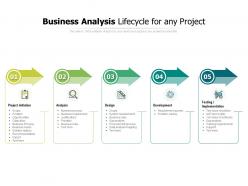
Análise de negócios do ciclo de vida para qualquer projeto





Try Before you Buy Download Free Sample Product
 Impress Your
 Audience
 100%
100% Editable
 Save Hours
 of Time


Elabore sobre itens interessantes com nosso Ciclo de Vida de Análise de Negócios para Qualquer Projeto. Insista em aumentar a conscientização.
Este é um processo de cinco etapas. As etapas deste processo são Análise de Negócios, Documento de Requisitos de Negócios, Processo de Negócios.
Esta é uma apresentação de PowerPoint totalmente editável e está disponível para download imediato. Baixe agora e impressione sua audiência.
People who downloaded this PowerPoint presentation also viewed the following :
Análise de negócios para qualquer projeto com as 5 etapas: 1. Iniciação 2. Planejamento 3. Análise 4. Desenho 5. Implementação
Insista em aumentar a conscientização com nosso Ciclo de Vida de Análise de Negócios para Qualquer Projeto. Elabore sobre itens interessantes.
FAQs for Business analysis lifecycle
So there are six phases: planning, elicitation, analysis, specification, validation, and implementation. Planning's where you figure out your approach and who you need to talk to. Then you gather requirements through interviews and workshops - that stuff. Analysis is honestly the trickiest part because you're trying to make sense of everything and prioritize it all. After that, you document it in specs, check back with stakeholders to make sure you got it right, and help with implementation. Oh, and don't think of these as steps you do once - you'll bounce between them constantly as things change.
So at the start, you're basically mapping out everyone who might care about your project - cast that net wide. Once you get into the actual requirements work, flip the script and go deep with your SMEs and end users. You'll be living in their inboxes for a while. Executives? They kinda disappear unless something goes sideways (which honestly happens more than you'd think). Implementation brings the whole circus back together for testing and sign-offs. Just don't overdo it with people - stakeholder burnout is totally a thing and you don't want folks avoiding your emails.
For requirements gathering, interviews are still the gold standard - just you and the stakeholder talking through what they actually need. Workshops are clutch when you've got multiple people who need to hash things out together. Don't sleep on document analysis, even though half the docs you'll find are probably ancient. Here's the thing though - observation is where you get the real tea. People will tell you one thing, then you watch them work and it's completely different. Surveys work if you need input from tons of people. Just pick 2-3 methods that actually fit your situation and stakeholders' schedules.
Honestly, risk assessment saved my butt so many times - it's like having a crystal ball for all the stuff that'll go wrong. Do it constantly, not just once at the start. During requirements gathering, stakeholders will flip-flop on what they want. Solution design? Technical hiccups everywhere. Implementation gets messy with budget cuts and timeline crunches. I keep a running list of potential problems and backup plans. Sounds boring but trust me, future you will thank present you when everything inevitably hits the fan and you're already prepared.
First thing - dig into what your company actually cares about, not just the fancy mission statement on the wall. Figure out the real priorities and how success gets measured. Then map your project stuff directly back to those goals and write it down somewhere. I've watched so many projects crash because nobody did this basic check at the start. Keep validating with stakeholders, especially when things change (and they will). Oh, and make a simple matrix that connects each deliverable to a strategic outcome. Sounds boring but trust me, you'll thank yourself later when the executives start freaking out about priorities.
So there's basically three main ones - Agile, Waterfall, and Lean. Waterfall means you do all your requirements gathering upfront before anything else happens. Pretty old school but some places still love it. Agile's the opposite - you're constantly going back and forth with stakeholders, refining stuff in short cycles. Way more flexible. Lean just cuts out anything that doesn't add value, which honestly makes sense but can be hard to sell to perfectionist managers. Most companies mix approaches anyway. Just figure out what your team's doing and match their pace so you don't look like you're on a different planet.
Honestly, visual aids are total game-changers for business analysis. They make complex stuff way easier for stakeholders to get - like, flowcharts and wireframes beat dense documents every single time. Nobody wants to read through pages of requirements anyway. You'll catch gaps and problems faster when people can actually see what you're talking about. Different people grasp concepts better when there's a visual to reference. I always start simple though - even a basic diagram works better than walls of text. Oh, and they keep everyone on the same page throughout the whole project, which is huge.
Keep it simple and clear - nobody has time to decode fancy jargon later. Give each requirement a unique ID so you can actually track what changed when (and believe me, stuff will change). Templates help tons for staying organized, though they're kinda boring to set up initially. Make sure stakeholders review everything before you move on. Getting their sign-off upfront is huge - it's way easier than dealing with scope creep later when everyone suddenly "remembers" what they actually wanted. Structure things consistently too. Your future self will thank you when you're not digging through messy docs at 9pm trying to figure out what requirement
No Reviews